Category Archives: early education & play

Engaging Songs to Teach Thumbs Up Choices and Safe Hands

My class of 3-5 year old students includes those with disabilities. They have been learning about making thumbs up choices. They are also learning about having safe hands. The teachers have been role playing using puppets and talking about experiences in the classroom.

Sometimes, when lessons are too wordy, my students struggle to focus and retain the information. For routine tasks, a song helps them to remember what to do. Many of my students are motivated by music and can often be heard singing to themselves.

I created these songs to help reinforce the concepts that they are learning. We also sing the chorus to the songs when students need reminders. Our older children are helping our younger students by talking about making thumbs up choices and using safe hands when they play.

The songs are part of our intentional teaching of the concepts . The teaching continues by reinforcing the learning throughout the school day and singing the songs when students need reminding.

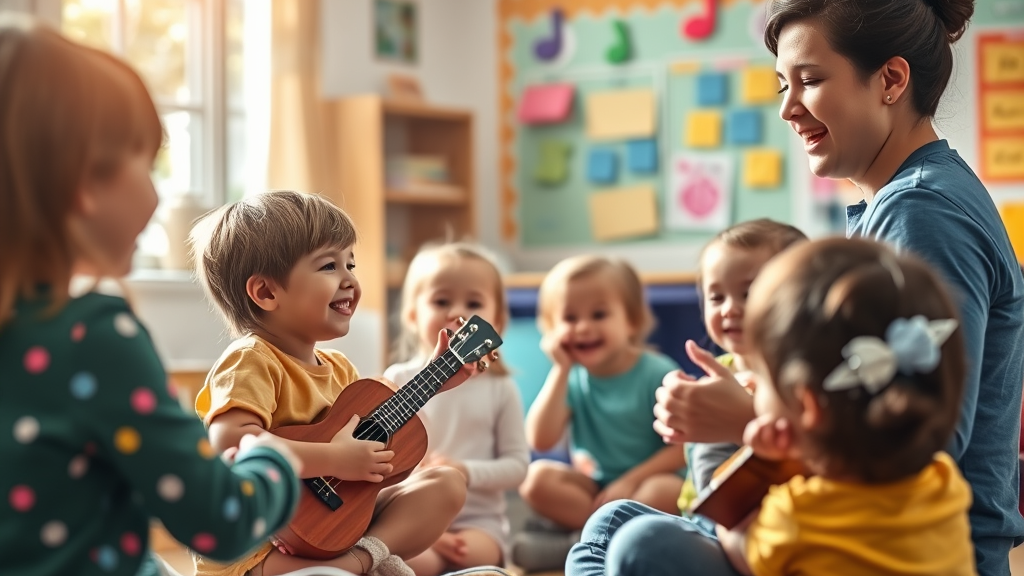
I teach the version without ukulele first to show the children how to do the actions. Some of my students attend better when I play ukulele. Once they had learned how to do the actions, I added ukulele.

For the safe hands’ song, I don’t play ukulele because I want to demonstrate what safe hands look like. Of course, I could add that playing ukulele is a thing we can do with safe hands.

Let me know if these songs have been helpful in your classroom.

Auditory Cues and Songs to Help Children Complete Routines

Whether at school, or at home, following a routine is important for developing young children’s independence. Constant verbal reminders can be frustrating. They often lead teachers and parents to resort to saying ‘it’s easier just to do it myself.’ For many children, visual prompts are helpful, using visual timetables, instructions or timers. In my classroom, auditory cues, particularly through songs or music, work well when verbal and visual prompts are not successful.

I use music to signal the children when to walk into the building. This way, they know when it is time to come into school. We sing ‘ Come on everybody let’s walk to class.’ It’s time for school. We sing this to the tune of ‘The Wheels on the Bus’. On the way home we sing the same, but substitute walk to class with walk to the door. We also use this song for other transitions. At clean up time, we sing ‘come on everybody let’s put the toys away.’ It is time to clean up. The same song is sung to come in from outside play with a substitute of, ‘it is time to line up’

Another simple example is beginning and ending circle time with a song. We start our morning circle with a hello song and close our end of day circle with a goodbye song. Our closing circle comes after tidying up from playtime. I begin to play the ukulele. All of the children immediately come to circle and find their space on the carpet. When I play an instrument, it signals to the children that it’s time to come to the carpet for circle time. This practice has really helped my class with the transition. We sing this song to reinforce expectations at the circle.

Multi-step directions can be hard for some of our preschoolers to follow. I have been amazed at how much easier it is to follow multiple steps if they are sung. At snack time, clean up was a particularly tricky spot. I wrote this song to help the students remember what they needed to do.

You can use songs for many daily routines and add your own instructions. You could sing ‘this is the way we wash our hands’ when washing hands. Use the tune of ‘Here we go round the Mulberry Bush’. For putting on your coat, this song to the tune of ‘ happy and you know it’, might be helpful.

Put your coat on the table on the table

Put the hood near your body near your body

Put your arms in the armholes flip the coat over your head

Zip the zipper now you’ve put your coat on

Do you have any routine songs that work well for your class?

Winter Themed Pre-School Songs

Winter is a popular theme at this time of the year. There are many things to discover as we explore the weather, temperature, animals, clothing, melting and freezing and many more. Below are a few I have used and adapted for a winter study.

Warm clothes in Winter Time

This one is also useful for a clothes study. It talks about putting on different clothes that we wear in the winter. You can use it to teach body parts, names of clothes, materials that clothes are made of and pairing gloves, shoes and socks.

There’s a Snowflake on my Nose

This song also teaches body parts . You can have the children make a snowflake or give them a picture of a snowflake and they have to put it on the correct body part. For mine I added double sided sticky tape to help it stay. For added fun you could add a picture of a snowflake to a bean bag and have them balance that on different body parts.

It is Snowing

An action song about all of the things you might like to do in the snow. This is a good introduction to different activities you can do in snow. You could also use it as a springboard to create a graph of the children’s favourite activities to do in the snow. Create a grid with 4-6 activities and give each child a snowflake to stick on their favourite one.

Five Little Snowmen

This one is my favourite counting song for a Winter study. As the sun comes out the Snowmen melt and you subtract one. You can do this song with the children playing the snowmen and as the they melt they have to sit down. In this version I have used visuals from Lessonpix.

Bear is Sleeping

This song is about animals that hibernate and animals that migrate. You can insert any animal into the song, I chose a few more unusual ones that the children may not have heard about.

Hot and Cold Song

In this song we learn about things that are hot and things that are cold. Visuals come from Lessonpix.


I hope you find my selection of Winter themed songs useful. Let me know if you need any other songs specific to another aspect of winter learning.


Creative Finger Exercises to Enhance Kids’ Focus

This year my school OT introduced a series of finger strengthening exercises from the OT closet. In this version, the exercises are set to a metronome beat.

I wanted to make these more meaningful and motivating, and include them as part of our daily circle time. To do this I decided to set them to words. You could use the rhyme at the start of a fine motor activity or at the start of the day to warm up fingers.

You can ask the children which exercise they like the best or which one is hardest for them. I always tell them that I like the squeezing hands part. If this makes them feel good they could also use it as a self regulation strategy. The children in my class loved the butterfly flying away part. It would become a daily competition to see who could reach up the highest with their butterfly.

The look action can also be used in games like I spy, or to practice looking carefully and focusing on details.

New Picture Book Recommendations for May And June.

Here are some of my favorite new titles due for release in May or June 2021. (links are Amazon affiliate links, I will receive a small financial incentive for every title purchased via this link)

May Releases

Carol and the Pickle Toad by Esme Shapiro

Do not be put off by the strange title,I love this book! The story centres around Carol’s very bossy pickle toad hat, that is always telling her what to do. If you have read Glennon Doyle’s Untamed, (which by the way I highly recommend), this is a picture book that explores many of the same themes . It teaches children to listen to their inner voice and not to be afraid to be who they are, rather than who someone else want you to be. Yes, it is quirky, and I’m not really sure why the hat is a pickle toad , but for me, that adds to the charm. The illustrations are beautiful and I smiled as Carol went on her journey to find herself. I think it would appeal to young children’s oddball sense of humor and is a great conversation starter.

Amazon UK link

Amazon US link

Sloth and Squirrel in a Pickle by Cathy Ballou Mealey

Pickles seem to be a bit of a theme this month!

Sloth and Squirrel are good friends but they have different ways of doing things and different speeds of doing them. So, when Squirrel gets them jobs as pickle packers to earn money for a new bike, things don’t go according to plan. Sloth and Squirrel in a Pickle is a fun story that I think little children will love. The illustrations perfectly embrace the personalities of the characters, through wonderful facial expressions. The story is slightly off the wall and zany, which always grabs the attention of my young readers. Hopefully we will see more Sloth and Squirrel adventures in the future.

Amazon UK link

Amazon US link

This is Ruby by Sarah O’Leary

This is a perfect book for a play advocate like me. It shows all the wonderful places your imagination can take you and the many things that play may, or may not lead to when you are a grown. It also relishes living in the moment. Another aspect I like about this book are the interactive elements promoting discussion between parent/teacher and child. It’ can be difficult to find books with children of diverse cultures, race and ability that are not specifically about that difference – Ruby does this perfectly. There isn’t really a story to the book but it has a good message and would be a valuable addition to a diverse library of books.

Amazon UK link

Amazon US link

June Releases

Dancing in Thatha’s Footsteps by Srividhya Venkat

This is a beautiful story about a boy who wants to dance just like his sister and his grandfather who shows everyone that dancing isn’t only for girls. Through the story, we learn about bharatanatayam, an ancient classical dance from India. The illustrations perfectly embody the movements in the dance, you can clearly picture Varun and Thatha dancing. Dancing in Thatha’s Footsteps ticks all the boxes for an inclusive picture book and I will be adding this to my preschool library.

Amazon UK link

Amazon US link

Let’s go for a walk by Ranger Hamza

This book is for families who love the outdoors. Go for a walk with Ranger Hamza from CBeebies ‘Let’s go for a Walk’. Each page has different things to look out for and can be used time and again. When my children were young, I would often encourage them to walk for longer by challenging them to find things along the way. Let’s go for a walk could be used in this way and as a story at home to talk about all the things you see when out and about. I love the vibrant colours and the suggestions to look up, down and use all of your senses.

Amazon UK link

Amazon US link

I hope you enjoy my choices and find some other great new titles this month.

Can mindfulness be introduced to preschool children?

Mindfulness is broadly defined as the ability to pay attention to the present moment. A common way to get in a mindful state is to sit still and direct attention to one’s breathing. Preschool aged children enjoy and learn best though moving around – so can very young children learn mindful practices, or even understand what they are?

Anything we teach to small children needs to be communicated and used in a way that makes sense to them. Young children need to know why it might help them, in what context and it needs to be embodied in the things that matter to them. You don’t have to use the term mindfulness with small children, but we can explain that what we do will help them to be calm and to think.

I often introduce new concepts in my classroom through picture books, rhymes, action or song.

Mindful Mr Sloth by Katy Hudson, explains the value of slowing down and enjoying the moment, in a way that makes sense to children. Sasha rushes around and is always busy, until one day she meets Mr. Sloth. Mr Sloth is slow and at first, this frustrates her, but soon he teaches her the merits of taking time to slow down and see the things that you would otherwise miss. The book is a gentle introduction to mindfulness, explaining the need to slow down from time to time. You can relate this to things that happen in the classrooom e.g. remember that time that George was rushing to get his lunchbox and he tripped and fell. Talk about rushing and slowing down. Do you ever feel rushed? Have you ever wanted to stop to look at something like Mr Sloth? What could we do at school to make that happen? Gather the children’s ideas. (Mindful Mr Sloth is released on 1st Aug , currently available for pre-order. Links are Amazon affiliate links, I receive a small financial incentive if you order via the link)

Play listening games to focus on what you hear. Have everyone be very quiet and close their eyes. Make a sound and have them guess what the sound is. You could set a timer and have the children sit silently for that time. When the time goes off they can each tell you what they heard. When you are outside focus on looking – some days have them look up and others look down, do they see anything interesting. Maybe on a walk to the playground, have them stop and look for 10 seconds. Who saw something interesting?

Once children have a concept of what mindfulness is, we can teach them how to slow down and regulate their emotions. In our classroom, we practice slow breathing every day using the concept – smell the flower and blow the candle. The children can use a picture or their hand as a prop, as they breathe in as if smelling the flower and blow out as if to blow out a candle. Because we practice this everyday, when children need a strategy to help relax or self regulate, we can use the phrase , smell the flower and blow the candle and they immediately know what to do.

Too Many Bubbles by Christine Peck and Mags Deroma uses visuals in a similar way.

This book is a simple introduction to the concept of focusing on breathing. In this picture book the fish is gloomy and the bubbles grow and grow around him and the reader is encouraged to blow the bubbles away. Just like , smell the flower, blow the candle, it gives children a visual and meaningful cue. (Too many Bubbles is released on July 7th)

Rhymes are also a good way to teach breathing. I like the ones in Breathe like a Bear ,as they include actions that make sense to small children , for example, blowing the steam from a hot drink.

These expandable breathing balls are also a useful tool. Hold them in front of you and expand them as you breathe in, and collapse as you breathe out.  They can be introduced during a circle time, as part of an exercise routine, or welcome activity.  

 Form a calm down basket in a quiet area of the classroom.  It could be a cosy corner of the classroom or maybe a tent or large cube.  Establish rules at the start of the year, so that children know that this is a place for one child to use at a time, when they need a quiet safe space.    Include things to squeeze or spin. items with different textures,  things with nice smells, liquid motion bubblers, books and maybe a pad of paper and pencils to draw.


New Picture Book Recommendations For April

I’m grateful to have the chance to preview upcoming picture book titles in digital format via Netgalley. There are a lot of great titles coming out this Spring and Summer. These are my recommendations for April. All links are Amazon affiliate links, meaning that if you purchase the book using this link I will receive a small financial incentive.

Blossom and Bud by Frank J Sileo

Blossom and Bud, live in a flower shop amongst the most beautiful flowers but they feel that they are not beautiful enough. The flower shop owner has the perfect job for them and they quickly learn that however they look, there is a special place for everyone. I was prepared for this book to be a little preachy but it isn’t at all. It is a simple beautifully illustrated story which shows the value in us all, without laying it on too thick. The brevity of the words and illustrations showing parings of people who are different from one another, but bring each other joy, complement each other perfectly. There are also useful tips in the back of the book for helping support children in learning about and valuing their body image.

Amazon US link

Amazon UK link

Arthur and the Forgetful Elephant by Maria Giron

Arthur meets an elephant, but the elephant is sad because he cannot remember anything. Playing together, Arthur helps the elephant to find happiness again and eventually to remember his family and be reunited. This is a sweet story about the bond between young and old and would be a good story to share with a young child who has a grandparent with memory loss. Beautifully illustrated, it shares the themes of love, joy, friendship and family.

Amazon US link

Amazon UK link

My Dad by Susan Quinn

In My Dad, a boy tells all the great things about his dad. He isn’t a super hero or a busy run around dad but he bakes, gardens and joins his son in lots of fun activities. The simple text and captivating illustrations show the loving, relationship between father and son. This one would make a special gift for a new dad or for Father’s day.

Amazon US link

Amazon UK link

The Grumpy Fairies by Bethan Stevens

I didn’t expect to like this one but it is a lot of fun and I think young children will really identify with the grumpy fairies. The fairies are grumpy because they keep getting asked to do chores, the moan and stomp around in a way that parents and young children will recognize. They are so busy being grumpy that they forget to heed the message of the woodland animals to look out for the troll. This repetitive part of the book will work great as a read aloud as the children call out the warning each time. When the troll arrives looking for a grumpy fairy snack, they soon change their mood – for now at least. I think this one would be a firm favourite with my preschoolers. As an added bonus for UK readers, the paperback is currently available for under five pounds.

Amazon US link

Amazon UK link

Enjoy the recommendations. I’m looking forward to sharing some great new titles for May.

Preschool Songs About Trees

There are a number of preschool songs about trees, but what are they teaching about trees?

I love to use song to reinforce learning concepts. Songs make learning fun and meaningful. The songs below were adapted from traditional children’s songs to teach early learning concepts and information about trees for young children.

  1. I’m and Old Oak Tree – an action song to teach the parts of the tree, to the familiar tune of I’m a little teapot. This song has been used in my class to support imitation and naming basic parts of a tree.

2. I Have a Little Nut Tree – sung to the tune of the nursery rhyme – I have a little nut tree, this song features a squirrel who comes to a tree to find nuts. Finding none, the squirrel is sad. Nuts are added to the tree and counted one at a time. This song was used in my classroom to talk about things that grow on trees, naming nuts that grow on trees and to practice counting up to 10. I would choose a child to tell me how many nuts to put on the tree and we would count them together.

3. Walking Through the Forest – An version of the preschool song Walking Through the Jungle. In this song I use a tree with small soft animals peeking through the holes. As we go through the forest we look at the different parts of the tree, and try to identify the animals that live there. This song was used in my class to learn about animals that live in and on trees. In a regular, non-Covid classroom I would hide the animals in the tree with only a small part peeking out and have the children put there hand in the hole to see which animal they find.

4. Way Up High in the Apple Tree – this song is a counting down song. Using the tree prop, after each verse we shake the tree until an apple falls down and then count how many apples are left. At the end of the song the apples are revealed in my tummy and we count them together. It can also be used for early phonics and for children working on speech sounds. One line of the song is about eating the apple, I emphasise the mmmmmmm sound and show them how to imitate the sound.

5. 5 Little Leaves – This is another counting down song. As the wind blows the children join you by blowing the tree to make a leaf fall to the ground. You could use different kinds of leaves and identify which tree they came from.

6. Tree Seasons Song – this song is sung to the tune of the wheels on the bus and teaches about what happens to the trees in different seasons.

7. The Green Grass Grows – the green grass grows is a song about the parts of the tree and the sequence in which it grows. I used it to teach positional language and sequencing. The audio for this one has been added to a powerpoint showing the sequence of the tree growing and visuals for the positional words.

It will be OK – A Picture book about Anxiety and Empathy

During the Pandemic – we are finding more and more that our children are anxious and worried. I feel is is very important that young children know that this is a normal response to these uncertain times, we can help them but also it is okay to be anxious.

Finding a book with this message, that suitable for the preschool children I teach is a challenge. There are plenty of books about worry, some are a little wordy, others have slightly scary characters and many by the end show a character who is no longer worried.

For the times we are in ‘ It Will be Okay’ ticked all the boxes for what I was looking for. I will, without a doubt, be adding this book to my social/emotional collection in my preschool classroom.

The story follows Giraffe, who can’t go out with his friend because he is worried about a spider. He knows his fear is irrational, but hides in the tree regardless and can’t bring himself to come down. His friend Zebra, listens to his fears and waits until giraffe is ready to come down. Zebra tells Giraffe that his fear ‘isn’t silly if it bothered him’ (my favourite line from the book), he shows empathy and understanding and shares a message that friends can help us with our fears, but most importantly it is okay to be worried by things. I love the resolution of the story. Instead of ‘curing’ Giraffes fear, it shows the comfort of an understanding friend and the message that being afraid is perfectly normal. Bravo for this modern take on worry, anxiety and friendship!

This is an affiliate link – I will receive a small financial incentive if you purchase this book using the link.

Amazon UK Link

Amazon US link

Problem solving in Preschool Using Songs and Puppets

Problem solving in preschool is particularly challenging to teach in the virtual classroom. I have been using puppets and songs, to help teach problem solving concepts. The videos are recorded for my class, so they can watch multiple times. The children love the puppets and find these songs especially engaging. Though it doesn’t replicate being able to practice problem solving skills in the classroom, it is a tool to help support social and emotional learning in a non- traditional classroom.

This is an adapted version of the song ‘Oh dear what can the Matter Be?’ In it the puppets are sad and talk about their problem, and then we try to come up with solutions.

We have also talked in class about problem solving, using the puppets as a model. I have taught about taking deep breaths and finding a quiet space as a way to calm down. Sometimes, children in our class encounter problems, even in the virtual environment. If we see a child is upset or frustrated we often notice saying, ‘I see ….. is sad, if you have a problem you can tell us’. In some ways, I feel in the virtual environment, we need to be even more intentional about teaching these things than we would in person.