Many of us provide elaborate parties for children under the age of 5 and then find that they are happy just ‘playing’. I’ve adapted my parties over the years. I found that before the age of 3 my children were happy to have one or 2 friends visit to play games and eat cake. Even when they were a little older they mostly enjoyed a few crafts, games and dancing.
According to a recent study by I CAN the communication charity, my children are not unusual. In a survey of 1500 parents they found that the top 5 party pursuits for under-5’s were:-
Dancing games like Musical Chairs, Musical Statues and Musical Bumps
Party games like Pass the Parcel and Pin the Tail on the Donkey
Playing outdoors with other children
Eating party food
Singing and rhyming games like the Hokey Cokey and Row, Row, Row Your Boat
I CAN Communication Advisor, Kate Freeman said “The top five activities all involve communicating and socialising with their friends – from pass the parcel, which boosts turn-taking and listening skills to singing and rhyming games like the Hokey Cokey. This type of activity enhances children’s understanding of the structure and meaning of language – and there is no better environment for a child to develop their confidence than with a group of friends and adults in a relaxed and fun setting like a party”. Furthermore, mealtimes and snack times are a fantastic opportunity for young children to continue to develop communication skills.
Fun games to play at parties to develop children’s communication skills include:
Singing and rhyming songs – a great way to help children learn vocabulary and have fun making music together
Playing clapping games (Pat-a-Cake) – to help children to develop their coordination, control and movement as well as learning vocabulary and social skills
Word Games (Simon Says and I Spy) – to help to develop children’s vocabulary about the world around them and to listen to instructions (These games can be adapted to easier versions for younger children)
Turn taking games (Pass the Parcel) – to help children to learn when to talk and when to listen
Games like musical statues to encourage children to listen carefully. Listening skills can be developed further by saying ‘Stop’ in a quiet voice instead of pausing the music.
Imaginative play like toys’ tea parties help children to expand their language.
When I was teaching in nurseries we often used to play ‘ring games’ like ‘Farmers in the Den’ and ‘Hokey Cokey’ if we had bad weather and it was difficult for the children to play outside. They were always a firm favourite. The children also loved playing picnics or tea parties.
I CAN is inviting nurseries, pre-schools, childminders or community groups to take part in their annual fun and educational event . This year I CAN is partnering with Entertainment One to make its pre-school character Humf the brand ambassador. The 2013 Chatterbox Challenge:Mad Chatter’s Tea Party with Humf asks groups to organise sponsored tea parties where children can join in with popular songs and rhymes to develop their communication skills in an enjoyable way. I organised an event years ago with my pre-school music group. We learned new songs and the children were awarded stickers and certificates for their achievements.
The singing and rhyming activities for the 2013 Chatterbox Challenge: Mad Chatter’s Tea Party with Humf have been developed by I CAN speech and language therapists and teachers. Lesson plans, which include Humf and his friends in the activities and illustrations, link to key aspects of the new Early Years Foundation Stage including Communication and Language, Physical Development, and Personal, Social and Emotional Development. All the activities are aimed at supporting and developing children’s speech and language skills.
Being involved with the Chatterbox Challenge: Mad Chatter’s Tea Party with Humf encourages children to think about communication, whilst helping support those who find talking and understanding difficult.
Chatterbox Challenge week is 1st – 8th March 2013 and most groups will be holding their Tea Party with Humf during this week, though groups can actually take part at any time during 2013.
To register and get involved in this year’s Chatterbox Challenge:Mad Chatter’s Tea Party with Humf, go to www.chatterboxchallenge.org.uk
A few years ago I ran training sessions for early educators and parents on communication, language and literacy. Many of the resources we recommended, including the excellent dvd Chatter Matters, came from the Communication charity I CAN. One of the key messages of this training was that ‘reading and writing float on a sea of talk.’
Kate Freeman, I CAN Communication Advisor and experienced paediatric speech and language therapist says:
Given the right support, many children learn to talk without too much effort. There’s a golden age for learning to talk – this is before 5½ and so skills learnt at this age bring great benefits later on. Evidence has shown the early years to be a vital time for supporting all children’s communication, as well as a time to identify any difficulties and put support in place to improve a child’s overall life chances.
I was very excited to review I CAN’s latest resource Chatting with Children. This is a really nicely presented set of 30 cards with activities for promoting speaking and understanding for children aged 3-5. The activities are simple and require no specialist resources. Some are copying or guessing games of the kind we often play in the car, some require household objects and a couple that I played with my 4-year -old and 2-year-old used our musical instruments box . These games would be great for including in my music groups.
Each card has ideas for making the activity easier if your child is struggling or more challenging if it is too simple. The activities are equally suitable for large groups or one child. They are a great resource for families and could provide a wealth of ideas for small group times at pre-school. Many of the cards remind me of games I played with the autistic children I worked with, helping them extend their vocabulary and comprehension and categorise language. These cards would have been an invaluable resource for these families.
The cards focus on a number of skills, listening, developing vocabulary, social skills and understanding what is said. The games are varied and can be played for a few minutes or half an hour or more. My 4-year-old loved the listening games, playing hide and seek with our timer and listening carefully for the soft tick to help us find it and making sounds with household objects and guessing what they might be.
Chatting with Children is also available as part of a brand new boxset being launched this month by I CAN – the Early Talkers Boxset (£19.99). The boxset contains the original Babbling Babies and Toddler Talk as well as the new Chatting with Children, and has been created especially for parents and Early Years practitioners supporting babies, toddlers and young children in learning to talk.
The three packs between them, contain activities for children from birth to school age. I was so impressedthat I am going to order the box set for my brother to play with his one year old twins.
Chatting with Children is available in paperback for £7.99 paperback and hardback for £12.99 .
All proceeds go towards I CAN’s work with the 1.2 million children in the UK who have long-term speech, language and communication difficulties. To purchase Chatting with Children or the Early Talkers Boxset comprising all three activity card sets visit http://www.ican.org.uk .
This is not a sponsored post, a copy of chatting with children was received for review purposes
Kate’s Top Tips for Chatting with Children aged 3-5 years old
• Be quiet Take time to talk to each other in a quiet room. Turn off the TV and radio, and shut the door to block out any other background noises. Children have to learn to block out background noises, so they need a quiet environment to focus on the sounds they hear.
• Be face-to-face Help young children to see your face – make sure you’re at the same level as them. Sit or crouch opposite them as they play, or sit them on your lap. Sit opposite the child so you’re face-to-face with them. Being face-to-face means that the child can see you and your facial expressions. Also, you can see them and their responses and reactions to the games you play together or the conversations you are having.
• Don’t rush – take plenty of time Young children take longer than adults to process what they hear – sometimes up to 12 seconds. They need plenty of time to respond to you.
• Be patient Young children can easily lose interest in what you’re doing – this is perfectly normal, especially for 3-year-olds. Don’t worry – just stop the game that you’re playing together and try again another time.
• Be prepared for anything Follow the child’s lead and adapt the game or conversation to fit in with what they’re doing. This can help maintain attention on particular games.
• Ditch the dummy A dummy gets in the way of attempts to talk during conversations and games. Children of 3 and over don’t need to use a dummy.
• Use the language you naturally use at home It’s important that you speak naturally to young children; this helps develop their language skills.
• Enjoy it This is a special time together, so have fun playing, chatting and learning about each other.
There has been a common thread on early education forums recently about how best to share information with parents. Parents are the child’s first educators and most good early education settings will look for ways to share learning journeys with parents. There could be barriers; some busy parents want to rush away without spending time conversing, other families are hard to reach, English is not their first language or they may feel uncomfortable about talking to teachers but it is important to understand a child’s home background and to support learning at home.
Put yourself for one moment in the shoes of a parent who drops their child to your setting at the start of the day and won’t see them again until it is almost bedtime. Imagine you are a parent who has stayed at home with your child for 5 years to suddenly find them in full-time school. Most young children will find it hard to remember what they have done during the day, leaving parents feeling completely out of touch with their child’s world. I remember when my daughter started school for the first time and feeling sad because I was no longer in control of her influences.
Many pre-schools are really good at sharing information. The key worker system means that staff know the children well and nurseries are generally happy to invite parents into the classroom and spend time talking to them. As Karin remarks
Thanks to the thorough keyworkers and pre-school staff we knew everything that went on every day.
Karin talks about the new learning journey parents experience when their children start school as she is learning to be a big school mum and asks
‘ how on earth can we find out what they are getting up to?’
As a parent there are a few simple things that can help. Start by asking very specific questions – Did you like the story you read today? What was your favourite thing that happened today? Who did you play with at playtime?
Chat to the other parents in the playground, children usually tell different stories and you may start to piece things together.
Encourage your child’s teacher to help you to find out by suggesting some of the things below. Start your discussion with it would be really helpful if …
As teachers there are things we can do to help. When parents feel valued and a part of their child’s learning and fully informed about what, why and how their children are learning, it is less likely that there will be a feeling of them and us.
Here are some of the ideas I have seen working well in practice
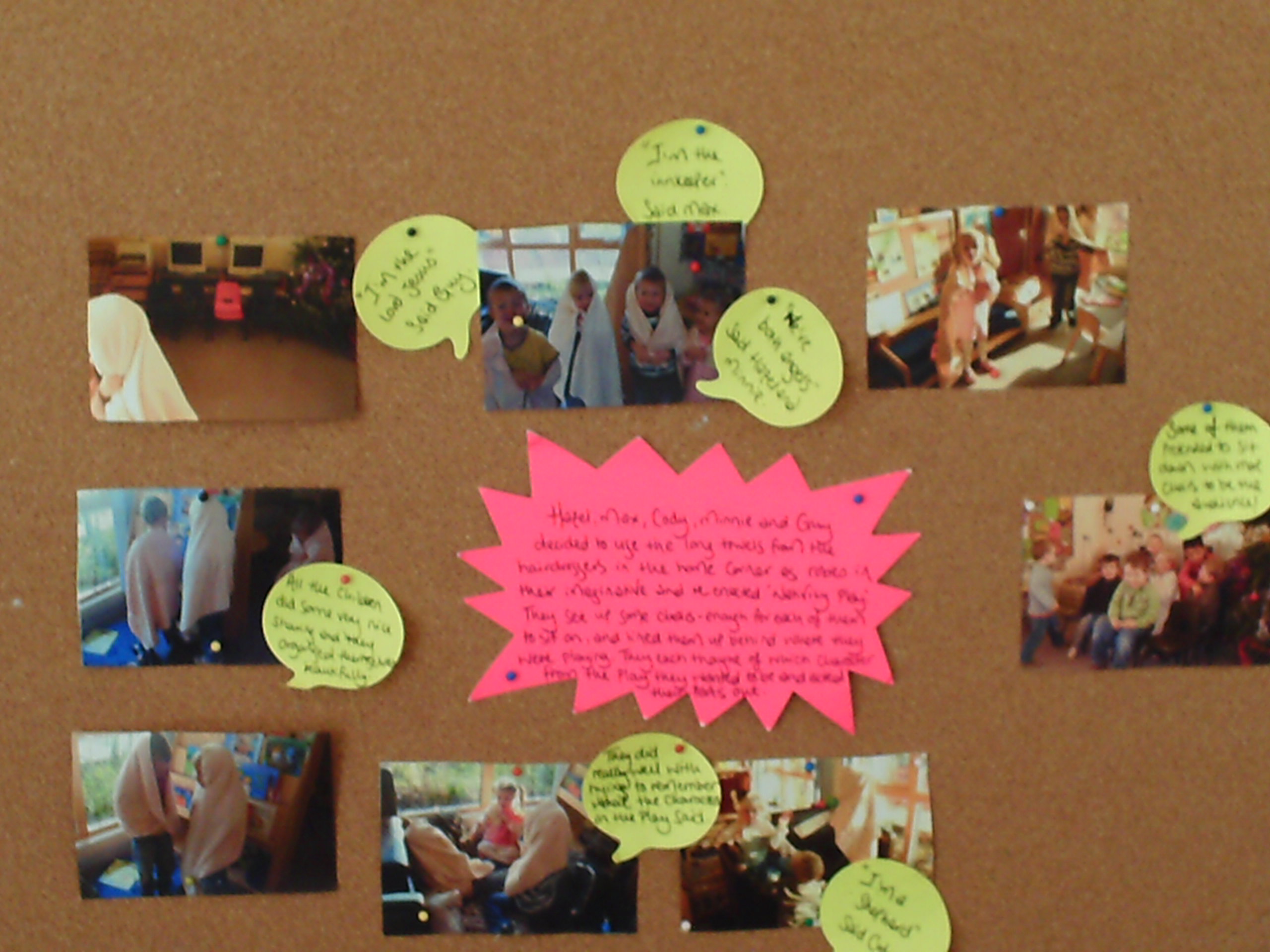
Documenting learning
The pink writing in the centre sets the scene, ‘ A group of children decided to use the large towels from the hairdressers in the home corner to re-enact the Nativity Play. They set up some chairs for each of them to sit on and lined them up where they were playing. They each thought of which character from the play they wanted to be and acted their parts out. ‘ The comments around the edge describe the learning in more detail, All the children did some nice singing and organised themselves carefully. They did really well at remembering what the characters in the play said. Some of them wanted to sit on chairs and be the audience. ‘We’re both angels’ ‘I am the Innkeeper’ ‘I am the Lord Jesus’
In my opinion this is the most effective way of showing parents what their children are doing. Documentation tells the story of what children have been doing by representing the stages of learning, using photograhs, anecdotes from the children, examples of work and teacher analysis. In this way parents can see what their child is doing, what they are learning and why they are doing it. Carlina Rinaldi president of Reggio Children in Italy says,
documentation is more than simply assessing or displaying the work of the children. “One of my definitions of documentation is that it is first of all an act of love,”
This describes perfectly the warmth that emanates from the documentation in Reggio Emilia – it is like shouting from the rooftops – look at what our children are doing. Isn’t it fascinating? Come and join in. Many good examples of documentation of children’s learning can be found in the projects of Sightlines Initiative.
Learning Diaries
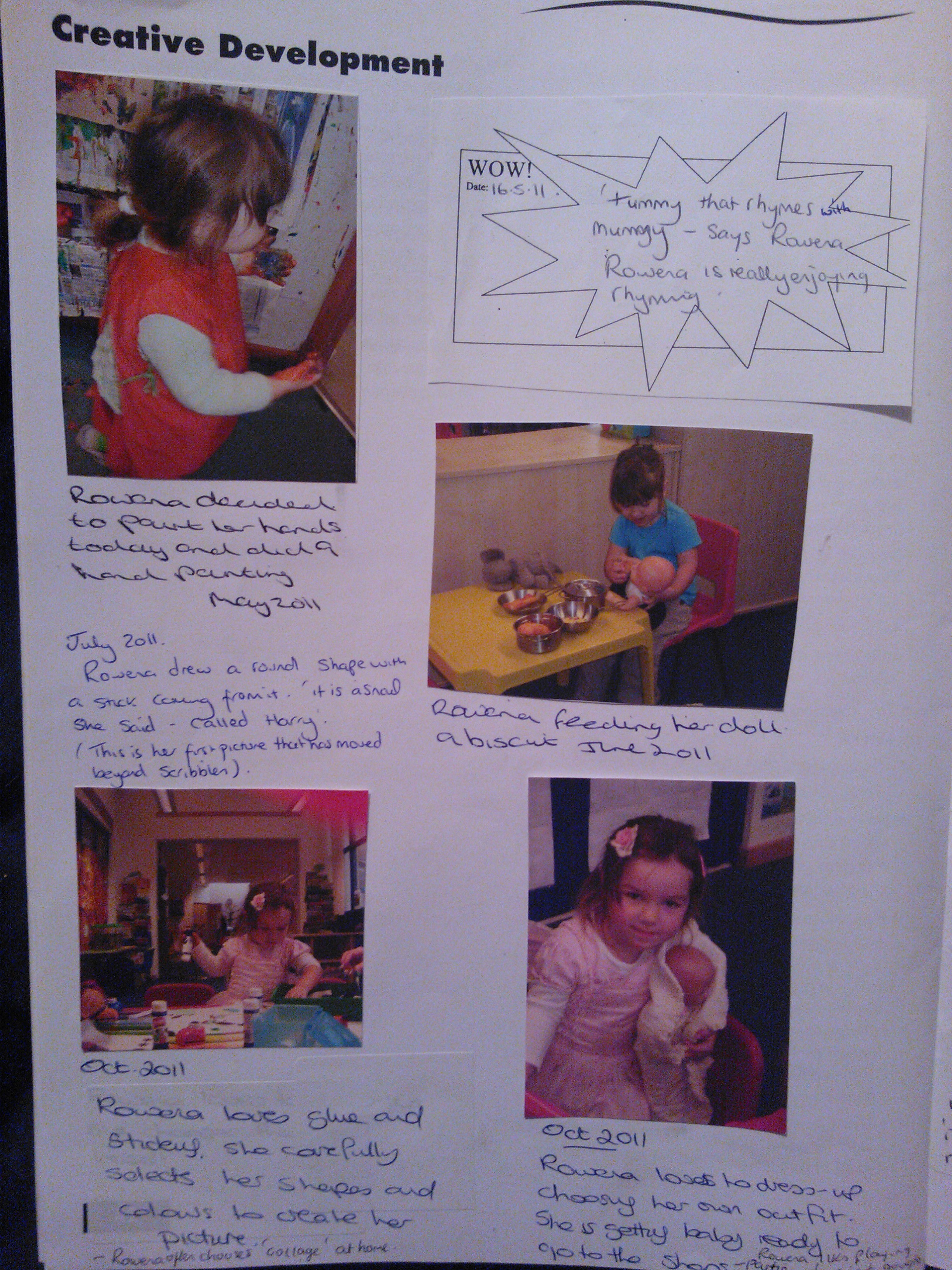
The pictures tell the story of the child’s fascinations and the teacher annotates explaining the learning that took place. The Wow moment was added by a parent about learning that had occurred at home. Parents can also comment on the learning at pre-school to show how this matches with what they do at home.
Learning diaries have been available for every Foundation Stage child (up until the end of their first year at school) in the UK since 2008. These show the learning journeys of individual children through photographs, children’s comments and teacher analysis of learning. The diaries are an excellent record of progress and should move with the children when they go to school. Parents should be made aware that they are available to be viewed at all times and encouraged to comment about learning at home.
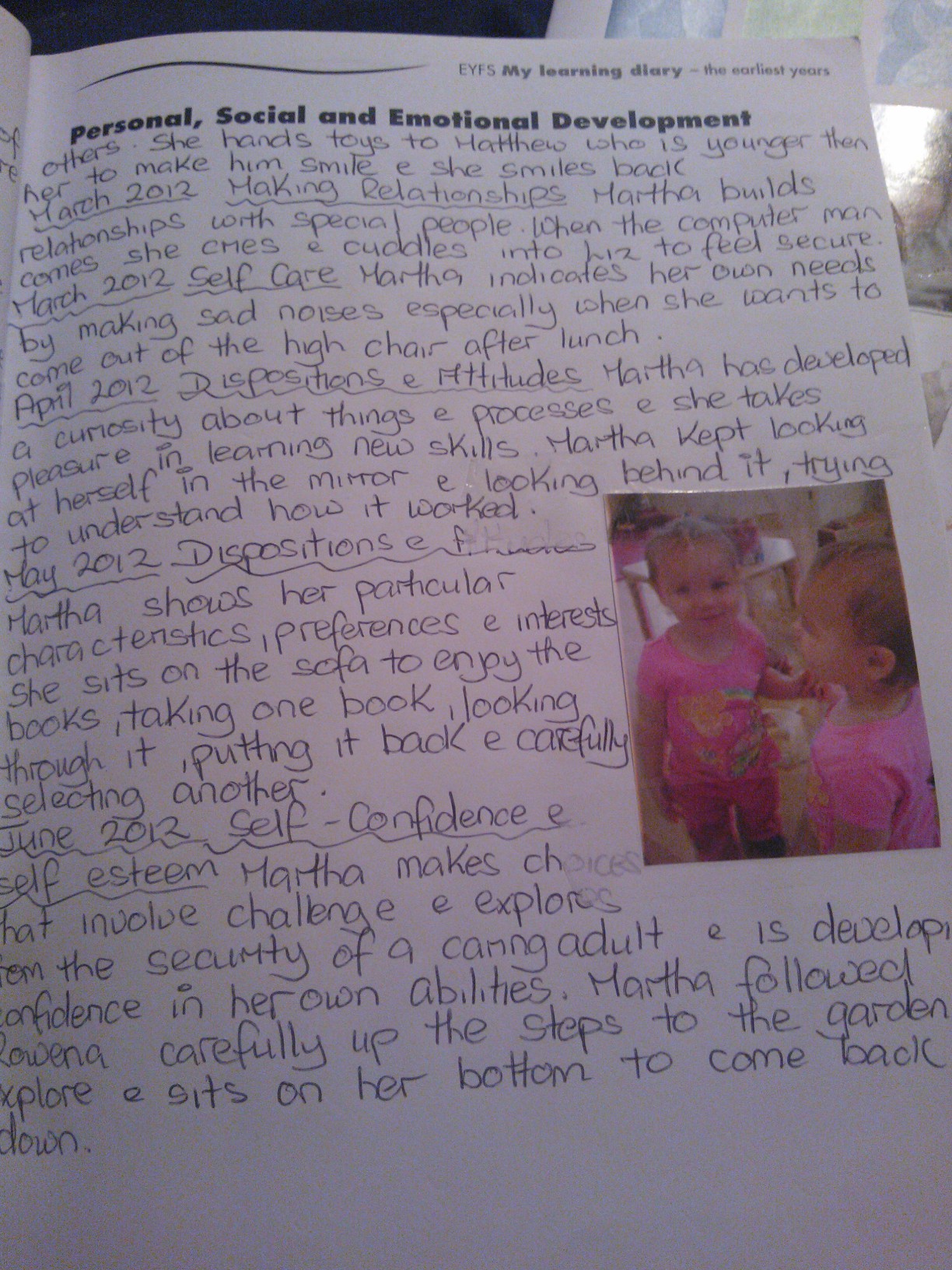
An example of a learning diary extract for a child under 2.
Learning diaries work best when they are, as the title suggests, a record of children’s learning. My first encounter with learning diaries was when working with children with additional needs, as a way of understanding what was happening at home and how that translated into their behaviour at school. In my experience this shared aspect of the diary is sometimes missed. Emphasise that this is the child’s book and it is important that everyone involved with the child shares information to build up a complete picture of the child.
Daily Timetable
If parents are struggling to get information from their children about the day at school it can be useful to display a timetable. Some specific information is also helpful, such as today we read this story or we looked at seeds and berries.
Using Technology
Not all will agree but I think that modern technology could revolutionise the way we build partnerships with parents. Allowing parents access to your email (preferably not your personal one) is a great way of sharing experience though I would suggest creating guidelines. Perhaps suggest that the email is for sending anecdotes about events or things they have been doing at home that they may like to share or build on in class. Teachers could send photographs to parents during the day of their children’s learning or maybe create an online version of the learning diary? I once had a childminder who even in the days before smartphones sent my daughter home with a sheet of thumbnail photos depicting what she had been doing that day. This meant so much and gave me a great starting point for talking about her day.
Open door policies.
In my experience most pre-schools and schools profess to have an open-door policy but in reality it means little. Many encourage parents to help at school and this is a great way of understanding what children are doing at school. However for working parents and those with younger siblings this is not always an option.
Most nurseries and pre-schools invite parents in to the classroom to collect their child. Parents have the chance to familiarise themselves with the environment, children can show their parents what they have been doing and there is a chance to talk to the staff. It surprised me when my daughter started at a school based nursery that children were handed to parents at the door and we weren’t invited in.
It can help parents to feel a part of their child’s day if the room remains set up at the end of the day and they are able to wander around with their child talking about what they have learned. Clearly this can be difficult if younger siblings start to play with toys or children don’t want to leave, so simply leaving one or 2 things out is sufficient. Outlining rules about this being a talking/sharing time not a play time should also help along with setting a clear time for leaving. Not all children/parents will want to stay every day. Perhaps encourage a parents’ rota for helping clear away.
The benefits of the above are plentiful
Parents will not continually demand information from you about their children as they will feel better informed.
Parents will be less anxious about their children if they feel a part of their life at school/nursery.
The children will be more likely to share what they have done with their parents by proudly showing their documentation and learning diaries.
Children can encourage parents to contribute to learning diaries creating a clear picture of the child for the teacher.
Photographs are a wonderful way of sharing information with families for whom English is not their first language.
Parents will feel better equipped to support their child’s learning at home.
With thanks to North Somerset Early Years advisory team, Liz Maggs, Hilltop Pre-School and Early Birds Nursery – Long Ashton for images and learning diary extracts.
My 2 youngest children are obsessed by drawing. ‘Pens’, ‘paper’, ‘chalking’, ‘want to draw’ are common utterances from my one- year-old. I keep a supply of fresh paper in a low cupboard in my kitchen and a tin filled with pens, pencils, crayons and ballpoint pens. The girls also have a magnetic drawing board, aquadraw and pavement chalk in the garden. They love to draw on paper, cardboard boxes and each other. I also keep a supply of pens in the playroom high enough for my youngest not to reach. The children know that she is not to have pens unsupervised as she will draw on walls or furniture.
As I was unpacking boxes of books I came across the wonderful book It’s Not a Bird Yet: The Drama of Drawing
The book shares a number of stories of children’s drawing accompanied by photographs and examples. It attempts to guide teachers to extend drawing and parents to support children’s drawing without taking over.
The book talks about observing children as they draw, listening to what they say as they draw, to learn about the meaning they ascribe to it. When children draw for the first time you can see them marvel at the crayon making a mark on the paper. This also translates to other media, for example when I tried to hurry my toddler along as she bent down to play in the dried mud on the way home from the park, she remarked ‘I’m drawing!’
When you give children feedback as they point to their ‘scribbles’ and say ‘look’, this prompts further mark making. Children begin to assign meaning to their drawings far earlier than we think, often before they can really express it in words. My youngest who is almost 2 was drawing on her magnetic board, I could hear her talking to herself so decided to sit with her.
The video shows my daughter who is turning 4 and her frustration at not getting her drawing right. With help she comes up with her own solutions and is happy to start again. My youngest who is almost 2 watches intently and joins in the conversation. The next part of the video shows my youngest daughter talking about the alphabet as she makes marks (something she has learned from her sister as she draws alongside her). The final clip is my youngest daughter ascribing meaning to her drawing and shows the suggestions her older sibling makes and how these extend her thinking.
Her elder sister is beginning to show an interest in writing. They often draw together and talk about the shapes they have drawn. I believe my youngest has learned a lot from drawing alongside her sister, she watches intently and copies her circles and lines.
Children often say they can’t draw things. I remember the Ursula Kolbe book was one of the fist things that made me think about alternatives to drawing for them. She explains that children see things differently to us so even if we draw for them we may not represent it in the way that they would like. This leads to a loss of confidence and the belief that their way is wrong. Often sharing drawing with other children is a good way around this as they will offer suggestions to one another. Giving hints helps, as does making children realise that it is okay to start again, artists make many drawings before they come to a finished product.
I save my children’s ‘best’ drawings, dating them to show progression. I am going to adopt a system recommended in the book; a folder with loose leaf transparent pockets so that the children can file their own favourite pictures and we can talk about them for years to come.
When working as an early education consultant in the UK my colleagues and I would often look to other countries for inspiration. We were in awe of the freedom and financial investment in early education in Scandinavia, drew on inspiration from Te Whariki the early childhood curriculum of New Zealand and were in awe of the pre-schools of Reggio Emilia in Italy. We recognised the investment in early education in the UK but were aware that there were also many things that could be improved.
On moving to the US, I expected early education to be different but was struck by the number of commonplace things from UK early education that were seen as new and radical here. Washington State where I live has invested a huge amount of resources to early education but in 2011 only 8% of 4 year olds and 2% of 3 year olds were enrolled in state pre-school programmes (NIEER The State of Pre-school 2011). I now realise that I had much to be grateful for in the UK. My 3-year-old had 15 hours of state funded pre-schooling per week and I could use this flexibly. I knew that I could find a quality pre-school without having to put my hand in my pocket.
While weighing up the different systems I came across a recent report by the Economist Intelligence Unit (EIU), Starting Well – Benchmarking Early Education Across the World. The EIU was commissioned to produce an index ranking pre-school provision across 45 countries. The Index looks at provision for children aged between 3 and 6, considering availability, affordability and quality of pre-school environments. Alongside the data, experts were interviewed and research reviewed to highlight key issues.
It will not come as a surprise that Finland, Sweden and Norway top the list due to long-term investment and prioritisation of Early Education which is embedded in their culture. What did come as a surprise however is that the UK is in fourth place. A number of factors contribute to the UK’s high-ranking:-
A legal right to pre-school education
A well-defined curriculum and health and safety standards
parental involvement
an environment that ensures children are healthy and well nourished when they enter school.
Availability
The US ranks 24th in the Index. There are many quality pre-schools in the US but these are not available or affordable to everyone and the quality of provision is variable. A growing body of evidence suggests that investment in early education reduces costs later in the education system. The success of many European countries lies in the recognition of the value of early education meaning that even during recession, funding is unlikely to be pulled. In countries such as the US where the government has not yet accepted responsibility for early education, budget deficits lead to cuts in early education funding.
Affordability
In general the countries that acknowledge the importance of early education are also those with the most affordable pre-schools. Chile(20th in the index) is a lower-income country yet 85 % of 3 year olds and 90% of 4 year-olds attend a pre-school of some kind. Public pre-school provision is free. The funding has been put into providing provision but as yet has not been assigned to quality. Teachers are not well qualified and there are no quality guidelines which drags the country down in the index.
Quality
The counties that rate highest in quality are those that pay the highest salaries and recruit the most highly qualified teachers. The other factor defining quality is the availability of well-defined guidelines and mechanisms for monitoring and supporting these, Finland, France, Sweden, New Zealand and the UK score highest on these points. New Zealand’s curriculum Te Whariki is successful because it embodies the values of its country and culture, many countries use it as a benchmark when designing their own curriculum. High performing countries in this measure also recognise the importance of Parental engagement. Belgium scores highly based on its statutory responsibility to work with parents and children and offer parenting programmes and support.
Education at a Glance 2012: OECD Indicatorsis an annual international comparison of education. The report states that whereas patterns of enrolment for primary and secondary education are similar throughout the OECD, there is significant variation in early childhood education programmes. 79% of 4 year olds in OECD countries and 83% of those in the European Union are enrolled in early education programmes, this ranges from 95% in the UK, New Zealand, Norway and France to less than 60% in Australia, Canada, Brazil and Greece. OECD research found that demand for early childhood education for children aged 3 and under far outstripped supply. The research backs up findings in the Economist’s study that the absence of public funding leads to a greater risk of variable quality or makes it only affordable to affluent families. In most European countries universal education for 3 to 6 year olds is generally accepted, in most of these countries early education is free and provided in school.
I am still coming to terms with living in a country where pre-school is a luxury for affluent parents rather than a right for all children. There are many noteworthy programmes for the most needy children but a huge void for any families in the middle. There has been a lot of change in UK early education during the last 5 years and that has lead to a level of unease amongst professionals. Research like the above is sobering and helps me to realise how far we have come.
With limited toys and great weather,we have been playing with natural materials and everyday objects. The children and I created a mud kitchen in the garden.
What is a Mud Kitchen?
A mud kitchen is an outdoor play kitchen for children to explore the properties of mud. In a similar way to my own mud pie and mud drink making as a child, ( I remember filling up small dirt holes with water and tasting the mixture with a stick) the children mixed the mud in a kitchen made of recycled materials. You could use a ready-made play kitchen but it isn’t necessary.
How to Build a Mud Kitchen
We made ours using various items we found around the house. We made a shelf using bricks and a piece of wood, an oven from a cardboard box and collected containers from our recycling. An old cupboard, table or sink would work equally well and I’m sure that when our stuff arrives from the UK we will find things to add.
Collect old kitchen utensils, pans and bowls from charity shops, friends or car boot sales. We put a sign on our fence next to the mud kitchen requesting items – no-one has donated yet but the children check for new additions every day. It is a good idea to place the mud kitchen near a fence or tree where the utensils can be hung – this way the kitchen will be nicely self-contained and easy to tidy.
The Benefits of Playing in the Mud
Children learn in a variety of ways; many children (particularly boys) prefer to play outdoors. In most pre-schools I have visited in the UK indoor classrooms exist alongside outdoor classrooms. Children who may not choose imaginative play indoors may be attracted to the mud kitchen. The mud kitchen is rich in learning experiences including learning the rules of good hygiene, exploring the properties of mud, manipulating mud and tools with their fingers, measuring, imaginative play building on the children’s own experiences, finding out about bugs, problem solving and co-operation and sharing. Involve the children in the creation of the mud kitchen, they will come up with many ideas that adults may not have considered.
Health Benefits
To add weight to my argument I read an excellent post this week about the health benefits of playing in mud. The Children of the 90’s project at the University of Bristol recently reported a number of benefits for children who spend time outdoors. One study suggests that children who spend more time outdoors are less likely to develop short- sightedness and they also found that good levels of Vitamin D was linked to better health including mental health. Another study from Bristol University in 2007 suggests that friendly bacteria contained in soil, activates neurons responsible for producing the brain chemical serotonin. A lack of serotonin is thought to cause depression; playing with mud is therefore likely to improve children’s mental health.
Our Mud Kitchen
We built our mud kitchen during August. In the UK this is often the wettest month of the year but here in Washington State we have had a perfectly dry month. This was probably not the best time to build a mud kitchen but as the seasons change the play will develop.
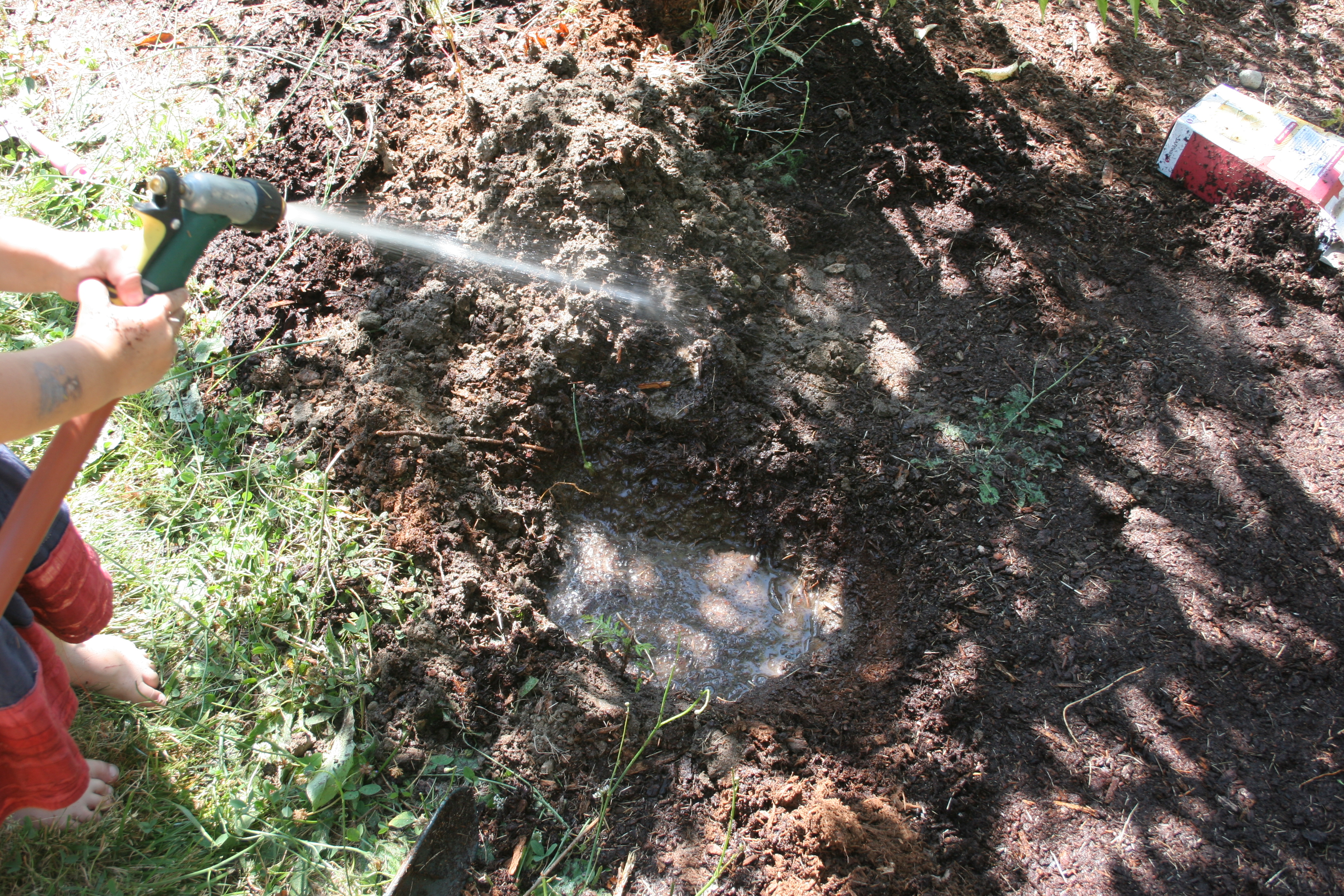
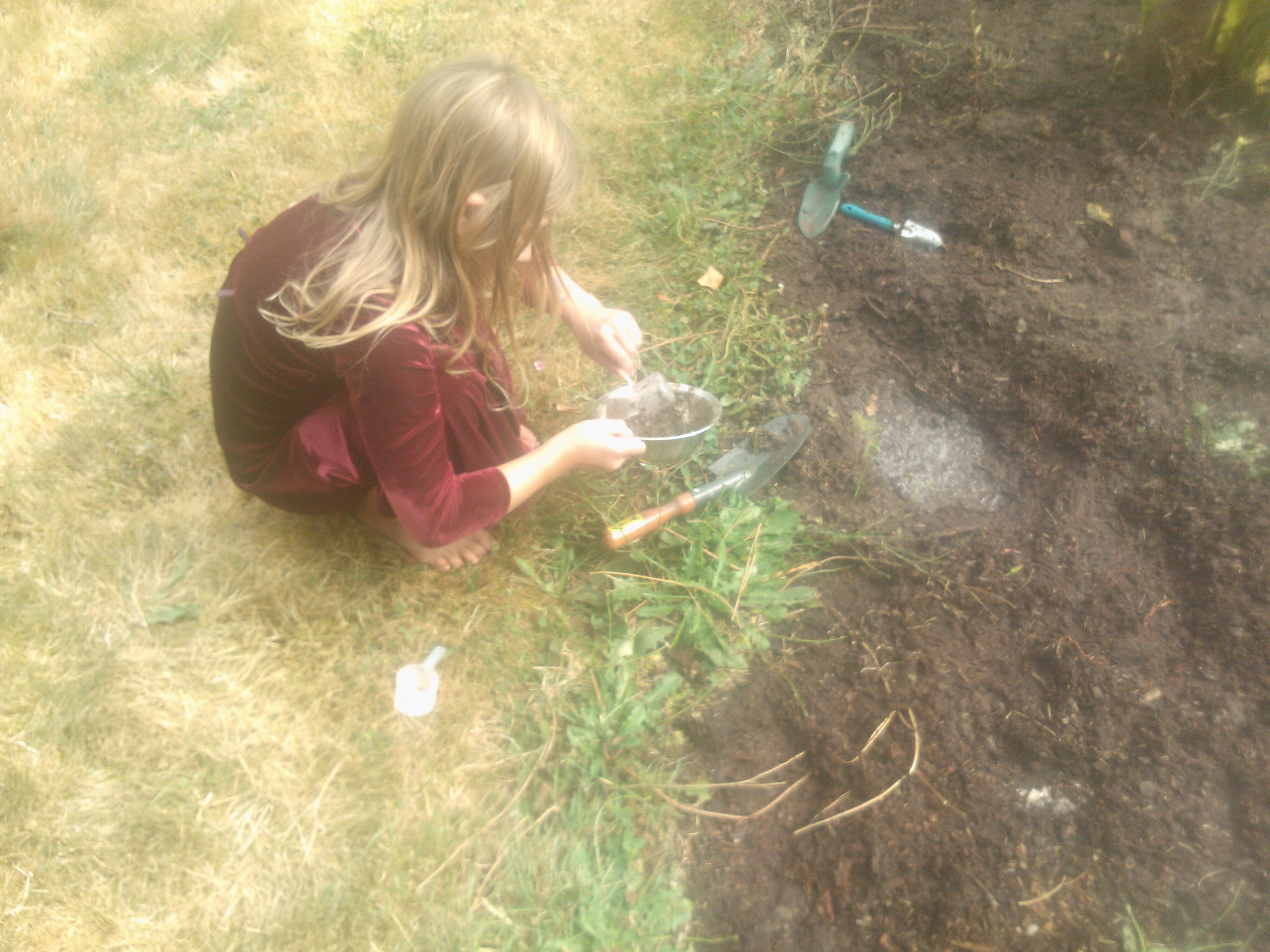
We built the kitchen in a patch of garden where there was plenty of soil but soon discovered that the top layer consisted of wood chippings from the surrounding Pine trees. This was great for sprinkling and pouring but moulding cakes and pies had limited success. I suggested we dig a hole to reach the true soil under the surface, we used the hose to wet it. Filling the hole with water attracted a flying insect that we hadn’t encountered before, the girls were apprehensive but interested in watching the creature.
We are making coffee powder
My 8-year-old who loves the idea of creating experiments or being an inventor, mixed the mud to make coffee.
I suggested she put it into the empty coffee container but she explained that it started wet and took at least a day to drain off before it could be transferred to the coffee container.
‘It takes at least a day to drain off’
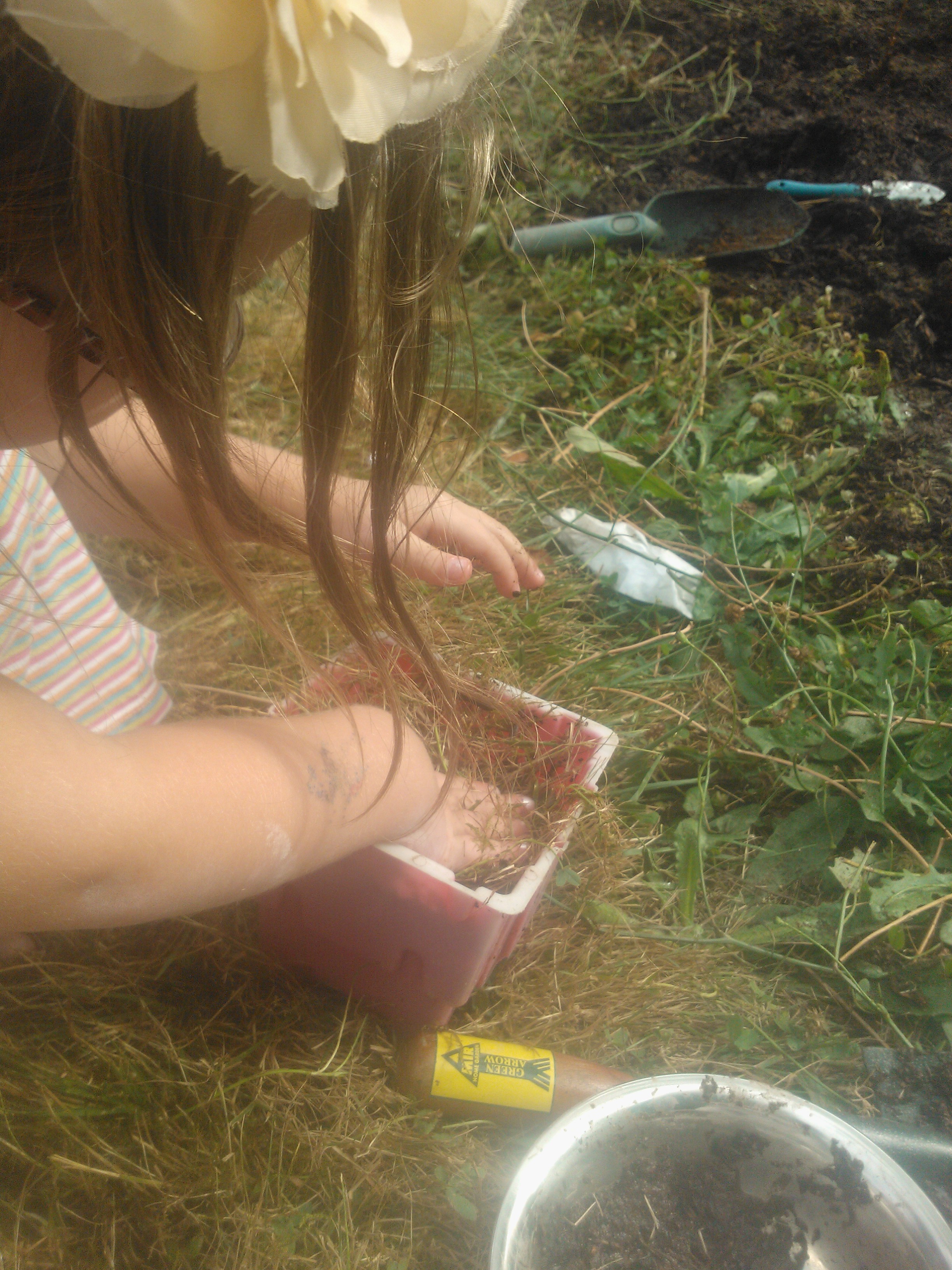
My 3-year-old preferred to make a cake. She sprinkled grass on the top.
I’m looking forward to the change in the weather and seeing how the play develops as the mud changes.
We have been in the US for 6 weeks but our furniture and the majority of the childrens’ toys will not arrive for another month. During this period we have become experts at finding things to play with from around the house. We brought a small selection of basic toys – colouring pencils, scissors, a glue stick, paper, a ball and a few books, other than that we have made our own fun. The other children in the street think it is strange to come to a house with no toys but if I am honest I don’t think there is a great deal that the children have missed.
I have been meaning to write a post about some of the household objects that we have played with for some time, but an article that I read yesterday made me look at it from a different perspective. Sadaf Shallwani’s article Questioning Play and Child-Centred Approaches discusses her experience of teaching children in Pakistan. Here, childrens’ learning was not built around pretend play but came from real experiences. Children would not learn to cook in a pretend kitchen but would be taught to use real kitchen utensils in a safe manner.
She also questions Western notions of child-centred education. Early educators try to see the world through a child’s eyes and provide child-sized furniture and objects. The value of using real objects is recognised in many highly-acclaimed pre-schools. The schools of Reggio Emilia use many real-life scenarios as the basis for their projects and a colleague who visited the schools was surprised to find the children climbing onto adult-sized chairs and tables. A key philosophy of the Reggio Schools is the belief that children are capable. With this in mind the teachers help the children to use real tools and objects. Similarly in the Danish Forest Schools that another colleague visited, young children were taught to use real tools and knives to whittle sticks and were free to roam in the woodlands and on the beach and trusted to return at the sound of a whistle.
I remember as a child using real objects from my kitchen to play shops and tea parties. Toy versions of everything are so readily available these days that it is easy to be drawn into the need to buy more and more. It is also easy to fall into the trap of believing that children need adapted versions of things for their own safety. If we trust them with real things, spending time explaining the risks and demonstrating how to use them properly, children are more safety-conscious than those who do not understand the danger of the real objects.
Not having toys has been a very useful exercise. We have used things from around the house and recycled boxes and paper to create an Olympics and a mud kitchen, we have borrowed books from the library and we have played ball games and skipping.
Here are a few other objects we have utilised:-
Pistachio Nut Shells
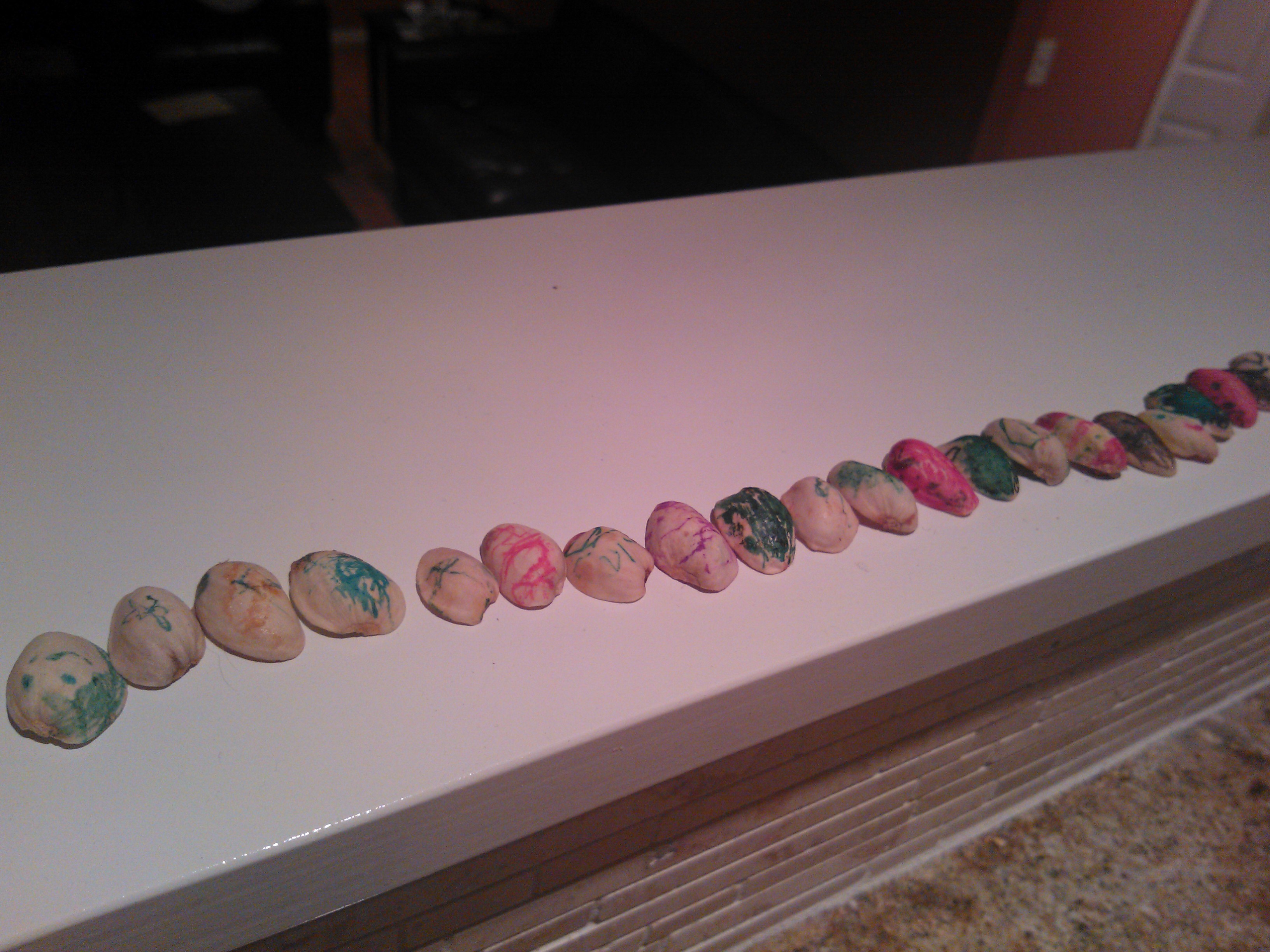
We saved the shells from our pistachio nuts and the girls had great fun decorating them. We coloured them so that we could make flowers and patterns and decorated some to look like ladybirds and other bugs. My 3-year-old chose some pebbles from the garden to decorate as they weren’t quite so fiddly for her small hands.
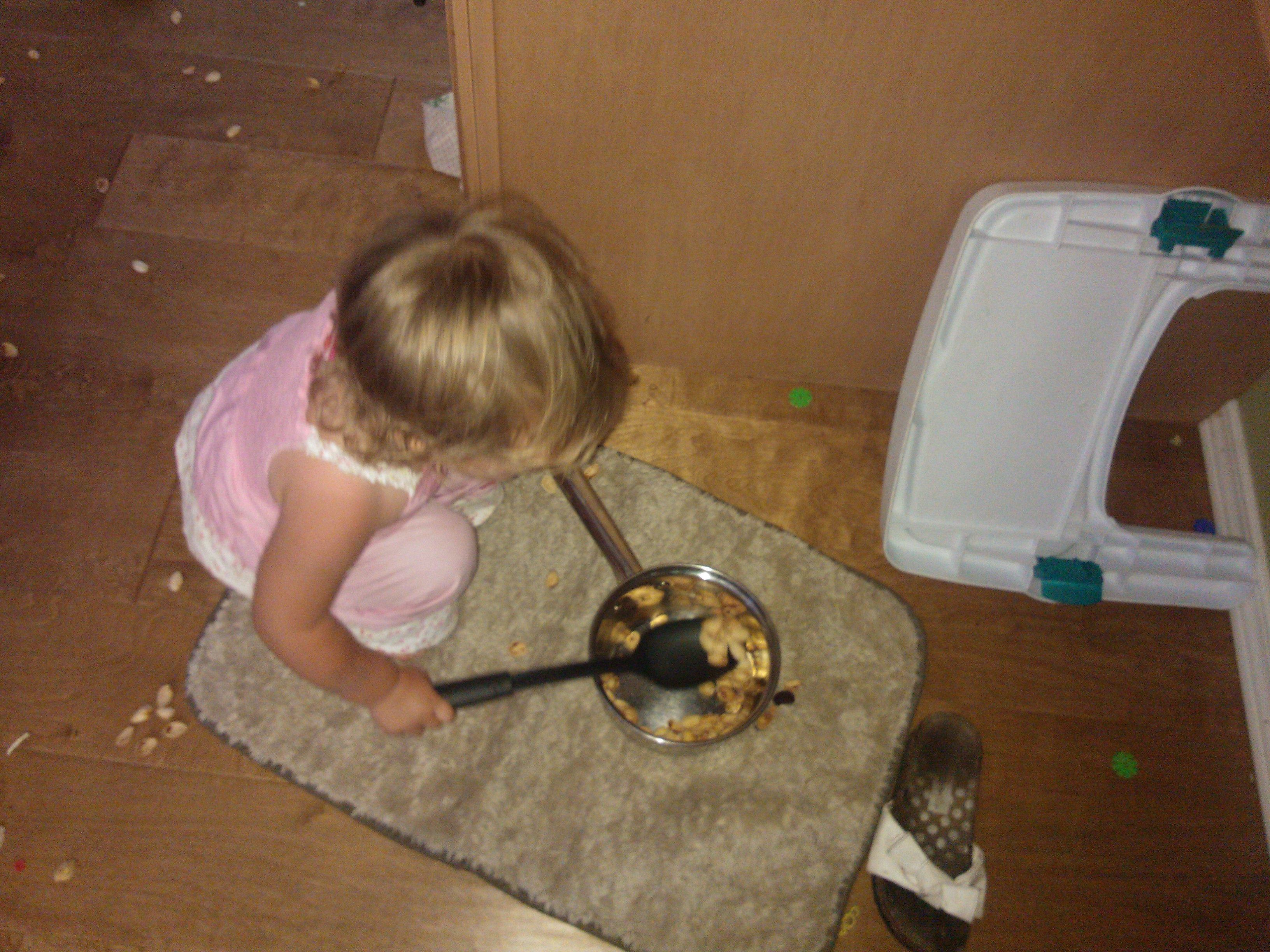
On another occasion I gave my 1-year-old the tub of shells along with a pan, spoon and a number of containers. She enjoyed scooping them and transporting the shells from one container to another. She also liked the sound they made as they fell onto the floor. As she walked they stuck to her feet so I showed her how to pick them up with her toes which she thought was very funny.
Coffee Filters
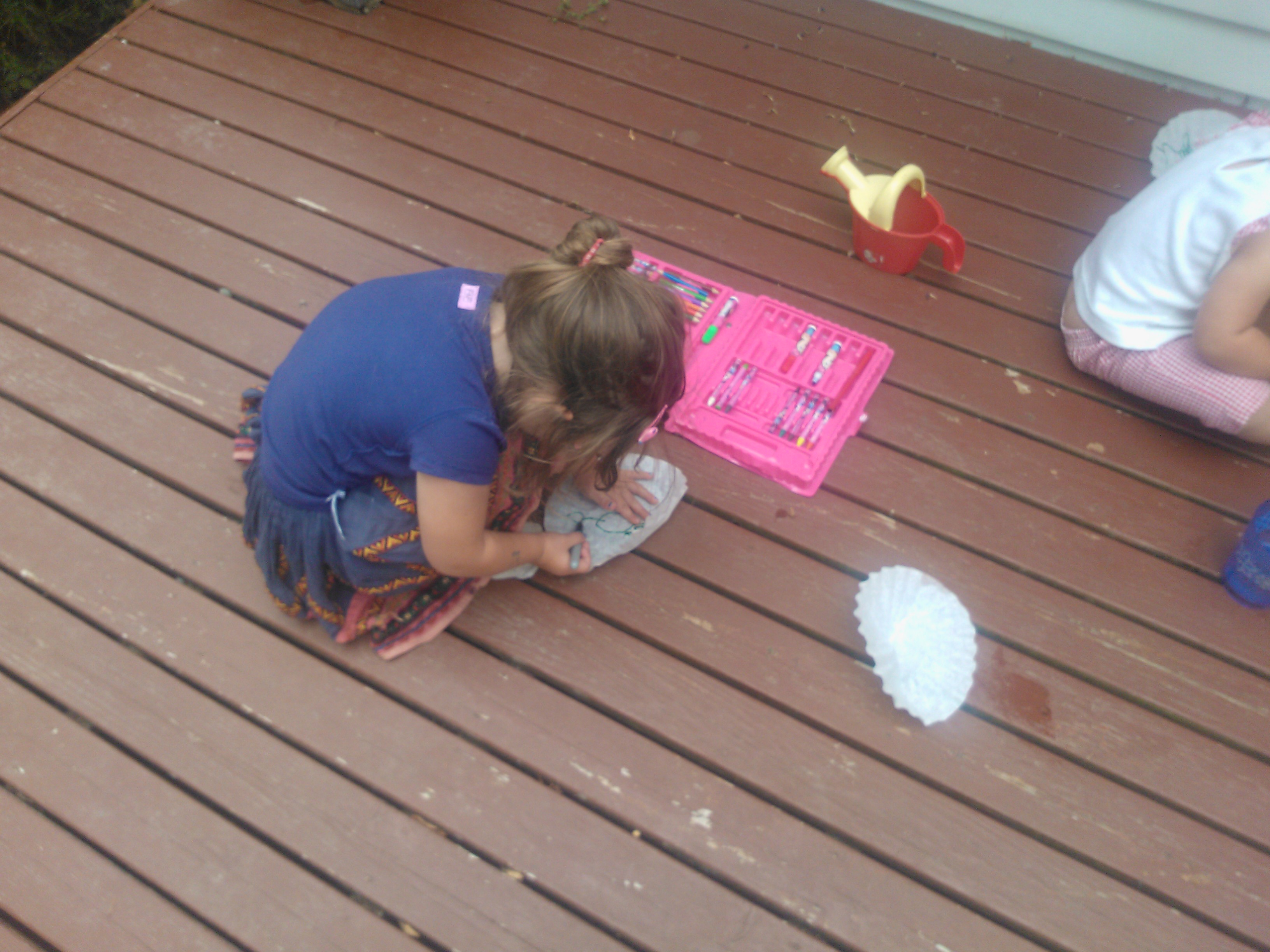
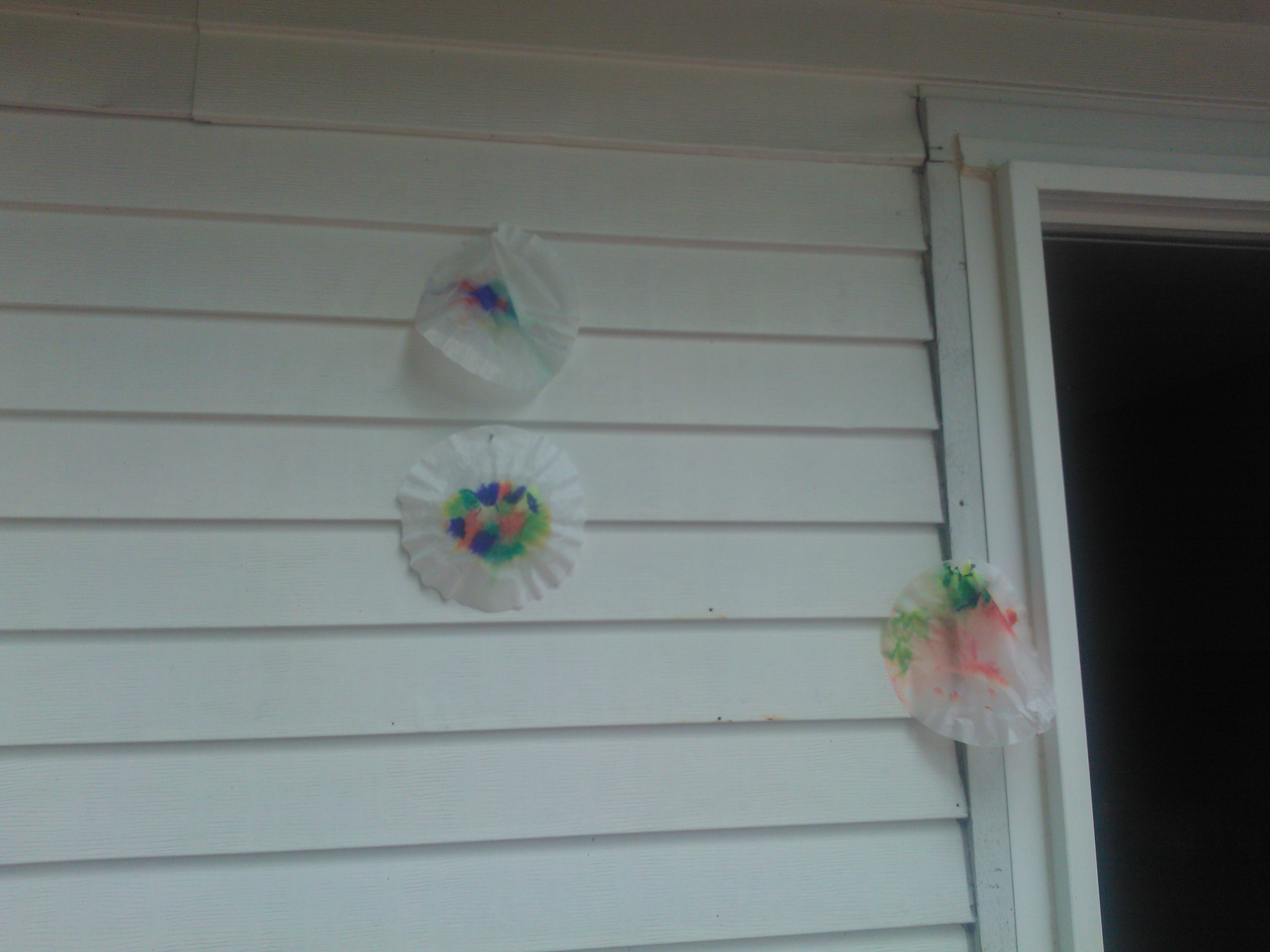
I remember doing this activity in science lessons at school. I gave the girls felt tip pens and coffee filters and asked them to draw patterns on them.
When they had finished they were given a small pot of water and I showed them how to drip it on to the paper creating rainbow colours.
Paper
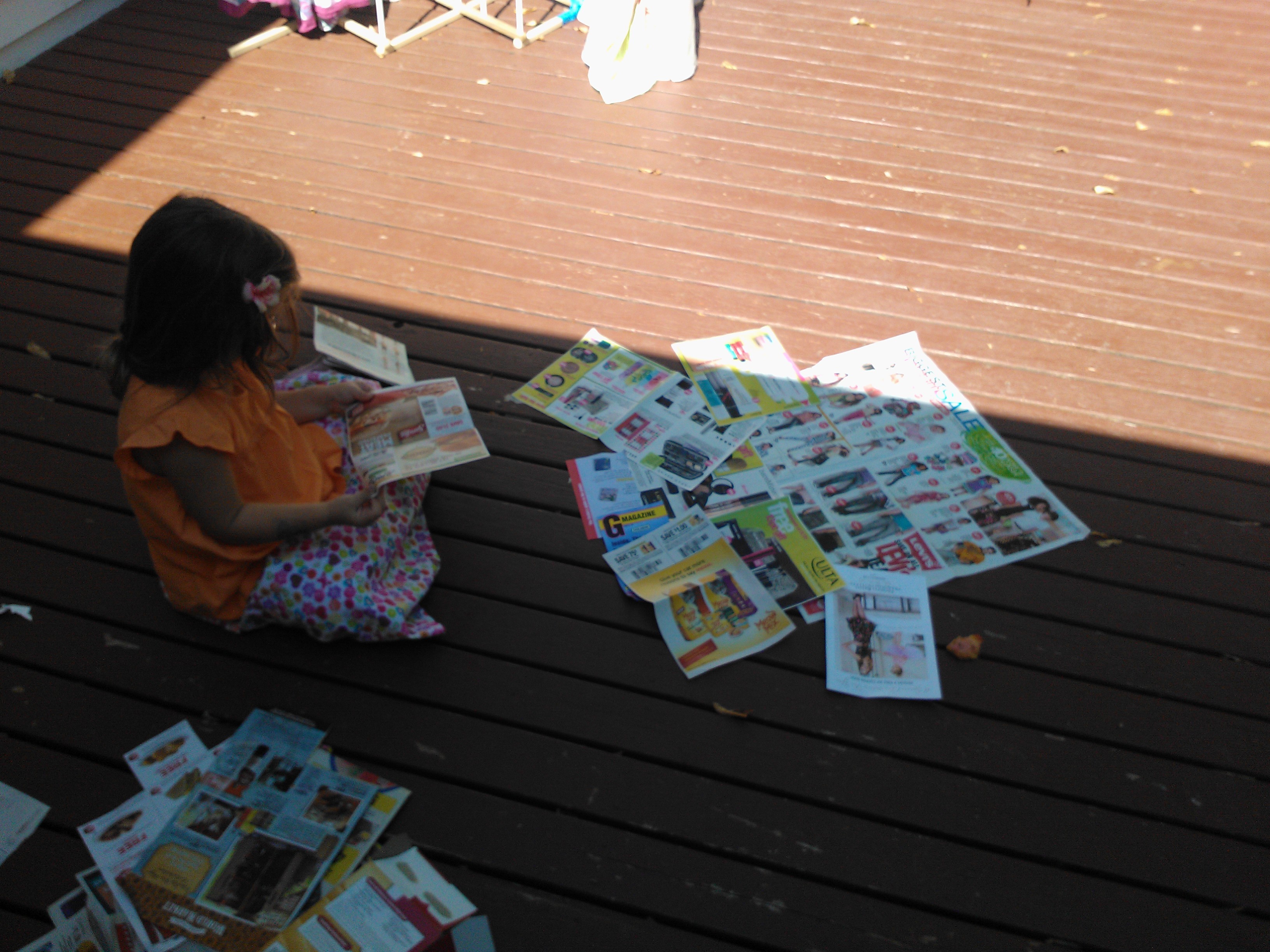
We kept newspapers and magazines with a view to making papier-mache. The girls would like to enter a local parade on Saturday and I suggested they might be able to make papier-mache masks.
My 3-year-old had other ideas. She decided to spread the paper across the floor. ‘I’m making a bed’ she said.
She had also made other things for her house by sticking boxes together
I’ve often felt that my house has been taken over by toys that the children hardly ever play with, so I’m not particularly looking forward to them all arriving. I hope that being creative with household objects will help us all to think about what we could use instead of buying yet another toy and maybe I can keep most of the toys in their boxes when they arrive.
Following the Olympics from the US has been a little strange. We’ve caught some of it live, some the following morning when we wake up and some just by following headlines, Facebook messages or Twitter feeds. The children have been watching it with me and were particularly keen to catch Imogen Cairns from their Gymnastics Academy at home.
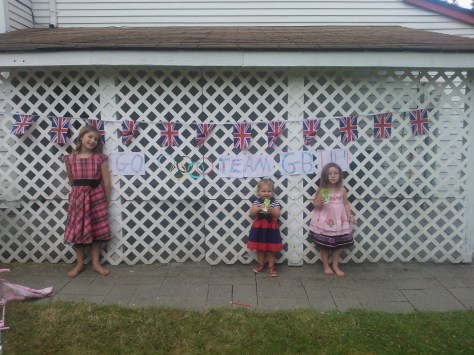
Being such a distance away we thought it was really important to make an effort to support our home team. We hung our Union Jack Bunting in the garden and the girls made Olympic rings, copying the colours carefully and a sign supporting our team. We then talked about staging our own neighbourhood Olympics, Team GB competing against Team USA.
My 8 year old made a list of all the events we could include. I ordered a pack of blank medals that the girls could colour and decorate and the girls spent a morning completing them.
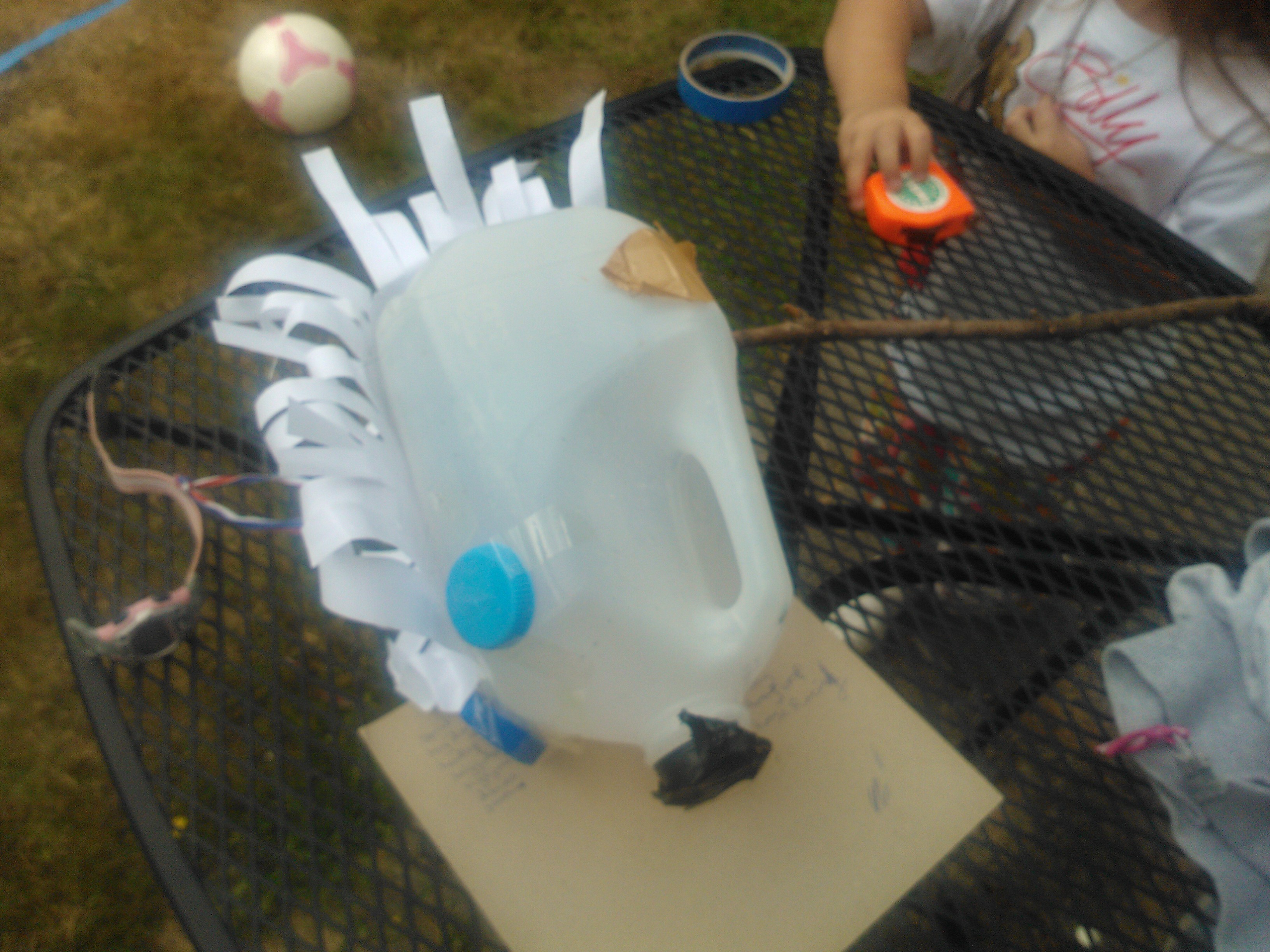
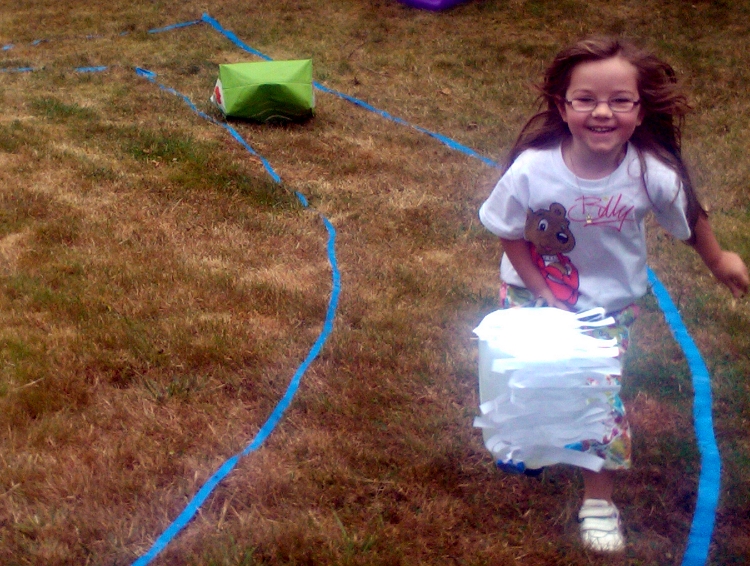
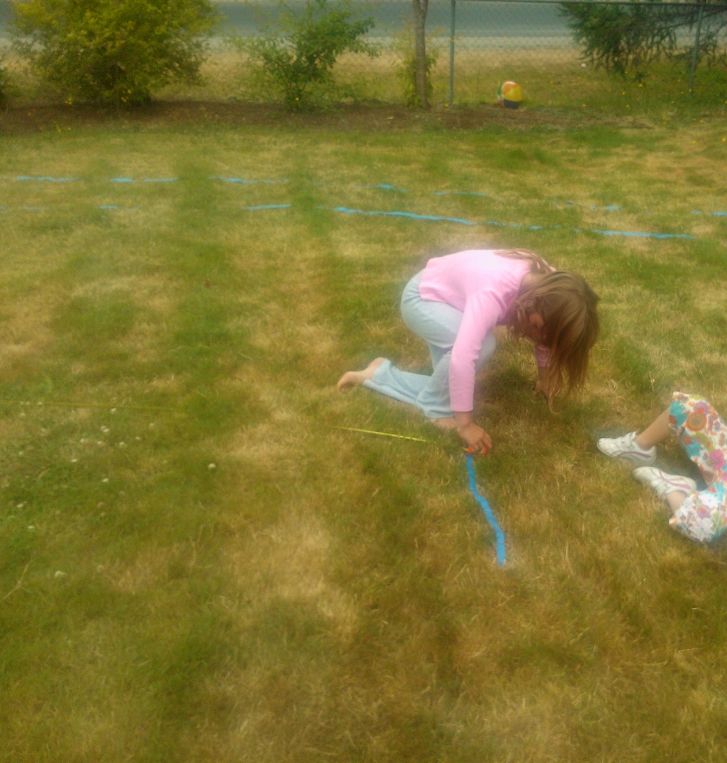
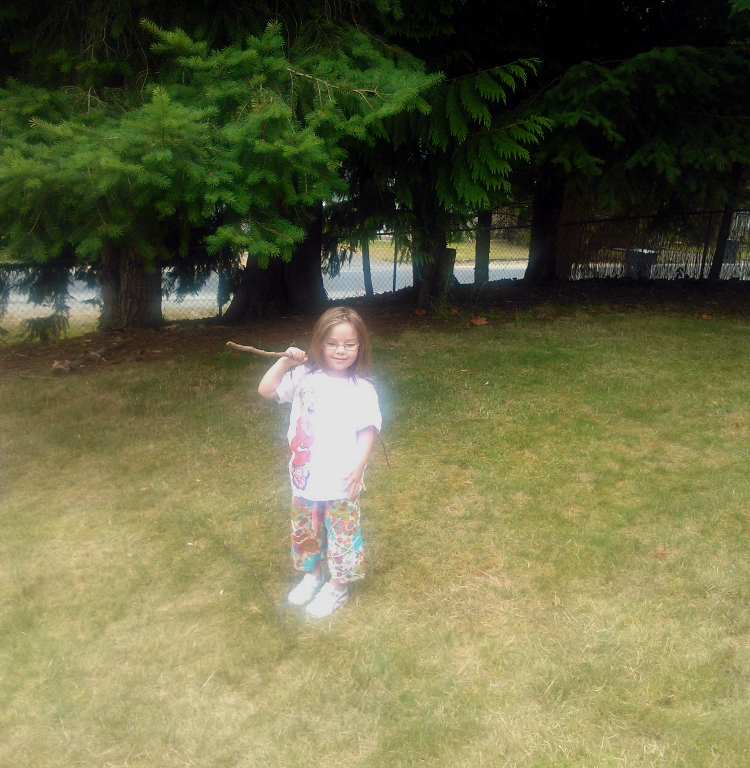
We made a hobby horse for the equestrian events using a stick from the garden and an empty milk carton. We then set to work marking out a track using masking tape. A number of low level obstacles were found to act as fences for the show jumping and double up as hurdles. We also found a straight stick to use as a javelin, a frisbee for discuss and a tape measure and stop watch for accurate results.
Event 1 – Show Jumping
Jumping boxes with a hobby horse was quite difficult, my one year old preferred to drag the horse by her side but my 3 year old had a great time. It didn’t matter to her that she didn’t win gold, she was very excited to stand on the podium (her bathroom stool) and receive her silver medal. We sang the National Anthem and this has been a really good way for them to learn the words (perhaps I’ll leave the Welsh one until they are a little older).
Event 2 – Hurdles
This was my one year olds favourite event she stepped her way over all the obstacles and loved waiting for the Ready, Steady, Go.
Event 3 – Long Jump.
We marked a place on the lawn where the children would begin their run up and another where they would begin their jump. I explained that if their foot went over the line then the jump wouldn’t count and they managed to remain accurate every time. The girls helped me to measure the jumps. My 8 year old fell over every time she jumped so there was a little bit of dispute over where we should measure her landing.
I thought you were meant to fall over, they did on the Olympics
I explained that the Olympic jumpers fall over because they jump such a long way and land in sand. I showed the girls on the tape measure how far an Olympic long jumper would travel and they were amazed.
Event 4 – Javelin
The girls found it quite difficult to throw the javelin from their shoulder but managed a few good throws. I showed them the technique I had been taught at school and my 3 year old who is still deciding whether she is left or right handed needed to work out which was her stronger arm.
Event 5 – Discus
To add a bit of variety I showed them how to spin around and then throw the frisbee. It took quite a lot of practice as it kept landing at their feet or travelling in the wrong direction, which my 3 year old found hilarious. Eventually both girls managed good throws, longer than the tape measure, so my 8 year old had to employ her adding skills. My 3 year old was very proud to win Gold beating her sister by 1 inch.
Events 6 and 7 – Sprint and Long Distance Run.
To make it fair we gave my 3 year old a head start and during the long distance run my 8 year old ran an extra lap. After winning comfortably she asked if she could race me – I finally won my own Gold Medal.
Our Track and Field Day is over. Other events the girls want to stage over the next few days are football, tennis, volleyball, basketball, table tennis, gymnastics, boxing, and cycling. We completed our rowing and swimming at the weekend at the lake but the younger ones might enjoy making a cardboard box boat to row. We’ve had great fun and hopefully some of the neighbours will be able to join us tomorrow to get some real competition going.
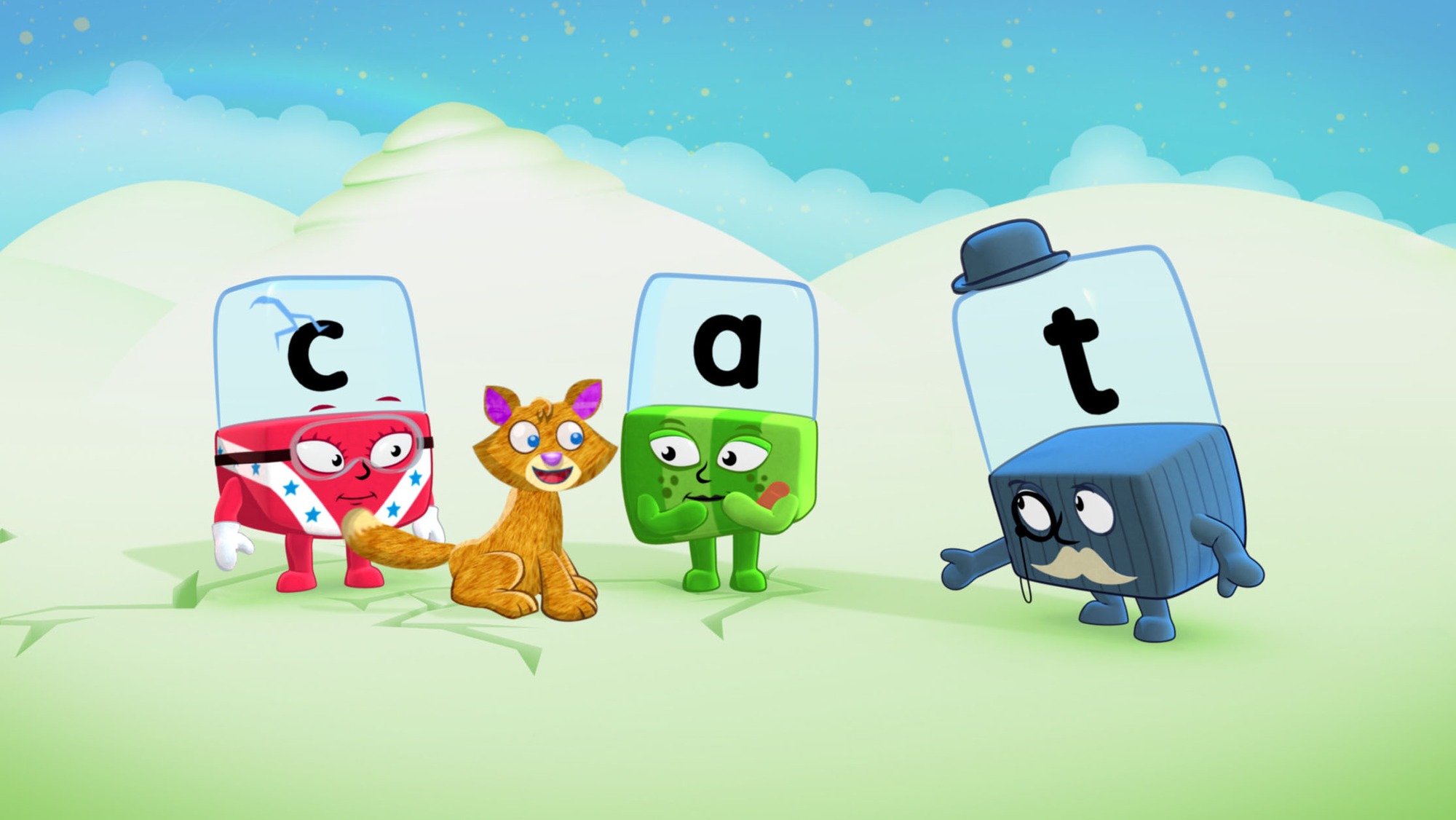
This year the UK government introduced phonics screening tests at the end of Year 1 and there is a firm commitment to the teaching of synthetic phonics as the primary method of teaching reading.
For me there are 2 key questions in this discussion:-
1. How important is phonics instruction for producing fluent readers?
2. Is it appropriate to test young children’s phonic knowledge?
1. The Importance of Phonics
Clearly, phonic knowledge is important. I learned to read using the phonetically regular Meg the Hen books and was always an advanced reader.
Phase 1 of Letters and Sounds (a resource for pre-school children published by DFES in 2008) gives an excellent grounding for later phonic skills. The materials introduce phonics through listening and playing with sounds before any focus is put on the written letters. My own children could recognise rhyme and alliteration at the age of 3 through playing games, and joining in with songs and rhymes. In my opinion it is this groundwork in early life that is sometimes missing in failing readers therefore phonic instruction in later phases becomes meaningless and sterile rather than fun. Building the underpinning skills through play is therefore an important factor.
There are numerous studies that cite the size of a child’s vocabulary in the pre-school years as an accurate indication of how easily they will learn to read. Further studies suggest the importance of children understanding story structures and the language involved in re-telling stories. Children develop vocabulary through talking and listening but to an even greater extent through reading. When a child is unable to read or in the early stages of reading, the importance of adults reading to them cannot be underestimated. Not only does it encourage an interest in books but it also enriches vocabulary considerably. As evidence to this point my 8 year old who is an advanced reader has a rich vocabulary and writes with mature language and expression. She enjoyed advanced books such as Winnie the Pooh and Pippi Longstocking in her pre-school years. She now reads Harry Potter, Little Women and the Narnia books and regularly inquires as to the meaning of words developing her vocabulary even further. As a writer myself I am very aware of the impact reading has on the quality of my writing.
There is little doubt that there is a percentage of children who are failing to learn to read, having a detrimental effect on future academic success. I would be interested in analysing the statistics to see what proportion of these are boys. Most girls enjoy reading, mark making, role play and other early literacy related play. Many boys do not. In my opinion more needs to be done to channel boys natural interests in physical play and technology into literacy activities. This does not have to exclude phonics as one of my colleagues demonstrated when she encouraged her pre-school boys to explore rhyme and rhythm by dressing them up as rappers, using electronic beats and encouraging them to make up their own raps.
To some extent therefore it is not what is taught that is the issue but the way that it is taught. If phonic instruction is to be the key method of reading instruction then it must be engaging or children will switch off from day 1.
2. Phonic Testing
I understand the reasons for introducing this test and would by no means undermine the fact that we need to highlight failing readers early to give them the extra support they need. However, I do feel that most teachers know the children who are struggling to read without the test. Certainly as a parent who has helped with reading in class this was easy to spot and it was also clear which children were struggling to decode using phonics. I think that putting children under pressure at a young age and giving parents another thing to worry about or be competitive about is wrong. I don’t have children who have been through these tests and from feedback from other parents I think that schools are handling them sensitively, ensuring that children are unaware that they are being tested, however I still feel that they are wrong.
Some children will be exposed to all of the experiences mentioned above but will still struggle to learn to read. Perhaps the tests will help to identify and address these children’s needs at an early stage but I am wary that catching children when they are failing is not the best starting point to addressing the problem.
A further point that was raised in the discussion is that all children do not learn in the same way and that the ability to decode words does not automatically produce fluent readers. I used to work with children on the autistic spectrum. One of these children had a fascination with letters and sounds, he could read phonetically regular words before he started school but his understanding was at the level of a 1 year old. When we read books together they were of the ‘Where’s Spot?’ type and anything more complex was beyond his understanding. I realise that this is an extreme case but I believe that it is a cautionary tale to those who may think a good phonics test result means that their child is reading fluently.
I will be watching with interest as my children move through the US education system (especially as they will start school a year later than in the UK) to see how literacy teaching differs and whether there are similar worries about levels of attainment.
As I was driving yesterday a discussion came on the radio that took my interest. The discussion was regarding proposed changes to make Childcare in England more affordable and improve quality. Great, I’m a fan of both of those.
However, the proposal suggests that the way to achieve this is to allow childminders to care for more children, five under 5’s (two of which can be under 1). Allowing childminders to care for more children would attract higher paid and therefore better qualified staff, in turn raising quality.
HOLD ON A MOMENT…..
Am I missing something here? I have three children (two under 5) and looking after three children on my own is hard work. If I met a woman with five children under 5 I would either think she was some kind of superwoman or look upon her with extreme pity. I am one of these supposedly highly qualified women they refer to, I have a teaching qualification, extensive experience in Early Education and Childcare and a masters degree in Psychology of Education. Even with all this knowledge and experience nothing on this earth would convince me to look after five children under 5 all day.
I have an amazing childminder and choose a childminder for my kids so that they have quality time with one carer. My childminder loves children, they do loads of fun things and she is unflappable. I admire her calm demeanor on the school run with 6 children – my idea of hell. Maybe it’s just me who thinks this idea is bonkers and will reduce quality rather than raising it? To help decide I asked my calm collected childminder for her response.
It ended with
I bet you wish you hadn’t asked!
On the contrary, I’m pleased to say I’m not alone in questioning the proposals.
Well, I have 4 each day and I personally think it would be impossible to have 5 and give any good level of care. I am able to offer places to 4 as I have known the children a long time and they gel together very well. However if you had an unsettled child and were caring for 5 I think the others in the setting would suffer.
The report also states that the numbers of childminders have halved in the last 10 years. From my experience of training childminders when the EYFS was introduced in 2008, they were dropping in their droves because of the amount of admin and paperwork involved and the bureaucracy of inspection.
This is echoed by my childminder
…the so called revised EYFS isn’t less paperwork as they have now given childminders the job of doing the 2 year check previously done by the health visitors. Oh don’t get me started !!!! I either need to employ an office worker to do my paperwork or stop playing with the children in my care which is what I really enjoy.
I’m so lucky to have a childminder who puts the children first, affordability and quality – I’m not convinced you can have both.






 Right from the Start