Category Archives: early education & play

How my 2 year old learned about deer and death.

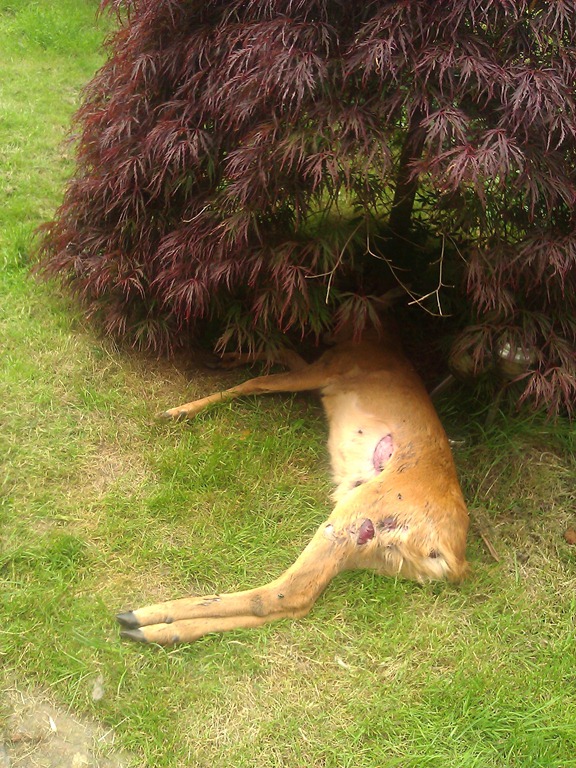
dead deer in a gardenIt’s not every day that you wake up to the sight of a dead deer in your garden!  I was first alerted to the fact when my dogs hadn’t come to whine at the door after being let out. My 7-year-old went to find them and see if they had gone into the woods at the bottom of our garden.  She returned and said that there was something lying down behind the dog,  I asked how big and she said she didn’t know.  I was expecting to find a frog or maybe a bird but was confronted by the above.

I wasn’t sure whether to let my 2-year-old see it,  she really wanted to see the ‘reindeer’ but I thought she might be frightened.  However, I’m always keen to avoid sheltering my children so we went to the bottom of the garden so that I could gauge her response.

She was in fact absolutely fascinated by it.  It isn’t often that you will get the chance to see a deer that close so we could look at it and talk about it.  I pointed out its hoofs and she said

maybe it will get proper feet – does it have to go like this? (standing on tiptoe).

From the outset I talked about how it was dead.  I think children are very matter of fact about such things and their questions should be answered honestly but in a sensitive manner.  She saw that it had hurt its legs and was very concerned,

Maybe we could put it in the shower or in the bath and make its leg better?

I explained that we couldn’t put it in the bath and that we didn’t need to make it better because the deer didn’t hurt anymore, he couldn’t feel it because he was dead

Does it have arms?

No it has 4 legs like the dogs. Most animals don’t have arms.

But we have arms.

Yes.

Perhaps when we talked about the deer not feeling hurt, she was thinking of feeling as touch.

Not that it’s likely that many of you will encounter a dead deer in your garden, but would you know what to do if you did? Probably not, well neither did I and it took about 2 hours to find the answer. First port of call  the vets – I thought they might be able to point me in the right direction.  They gave me the number of the RSPCA and the local council.  According to the council a wild animal can only be collected from the roadside or public place, if it is on private property then the disposal is your own responsibility.  If I couldn’t find anyone to collect it then it became an environmental health issue and they would come and collect it.  The RSPCA suggested I contact DEFRA .  They said that they would normally advise people to dispose of animals in normal refuse, but that a deer probably wouldn’t fit! Their advice was to call the council again. The senior staff at the council finally authorised collection free of charge.

The men arrived and my 2-year-old delighted in showing them the way, saying ‘we think it is dead’.  I think they had visions of an animal that as soon as they moved it would start kicking out – I reassured them that it was dead.  The small antlers were caught around the tree and the deer was too big to fit in the bag they had brought so they carried it up the garden.

Oh look it’s awake now

my daughter said when she saw its eyes wide open.  She wanted to see them put it in the van and know where it was going.  I told her that they would probably bury it.  They put it in a yellow bag and onto the truck.

Are the mummy and daddy reindeer dead?

I don’t think so, they might be looking for it – poor deer

It’s alright reindeer you’ll get better soon.

We waved goodbye to the deer and the men.  So that was her first experience of death – we will see what other questions it raises in the coming days.  For now she has gone to bed with her cuddly reindeer kissing it’s legs and telling it she will give it a plaster to make it better.
Toddler Takeover @At-Bristol

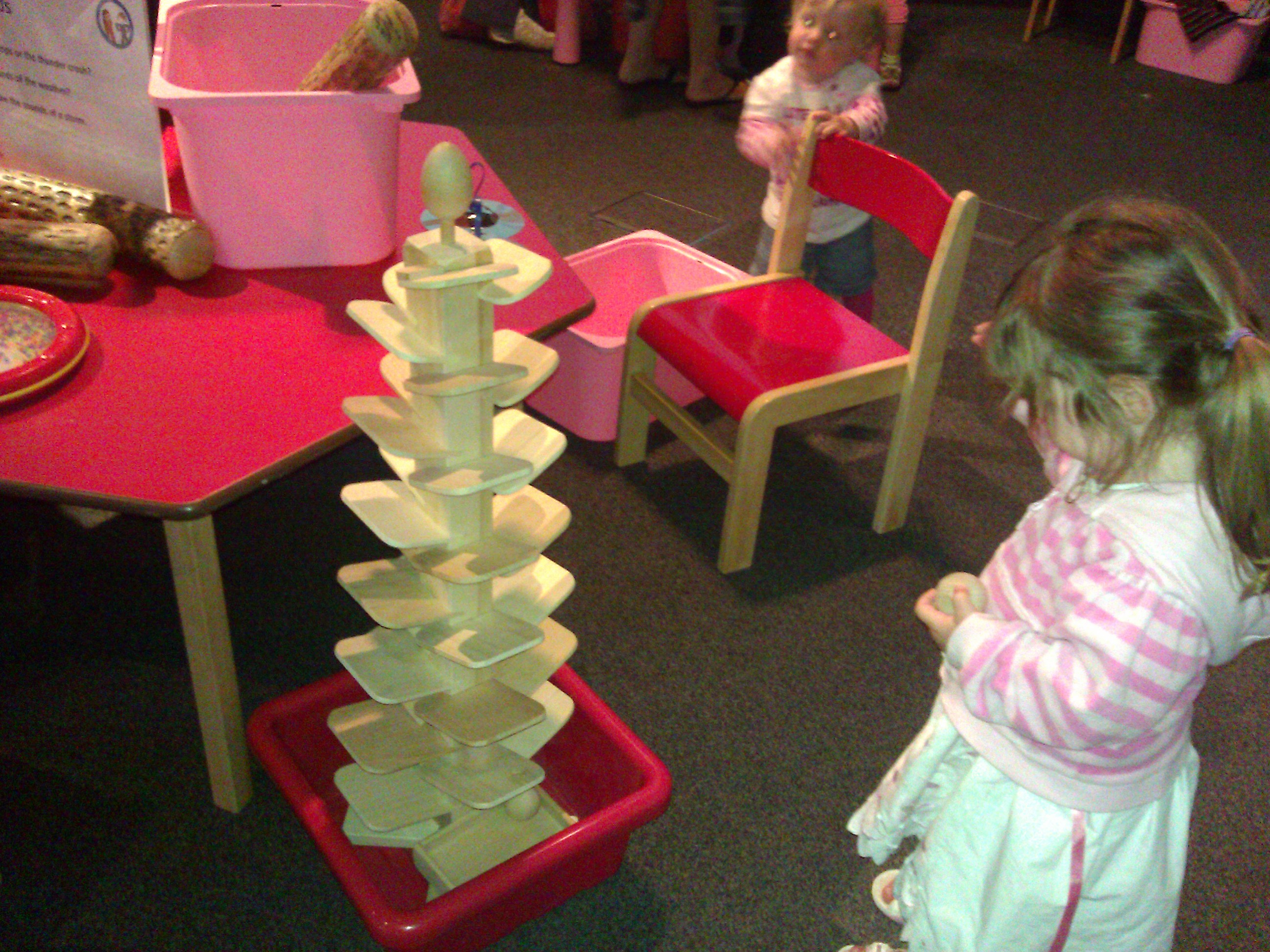
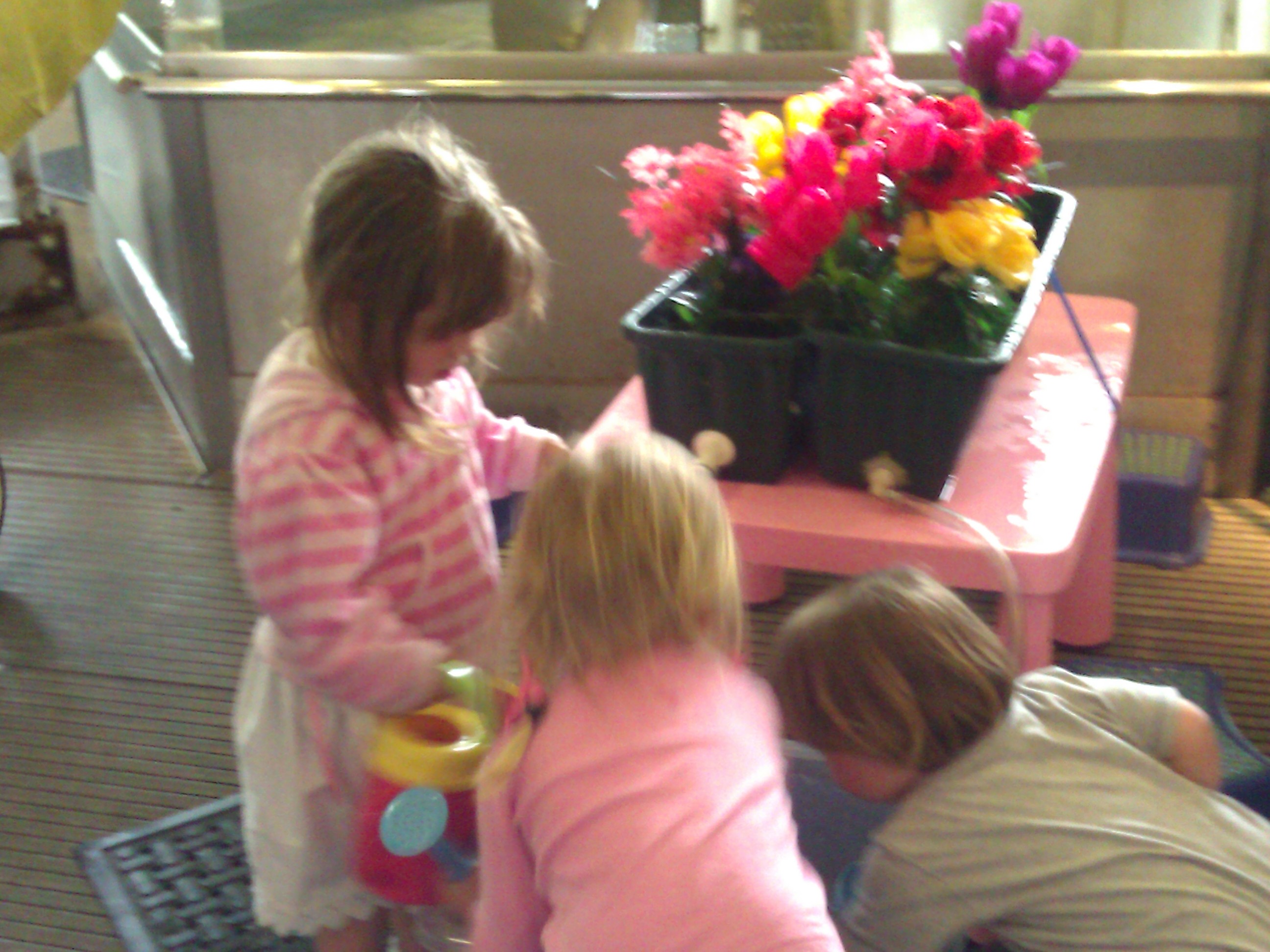
watering cans
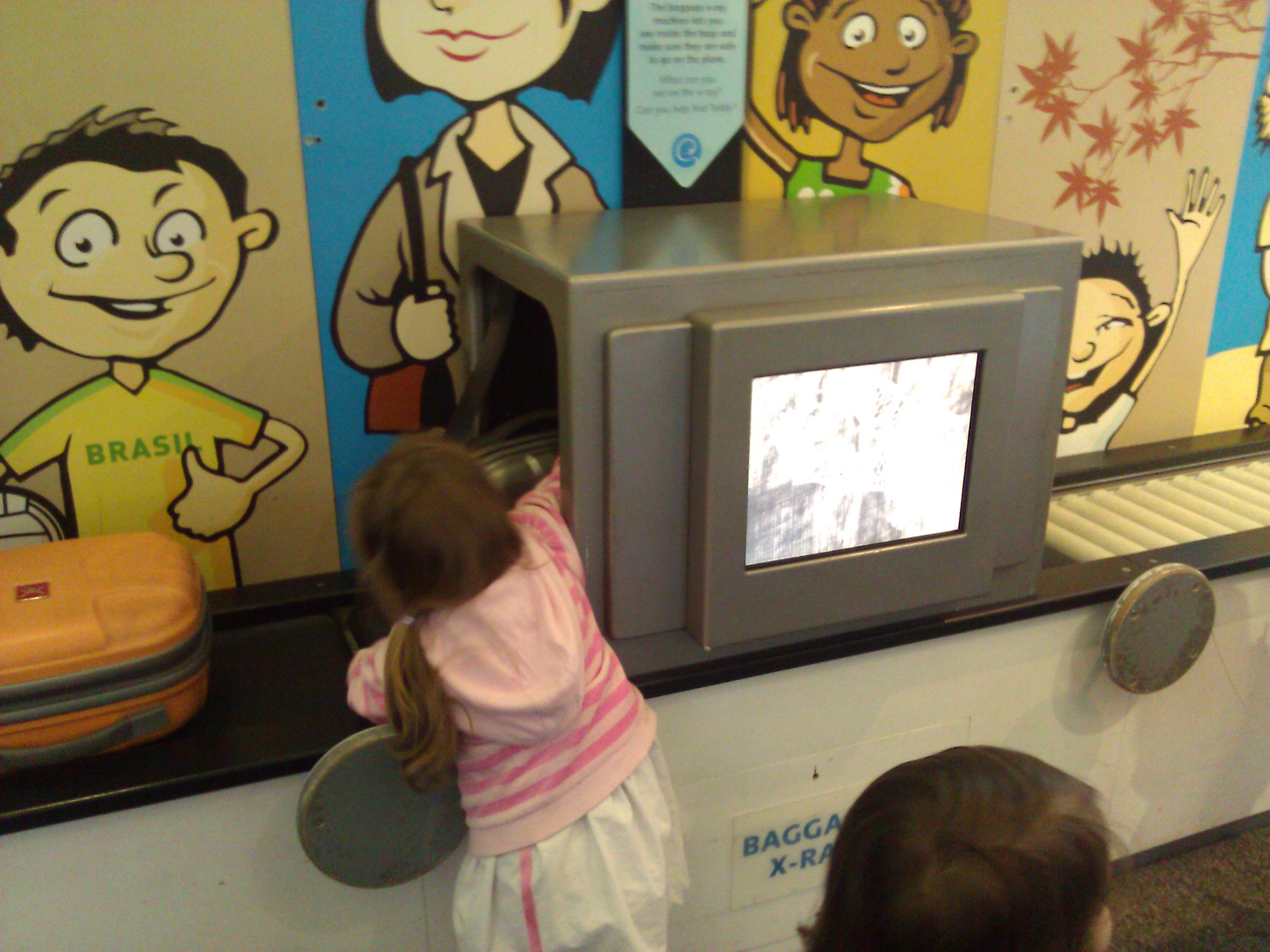
I’ve had a really fabulous day out with my 2 year old and her friend at the bi-monthly Toddler Takeover at At-Bristol.  At-Bristol is an interactive science centre with over 300 hands on exhibits.   The Toddler Takeover is a themed day targeted at the under 5’s.   The theme for today was ‘Come Rain or Come Shine ‘.  I’ve been impressed by the amount of exhibits that my 2 year old can enjoy when visiting with her older sister in the past.  There are 2 under 8’s areas that are always available .  A role play airport including a cockpit where the children can fly a plane, passport control, luggage and an x-ray machine and a hostess trolley.  When my eldest was 4 we spent most of the session playing here.playing airports  The other has an animal theme and includes a tunnel, dressing up, storytelling and a sticky spider’s web game where the aim is to throw bugs at it to try to make them stick in the web.

throwing

I once saw a superb storyteller in this area so was disappointed to have missed the storytelling session today.

As our children were under 3 we only had to pay for the adults therefore the day was good value for money.  In addition to the usual exhibits, there were a number of theme based activities  designed with the under 5’s in mind.  These activities were on the whole well thought out and there was a mixture of child directed hands on activities and more structured adult directed activities.  Some of the activities involved making an end product – a windmill or weather wheel and some were more exploratory such as musical instruments that made weather sounds, pretend snow and water play.  These were suitable for even the youngest children and each of the exhibits included a list of  suggested questions and discussion points .

There were a lot of staff helping the children to make the most of the exhibits including a number of volunteers.  Some staff were better at engaging the children that others but in all I felt that the level of supervision was excellent.

For an extra 50p the children could watch a show in the planetarium.  This was very interactive and visual and at about 15 minutes short enough to keep the children’s attention.  It may have been better presented by someone with experience of working with large groups of under 5’s but he managed to keep the interest of most children.

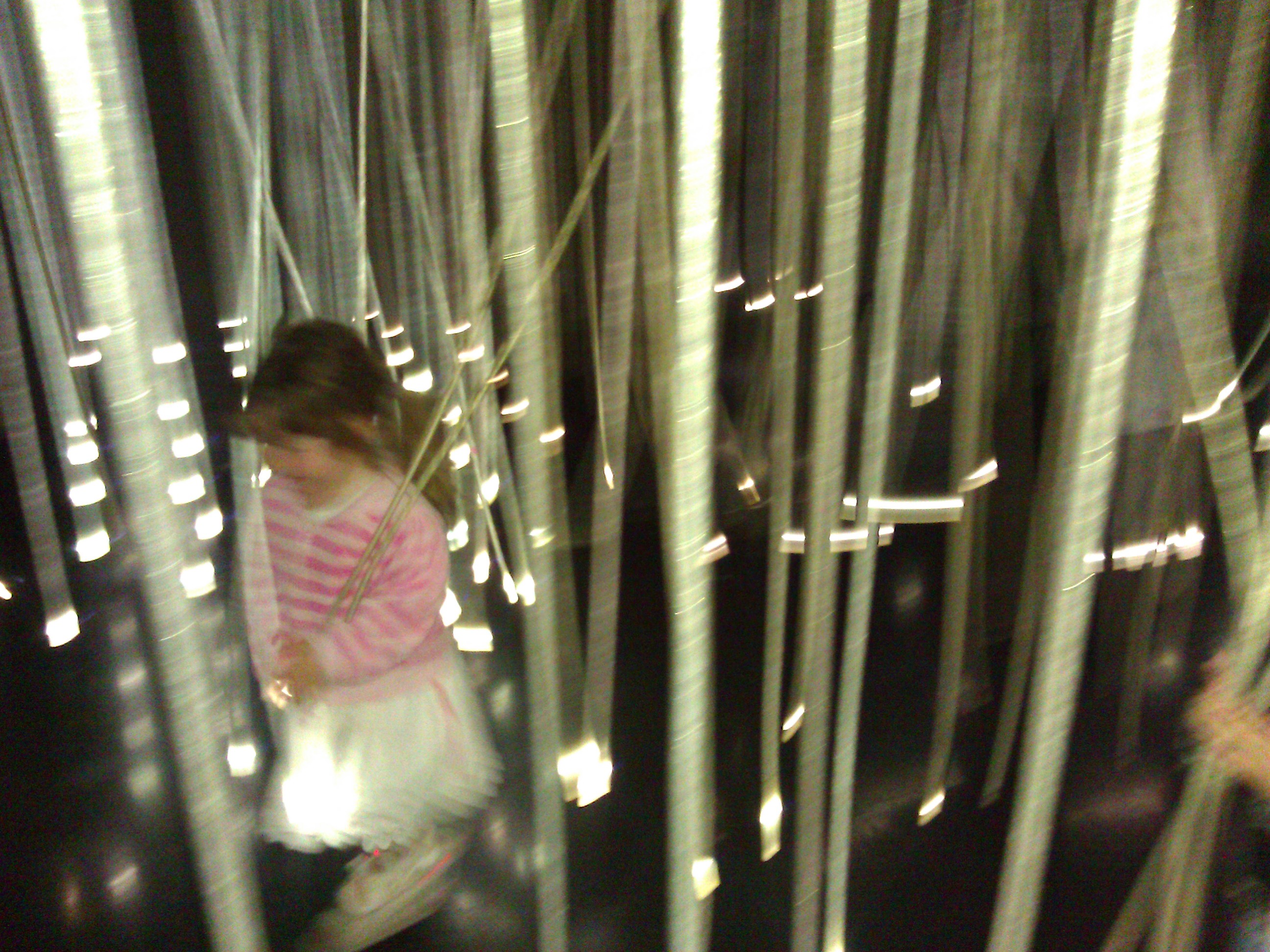
My little one enjoyed running through the lights best of all and is looking forward to returning with her sister so that they can do it together.

playing with light

We had a lost child incident whilst we were there and would just like to commend the staff for the efficient way that this was dealt with.  The child had wandered from the cafe to the main exhibit area.  When  staff  observed that he was without an adult, 4 members of staff  kept in close contact  without approaching him directly, so as not to alarm him. When reporting the lost child the reception staff immediately alerted all the other staff and the child was found .

On a practical level there are a number of baby change areas and buggy parks throughout and a picnic area where you can sit and eat your own food.  The cafe has its own small play area so the children can play whilst you have a coffee break. Parking is on the expensive side but park and ride or public transport are an option.

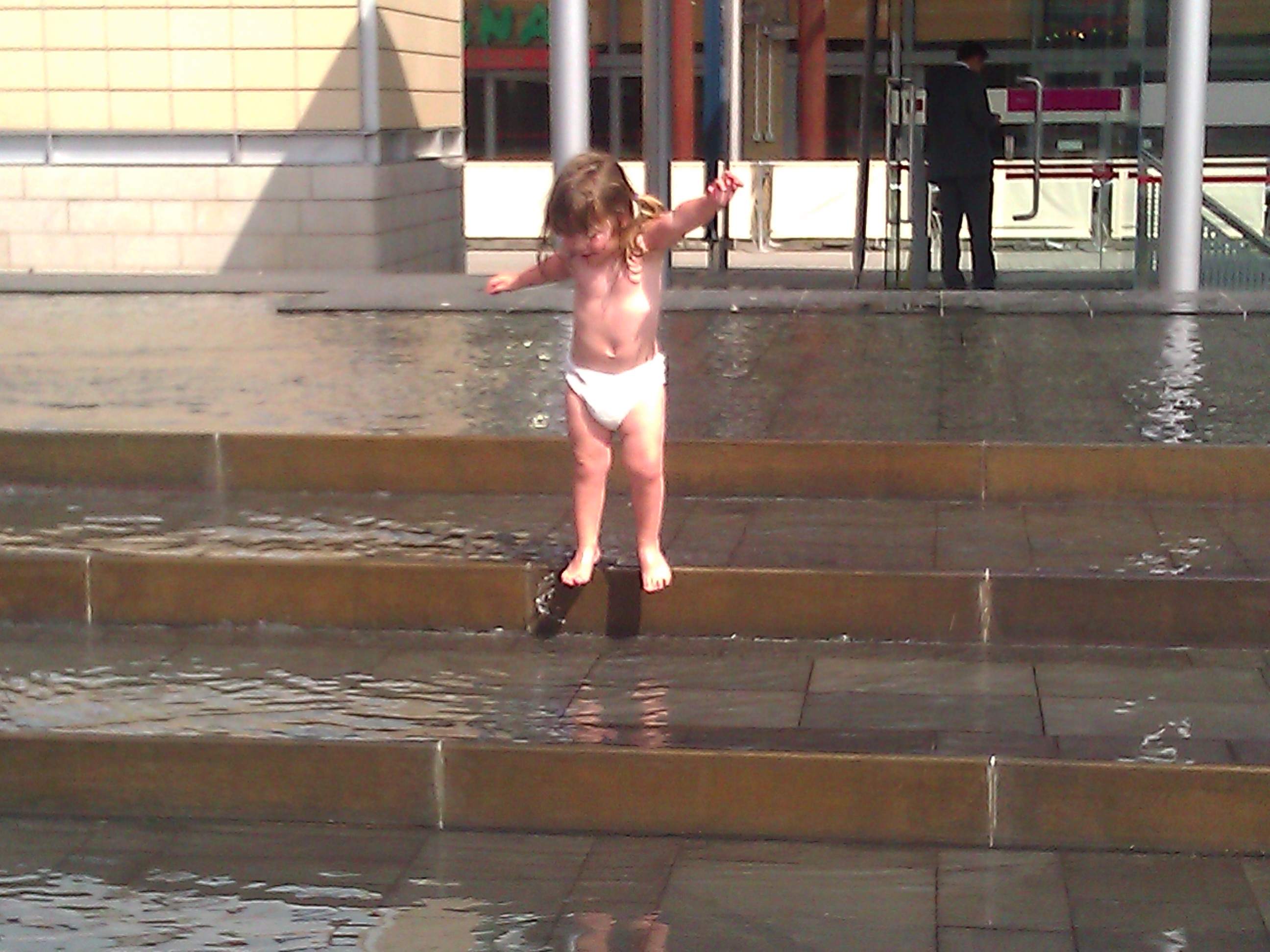
As an added bonus to the day out, outside At-Bristol there are a number of water features that on sunny days become a great place for children to splash about in.

splash

My only real suggestion for improvement is that there could have been better signage from outside that the event was going on . I’ll definitely be recommending this to my friends and am looking forward to the next one.

At-Bristol is also a great place to visit with older children too, my 7 year old wants to go tomorrow and is disappointed that she couldn’t come with us today. ‘I want to play with the fake snow’ she said when she found that it was only available for the toddler session.

http://www.at-bristol.org.uk/

Is there any value in pre-schoolers using iPads?


As you may have read in previous posts I am very interested in harnessing technology to engage children in early literacy.  I have been reading a number of articles about using iPad with pre-school children and am still yet to come to a satisfactory conclusion. 

In Maine there is an initiative to give iPads to  pre-schools in the hope that it will open up new worlds of learning for students.  It is recognised that this it will take a great deal of thought to achieve optimum benefits.  The hope is that it will be used to open up new avenues for exploration and not purley for entertainment.

 http://new.bangordailynews.com/2011/04/22/education/ipad-use-among-kindergartners-sparks-debate/

This is where I struggle.  My 7-year-old has just been allowed a DSi and I had hoped that she would use it as a camera and music player, creating projects to share . As yet I have only seen her engrossed in solitary activity and pushing her younger sister away.  I fear that this could also be the case with iPads if the applications are not creative and far-reaching enough.  Are there any applications that promote creativity and open-ended activities?  Are there any that are designed to be used with groups of children collaborating on tasks?

I have looked for many recommendations but have so far found that most involve variations on the same theme.  The kind of things that have been around on children’s websites for years – memory match games, puzzles, flashcards, colouring in, matching and tracing. Also I have seen a number of interactive books which are great on some levels but would worry that they would replace important aspects like bedtime stories.

So I’m very much on the fence at the moment .  If anyone has experience of using an iPad with pre-schoolers (particularly in the classroom) or has found any ground breaking applications in line with an active, play based,creative and interactive classroom I would love to hear about your experiences.

There’s a Spider on the Floor – Fun with Rhyme


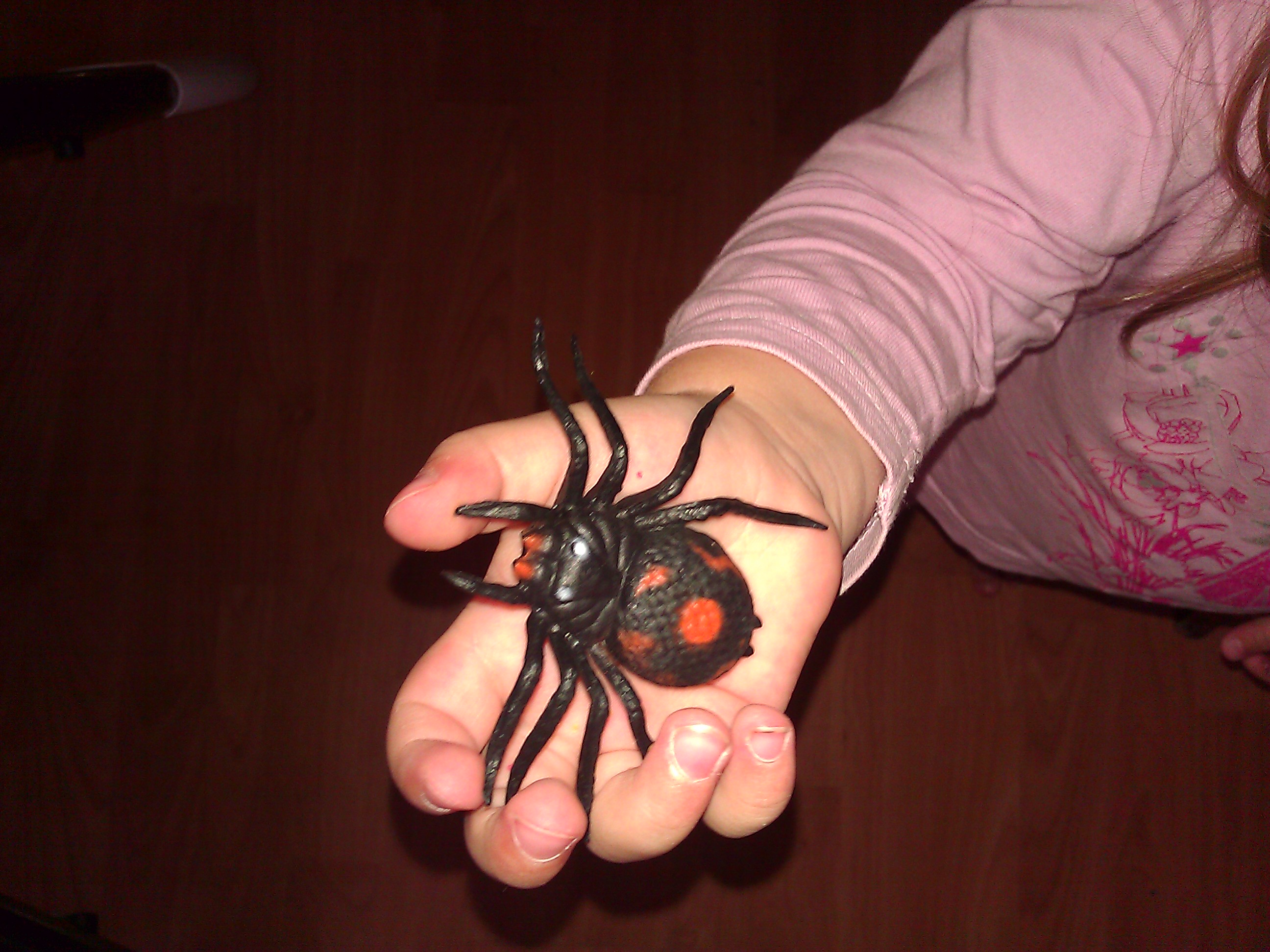
My 2 year old is just beginning to get the hang of rhyme and we often have fun at the dinner table making up rhymes for words. This morning at breakfast the girls found a plastic spider and I remembered a song that I used to sing with the children at nursery.

There’s a spider on the floor, on the floor
There’s a spider on the floor and it wasn’t there before
There’s a spider on the floor on the floor.

The children then choose where the spider should go next.  My 7 year old chose her head and rhymed it with bed.  This was a bit advanced for my 2 year old but she enjoyed choosing parts of the body – it was a great fun activity,  that they could both join in with at their own level and engaged them for about 10 minutes.  They liked it when I made up funny verses e.g. There’s a spider on my knee please don’t fall in my cup of tea.

Fun like this reminds me of the reasons I like to sit with the kids at mealtimes.

Leapfrog Maths Adventure to the Moon–A Review and the chance to win one of 3 copies.

Maths Adventure DVD 3DI wouldn’t recommend that you teach a child mathematical concepts via a DVD, however for all of us the electronic babysitter is at times a necessary evil .  If the kids are going to watch DVDs without me I’d like to know that it’s well made and entertaining and if it’s educational too that’s an added bonus.  Our kids watch DVDs in the car on long journeys, I think my husband may throw the Mr Men out of the window if he hears the music one more time, so a new addition to the collection is always welcome.

My 2 year old and 7 year old watched the DVD together, I didn’t expect the 7 year old to enjoy a DVD about counting but actually it has lots of levels and would appeal to a mixture of ages.  She managed to watch it till the end and  I even caught her joining in with the counting in 2’s, 5’s and 10’s.  The story revolves around  Tad and Lily ,a girl and a boy frog who are finding maths difficult and go on a journey to space where they see how maths can be applied in all kinds of contexts.MathsAdv1  It explores simple concepts like counting to 10, but also counting backwards, counting in 2’s 5’s and 10’s , following repeated patterns, sorting by shape, size and colour and simple addition. Many of these are introduced using a catchy song helping to engage the younger children.  My 2 year old has asked to watch it again after watching a few times so I think it will be popular with her.  I would say it is ideally suited to children aged between 2 and 6. It lasts around 40 minutes and there are additional features including 5 songs and a sorting game.

It is a good quality, entertaining DVD that I think children would enjoy for a number of years before growing out of it.  Don’t use it as a quick fix to teach your child maths, but if you want to use it to back up playful, active mathematical learning then I think it is a good choice.

This never before seen on television title is released on May 9th with an RRP. of £9.99. 

I have 3 copies of this DVD to give away.  To be in with a chance simply subscribe to my blog or post a comment on any of my posts before 9th May .  Winners will be chosen at random on that date.

Terms and conditions

Only available to UK residents.

Please supply a valid email address so that you can be contacted if you have won.

ThePrizeFinder – UK Competitions.

Loquax Competitions

Sesame Street on Kinect

Cookies_Are_Circular_

I know it’s a bit sad but I was very excited to hear this news.  Firstly, I am a huge fan of Sesame Street – my mum often attributed my intelligence to the fact that she watched Sesame Street whilst carrying me.  Secondly no more shouting ‘Get out of the way’ when my youngest tries to join in with Kinect games because this one will be aimed at her.  When we got our Kinect for Christmas I thought it would save all the arguments over controllers and my 2 year olds inability to handle them properly, but so far there hasn’t really been able to join in.  She has played bowling with some success and manages some of the games on Kinectimals but I do feel that she is a little young for these. So Hooray, finally a game aimed at pre-schoolers and with Sesame Street behind it I trust that it will be good.

I love that ‘Once Upon a Monster’ is aimed at families playing together – we often have 5 children trying to play ours and it can get a little manic.  The game is aimed at teaching young children about emotions like sensitivity, empathy and friendship that’s got to stop the arguments surely!

I can’t wait to see the finished product – I hope it lives up to my expectations.

http://www.wired.com/gamelife/2011/04/sesame-street-kinect-game/

My Thoughts on the Tickell Review of the Early Years Foundation Stage

I usually approach such reading with trepidation, however when Jonathan Douglas Chairman of the National Literacy Trust described it as ‘exhilarating’ my ears pricked up.

The Review recognises the success and popularity of the EYFS and that it will be some time before this will be fully embedded in practice.  It therefore does not recommend radical change, but maintaining  EYFS in its current form whilst  fine tuning certain aspects.  I’m sure this will be a relief to many who are only just getting to grips with the EYFS and dread being faced with even more change. The tone of the report feels very much as though Dame Tickell has listened to the many individuals and organisations involved in the consultation and shows a commitment to the importance of early education. The review supports learning through play, active learning, creativity and critical thinking as characteristics for effective teaching and  recommends  that the EYFS remains inclusive and mandatory.

There are a number of recommendations in the review including:-

  • A greater emphasis on parental partnership .  The EYFS should be more accessible to parents by making sure it is in plain English.  I also think this would really help with the wide range of people that use it and help to remove any ambiguity .  In addition an online interactive version of EYFS is recommended that would be accessible to parents.
  • A reduction of the Early Learning Goals from 69 to 17, with a simple scale defining the skills needed for emerging, expecting and exceeding each goal.  Anything that reduces targets has to be a good thing in my opinion and the examples of the simple scale are very clear.
  • A commitment to greater clarity on the level of paperwork required, alongside the suggestion that paperwork should be reduced.  This sits alongside the recommendation that Ofsted and the Local Authority work together to ensure that no unnecessary demands made.
  • There continues to be an emphasis on formative assessment based on observations of daily activities to illustrate children’s learning.  Summative assessment (the Foundation Stage Profile) will be significantly reduced and there is a call for stronger links between EYFS and KS1.
  • A call to investigate as a matter of urgency the suitability of a ratio of 1:30 in reception classes.
  • A commitment to recruiting a professional and highly qualified workforce including a review of Early Years training courses and a clear progressive structure for qualifications.  I just hope that this quality is maintained by providing financial incentives.
  • A recommended change to the areas of learning. This would create 3 Prime areas – Communication and Language, Personal, Social and Emotional and Physical and 4 further areas through which these will be applied. These would be Literacy, Maths, Expressive Arts and Design and Understanding the World.  I am undecided as to whether the separation of Communication and Language from Literacy will lead to a greater emphasis on speaking and listening or whether it will detract from the interdependence of reading, writing, speaking and listening.  I hope that there will be clear advice as to what early literacy is .  I am a little disheartened that literacy is defined in terms of reading and writing and that definitions have not been reframed for a new technological age.  I am also unsure about the change from Creativity to
  • Expressive Arts and Design.  I am certain that it has been changed to avoid ambiguity, but creativity encompasses so much more than art and design, that I would hope that this would be fostered in diverse ways.  It is good to see that technology has a specific mention in Understanding the World.
  • A review of children’s development at aged 2-2.5  sharing knowledge from all agencies.

The examples of good practice in the appendices make good reading and there are some thought provoking quotations interspersed throughout.  Reading the whole document takes some time, but is worthwhile.  If you didn’t want to read the whole review the summary of recommendations in Annex 2 will give an overview.

I watch with interest to see how policy makers will adopt these recommendations for the new EYFS.

The full consultation report can be viewed  here http://www.education.gov.uk/tickellreview

Can Technology Engage and Improve Boys Literacy?

How many times do you hear stories about boys falling behind girls in their literacy scores?  In the last 2 years the Foundation Stage Profile Results ( assessment at the end of the child’s first year in school) show that girls are outperforming boys and that Communication, Language and Literacy has the widest gap.

My opinion  is that to a large degree it is down to the fact that boys are not motivated by literacy, because it is not taught in a way that is relevant or interesting to them.  It is important that this is addressed at an early age, rather than once they have already lost interest and are failing.

Children are growing up in an increasingly technological world.  Think back to how much has changed in the last 10 years and we can not possibly imagine what life will be like for our youngest children by the time they leave school.  There is no doubt that children’s experience of literacy in the future will be very different to the pen, paper and print concepts they learn about today.  

 Children’s experiences with technology in the home are generally incompatible with  what they see at pre-school or nursery.  In my experience, having visited many nurseries, technology is generally used in a piecemeal way.  If  I compare this to my children’s  experiences at home it is vastly different.  At home my children play on games consoles, operate the television by remote control, talk to family via video chat, watch cartoons on the laptop or mobile phone, take photos and videos using a mobile phone, record their voices onto a laptop or mp3 player, draw pictures on a drawing tablet, play games on a mobile phone, search the internet for information and much more. The richness of their home experiences are not reflected in their learning at pre-school.

Often this is based on fear, an uncertainty about introducing children to technology (especially screen based) because it will lead children to become lazy and replace more healthy, active or outdoor pursuits.  I recognise those fears; none of us want our children to grow up as screen junkies or for technology to replace important things like reading to your child.  However, I would argue that as technology is evolving, it is becoming more accessible to pre-school children and the opportunity to use it in innovative ways in a play based setting presents itself.  Technology is an ever growing part of their lives and it is important that it is utilised as a natural part of children’s play in pre-school settings.

Boys generally love anything technological and lack interest in reading and writing – this is a generalisation but on the whole it is the case.  I hear people ask all the time ‘ how can I get my son off the computer?’  So maybe instead of trying to ban the things they are interested in we should be using it to our advantage.  I was told a story just a few days ago about how a boy aged 11 who could never understand how anyone could choose reading or writing as a pastime and had joined a computer club at school.  The teachers had shown them how to create animations and story boards.  Following this he has gone away and invented characters, writing comic books and animated stories with such enthusiasm that he couldn’t get to the club quickly enough. 

If we can encourage this enthusiasm at pre-school, maybe we could avoid many of the negative feelings that boys have around literacy and inspire them to be literate in a different way.

This premise forms the basis of my proposal for Phd research ( subject to finding the necessary funding). The hypothesis is that if boys were given opportunities to learn the foundations of literacy through technology, then they would be motivated to learn and this would in turn improve their literacy outcomes.  I would  create a play based environment whereby children could explore the underpinning skills of literacy, through the medium of technology.  This would occur alongside more traditional activities to see whether the technological experiences were more engaging. Technology would be integrated into ongoing practices of teaching and learning.  Each classroom would be designed around the needs and interests of the children. Technology would be freely available and would be used both indoors and outdoors.  I would hope that it would also inform those who create technology, software and applications highlighting possible future developments.  To work together to provide suitable experiences for our youngest children that would reframe  long held notions of literacy.

World Poetry Day – Musings on Poetry and Some to Share

V__CA20

There has been a lot of discussion in recent weeks amongst mummy bloggers  as to whether or not we would be prepared to share poetry that we had written as teenagers.  The general concensus was ‘no way, it is far too personal and embarrassing’.  When I joined the discussion, I had just found my book of poetry from my teenage years and started to read it.  I agree that much of it is very naive, about love and loss of love and the desperate nature of teenage romances.  However, some of it is about other issues.  It shows the common beliefs that you hold when you are young , a sense of injustice and the hope that you will change the world some day.    I wrote lots of poetry as a teenager , helping to frame my thoughts and work through issues.  As an adult I write them less frequently, usually when I am unhappy and still find it therapeutic.

I’ve decided to be brave and share a poem that I wrote when I was 16 years old – this was written in the mid/late 80’s when there was lots of scaremongering about nuclear war – remember the dramas about what would happen if a nuclear bomb exploded? It’s unedited and uses the punctuation that I chose when writing it.

The End of the World

Screeching! Wailing! Shouting! Screaming!

People run to take cover where they cannot be saved.

Heart jumping, legs quaking, head  pounding,

I watch the sky for the beginning of my fate.

Then it comes, with no noise, people silent,

As we watch the air explode into smoke

See the world turning purple, red and yellow,

I feel sick, on my tears I could choke.


Bring my hands to my eyes and bury my head

To protect me from the great blinding light.

What’s happening? Help me! I can’t see!

Am I dead? Is this Heaven? Help me out!

Crumbling world all around me, dying people

But it’s all brought about by greedy men.

It’s the innocent , God fairing children

That are punished and have said their last Amen.


In my last few moments I remember a land

Full of green, much love and content.

See the earth slip away – not just my life

But a place, far too late to repent.

Dust fills my lungs and I crumble to the ground,

And though I am weak and my brain is concussed,

I still know how appropriate those funeral words are

of Ashes to Ashes and Dust to Dust.


I asked my 6 year old daughter to write something for me to share on my blog.  She loves poetry and often chooses a book of poetry as her bedtime story.  My husband taught her to recite ‘ Custard the Dragon’ by Ogden Nash, it was lovely to watch them doing this together and I’m sure it has helped with her expressive reading .  She used to add in her own bit when Custard cried for his nice safe cage – she would add in a deep ,whiny voice ‘Boo-hoo I want a safe cage’.  I think my 2 year old will follow in her footsteps.  She often chooses singing books at bedtime which include a mixture of song and rhyme.  Learning poetry by heart is such a valuable skill for young children.  It covers so many things that are important for becoming competent readers, awareness of rhythm and rhyme, use of alliteration, memory and the use of expression to convey meaning.  And of course it is fun.

Here are my daughter’s poems

Elephant

Elephant, Elephant

Wrinkly and Grey

I’m going home in case you

Step on me on the way.

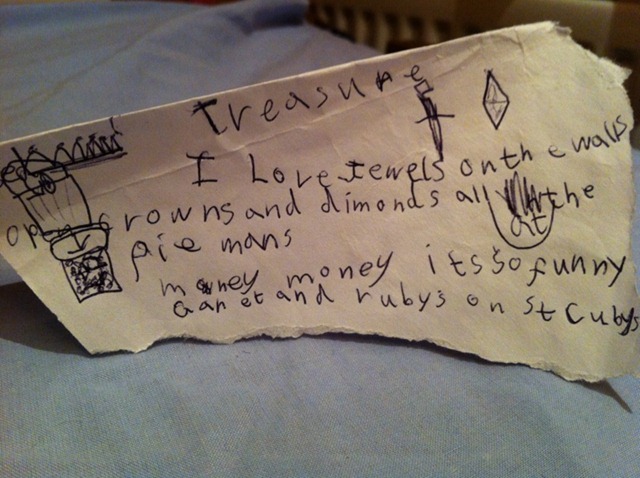
Treasures

I love jewels on the walls

Crowns and diamonds all at the piemans

Money, money it’s so funny

Garnets and rubies at St Cuby’s

Someone to Watch Over Me – Childhood Risks

I’m so pleased that my eldest (almost 7) has finally started to play in the street with her friends.  It is well known that if you ask adults about the most memorable and enjoyable times from their childhood they will almost always involve being out of doors, with friends and with no adults around.  I can’t remember a time when I didn’t play out in the street, I certainly have clear memories of being 3 years old and doing so.  When we moved from the city to a cul-de-sac before we had children, I hoped that we would find somewhere that our children could play in relative safety from traffic.

This has come at an opportune moment as I have just finished reading ‘Beware Dangerism’ by Gever Tulley, which discusses the irrational fears that we have about our children’s safety and how this makes them less able to deal with risks and challenges.  Gever runs a school called Tinkering School which encourages children to build and take things apart using real tools.  This reminded me of photographs that a colleague of mine shared on her return from visiting forest schools in Denmark.  I saw pictures of under 5’s using sharp knives with great skill to whittle sticks.  She talked of how one of the schools had been on the coast and the children were sent off without adult supervision onto the beach, with the only rule that they were to go no further than the edge of the water.  They were called back hours later by a bell.  This approach reminds me of the hours that I used to spend in the woods near our house as a child.  We used to often pretend we had run away – the idea of being independent was always a thrill I’m sure that I am often looked upon as a bad mother.  On holiday last summer another parent looked horrified as my 18 month old stood waiting to go down a big slide.  I watched as her child looked worried about going down the smaller one and an adult stayed carefully by her side.  I looked at the other parent and said ‘She’ll be fine , she does it all the time with her sister’ as she launched herself down the slide smiling and laughing.  I often see parents holding their children on reins as they attempt to climb in playgrounds, as if they are afraid to let them try anything on their own.  I once had an argument with a lady in a charity shop because I was letting my daughter touch china pots whilst I was next to her supervising.  The lady very crossly asked her to stop and I asked her how my child was expected to learn to be careful with things if she wasn’t allowed to touch them under adult supervision.  I want my children to try things with confidence and not to grow up cautious and timid, I never underestimate what they can do as long as they have clear safety  rules.

Lenore Skenazy has a great blog  that talks about kids and risk taking many daft restrictions on children