Category Archives: families

Autism Awareness Month: Parenting a Child on the Autistic Spectrum # Story 3: The Wilkins Family–A Step Parent’s Story.

188974_210144349012735_4390559_nThe Wilkins family; Kirsty, Mark and Connor(4). Kirsty separated from Connor’s father when he was small. Kirsty and Mark lived in Local Authority housing and were expecting a child together. Connor received a diagnosis of autism at the age of 3 years 2 months. A home tutor visited the home for 2 sessions per week focusing largely on behaviour and communication.  Connor attended full time nursery in a specialist nursery school with a support worker.

Causes of Stress

Kirsty had no experience of parenting a child without ASD thus it was difficult to say whether or not it was more or less stressful.  Parenting any child was difficult but when she compared him to other children his behaviour was better.

“I wouldn’t change him for the world, it (autism) is part of him, part of his characteristics.”

The only aspect that she found more difficult than parenting a ‘normal’ child is that he required more supervision because he had no sense of danger.

1. Communication/Understanding

The majority of Connor’s difficult behaviours stemmed from communication problems. Connor understood simple sentences and commands and spoke in short phrases, though some of it was difficult to understand. Kirsty found it frustrating that he didn’t understand what she was saying and that she couldn’t always understand him. His language improved since attending nursery full time and having input from speech therapists, a play worker and tutor but Kirsty still found it difficult.

Connor’s lack of understanding meant he would do things that were not allowed but had no concept of why it was wrong.  He would take food from the fridge just before mealtimes or play with the toilet and bathroom products.

They couldn’t ask him what he was doing because he was unable to answer; they had to go into the room to check what he was doing.

“With a ‘normal’ child you can say don’t touch that and they will say ‘why?’. With Connor you say it is hot and he has to touch it to find out what hot means”

As Connor’s understanding improved and he was able to ask for things he became a much happier child and therefore family stress reduced.

2. Disobedience

Mark didn’t find Connor’s behaviour stressful, but the effect that this had on Kirsty was.   Kirsty felt that there were a number of behaviours that Connor only displayed for her,

“He is like any kid, he will play up for his mum”.

This included running away and when Kirsty said ‘no’ to him he treated it as a game,

“Sometimes I feel like I am always yelling at him, I know it’s not his fault but then I feel stressed because I feel guilty for yelling at him….it’s a no win situation”.

Kirsty also acknowledged that if Connor started the day badly this affected her stress levels all day. If she began the day badly, small things caused her stress that wouldn’t usually.

Mark and Kirsty felt that Kirsty’s family had a tendency to give in to Connor and allowed him to do things that they wouldn’t normally allow. They feel that because of this it was difficult to set boundaries for his behaviour.

3. Going to Public Places

Going anywhere outside of the house was particularly stressful for Kirsty. She didn’t drive and anytime she walked Connor anywhere he would run away and has no road sense.  Kirsty avoided going places on her own. Kirsty’s mum would take Connor out because she had a car and often had Kirsty’s sister to help.  His behaviour improved, he stopped wearing reins and would walk around shops without running. The difficulty for Kirsty was getting him to the shops in the first instance.

4. Concerns about the New Baby

Kirsty worried that when the new baby was born Connor would regress. He liked to imitate babies and animals therefore the family worried that he would want to wear nappies or have a dummy like the baby. The family prepared him for the baby by talking to him, involving Connor in shopping for the baby and decorating the baby’s room. Nursery,his tutor and play worker also encouraged  imaginative play using baby dolls.

Coping Strategies and Support
1. Support from Professionals

Kirsty felt that all professionals were extremely supportive. Since Connor attended full time nursery his understanding and behaviour improved significantly. He developed many good habits such as eating different foods and sitting still for a period of time. Having a tutor and play worker come to the home  helped Connor to cope with new people. In the past he was frightened of people outside of the family but he became more sociable. Kirsty also found the tutor valuable as a source of information. Mark felt that if Connor continued to progress at the same rate as he had in the last 6 months then they would not have any significant worries about his future.

2. Support from Parents

Kirsty felt able to turn to her mum for advice and as a primary school teacher she often had useful strategies. Kirsty’s mother looked after Connor overnight every Wednesday; this gave Kirsty a regular break, which she found particularly helpful.

A Wish List for the Future

Kirsty and Mark couldn’t recommend any further/ different support as they valued all the help they got from professionals. The only thing that might help slightly would be for Kirsty to be on her own less so that when she was feeling stressed she could take a few minutes to calm down without being in the heat of the situation.

Story 2 is a Single Parent’s Perspective and Story 1 Taking Time off Work

Disclaimer: all names are pseudonyms.

Autism Awareness Month: Parenting a Child on the Autistic Spectrum # Story 2 : The Simpson Family–A Single Parent’s Perspective

autism awareness monthThe Simpson family are Leanne, Chloe (age 6) and Robert (age 3). Leanne separated from the children’s father before Robert was born. Robert received a diagnosis of autism when he was 2 years 4 months. The main concerns at this time were communication and social interaction. Leanne also felt that she needed a lot of information because she knew very little about autism. Robert attended pre-school for 5 mornings per week supported by a tutor, a tutor also visited at home.

Causes of Stress

Leanne felt that parenting a child with ASD wasn’t significantly more stressful than parenting any other child but different things caused her stress. The knowledge that he would always be autistic in particular changed the way she thought about things.  Once she knew that he was autistic she felt unable to allow him to be content to do his own thing, there was pressure  to ‘get him to do things’ so that he would reach his full potential’.

  1. Smearing

Robert as a very tactile child  often sought sensory stimulation, including tickling, walking on bricks and exploring paint, water and sand with his hands. Often, when he had dirtied his nappy he would play with the contents and smear it over the room. This usually only occurred when he was on his own. At night Robert wore an all in one pyjama suit with the fastenings sewn together so that he couldn’t  get his hands in his nappy. This worked well,  and Robert stopped smearing every night. Leanne felt that bathing him after an incident was offering him a reward because he enjoyed baths. Leanne avoided  this and instead made minimal fuss and put Robert in the shower (which he disliked).

The most stressful aspect of this behaviour was that it had to be dealt with alone. Leanne felt that school would help with other things, like communication but this was primarily a home problem.

2. Communication

On the whole the most stressful aspect of parenting a child with ASD was communication.

“Smearing is the most stressful thing day by day but communication is the most stressful thing on the whole”

Robert’s inability to communicate was less stressful than his inability to understand. It was often possible to guess what Robert wanted or offer alternatives.

Robert’s communication improved significantly since his home tutor first became involved. Initially Robert’s only form of communication was to push Leanne towards desired objects.   A picture exchange system (PECS) was introduced to enable Robert to exchange a picture for a desired object. Initially this was very difficult for Robert to grasp and although he was able to pass one card to an adult he could not make a choice between 2 or more. Eventually Leanne discovered that he was interested in fridge magnets, the pictures were mounted on magnetic strips and placed on the fridge. Desired objects were placed out of Robert’s reach and each time he would reach for something Leanne would ask ‘What does Robert want?’ whilst signalling to the pictures. Robert quickly learned to pass the correct picture spontaneously. Robert developed a wide range of vocal sounds and used some words in context including ‘go’ and ‘again’.

3. Going to Public Places

There were 2 difficulties when taking Robert to public places: –

  1. Throwing himself on the floor and refusing to walk .
  2. Grabbing things from shop shelves.

Robert had a large pushchair that was generally used when Robert went out. This enabled Leanne to visit a variety of places that would not otherwise be possible. However, Leanne was anxious that as he got older it would be less appropriate to take him out in a pushchair. When Robert was expected to walk even short distances (e.g. from the car to his sister’s school) he would drop to the floor and refuse to move. Leanne’s main strategy for dealing with this was to walk away and wave good-bye, Robert usually responded by following. When this didn’t work Leanne tried to make it into a game. Robert enjoyed playing ready, steady go games and running on the word ‘go’. The game was used to encourage him to walk.

4. Impact on Siblings

Chloe was old enough to be aware that Robert was autistic but Leanne found  it difficult to explain things to her in a comprehensive manner,

“Only the other day she said ‘if I was autistic Robert wouldn’t be’, which is quite hard.”

As a single parent it was also difficult to go to places that Chloe would like to visit. Leanne found it difficult to cater for both of their needs.

5. Diagnosis

The diagnostic process in itself was not stressful but Leanne felt that her health visitor/doctor did not prepare her for a diagnosis of autism,

“When they were asking me questions that I know now was to do with autism, nobody mentioned to me at all; it could be this, which meant that when I did go to the paediatrician and they said it probably was autism it shocked me”.

Leanne would have liked to have been prepared for the possibility so that she could have found more information.

6. Nursery and Schooling

Finding the right nursery place for Robert was stressful for Leanne. Robert was offered a place at a specialist nursery from September but in the meantime Leanne felt it would be valuable to attend a local pre-school to see how he would interact with other children. Many of the pre-schools she visited didn’t feel right, as it seemed they had no experience of autism and were less than enthusiastic about taking him. On the contrary Hawthorn’s pre-school had experience of autism and appeared very flexible in their approach.

After a few weeks at the pre-school Leanne became worried because nursery workers gave comments that they were unhappy about Robert attending without a support worker,

“Hawthorn’s was a complete nightmare that really did stress me out…knowing what I do now I wouldn’t have put him in that school”.

With time and negotiation Leanne felt more comfortable about Hawthorn’s but feels that it was an unnecessary burden.

Leanne was also worried about choosing the right school for Robert; she felt that ultimately it was her decision but that it was a huge weight on her shoulders,

“If you get the right school and the right help then wherever he goes in life that will help him get to the highest potential, because that will be the majority of his learning.”

Coping Strategies and Support

1. Professional Support and Information

The Support Leanne had from professionals was particularly valuable, the most notable of these being his home tutor and the Early Bird course. These helped share information about autism and suggested strategies for dealing with problem behaviour.

Leanne had a particularly good experience with her Early Bird group. The group of parent’s bonded particularly well and they continued to support one another and meet socially both with and without their children.

The most important contribution from the home tutor was the introduction of PECS. Leanne felt that she needed to be taught from scratch how to communicate with Robert and the regular contact with the tutor helped. They also helped Leanne to see what Robert was capable of,

“Before I used to say he is never going to do that, it’s taught me not to think that way”

Having someone to talk to on a regular basis, particularly someone with knowledge of autism and experience with other children was invaluable. The flexibility of the early intervention programme and informal relationship with the tutor meant that there was no pressure,

“You feel like you aren’t on your own”.

2. Support from Friends

Leanne’s close friend Helen had a child slightly older than Robert who was also autistic. They spent a lot of time together both with and without the children. Leanne often telephoned Helen when she was having a particularly stressful time. Helen had first hand experience of autism and the practical advice she gave was refreshing,

“I don’t want to hear ‘aah’, I want to hear ‘yes I’ve been through that as well’ ”.

A Wish List for the Future

Leanne would like to continue having someone help her develop strategies for dealing with Robert’s behaviour.

If Leanne could have any additional help the most useful thing would be to have a regular break.  Someone looking after the children for one night per week would give Leanne something to look forward to.  It would be important that she could trust the person caring for her children, being sure they were safe would help her relax.  Leanne felt  support of this kind was lacking, her parent’s would baby-sit but never have the children overnight.

“ If you don’t have anything to look forward to it is a constant thing. If you’re having a bad week, which you do, and your child’s having a bad week as well you can see no end to it.”

As a single parent this is particularly important. Single parents are more likely to require  respite care and support from other families.

Story 1 : Taking Time off Work Story 3: The Step Parent’s Perspective

Disclaimer: all names are pseudonyms.
8 Things a Child Can Learn From Playing Golf.

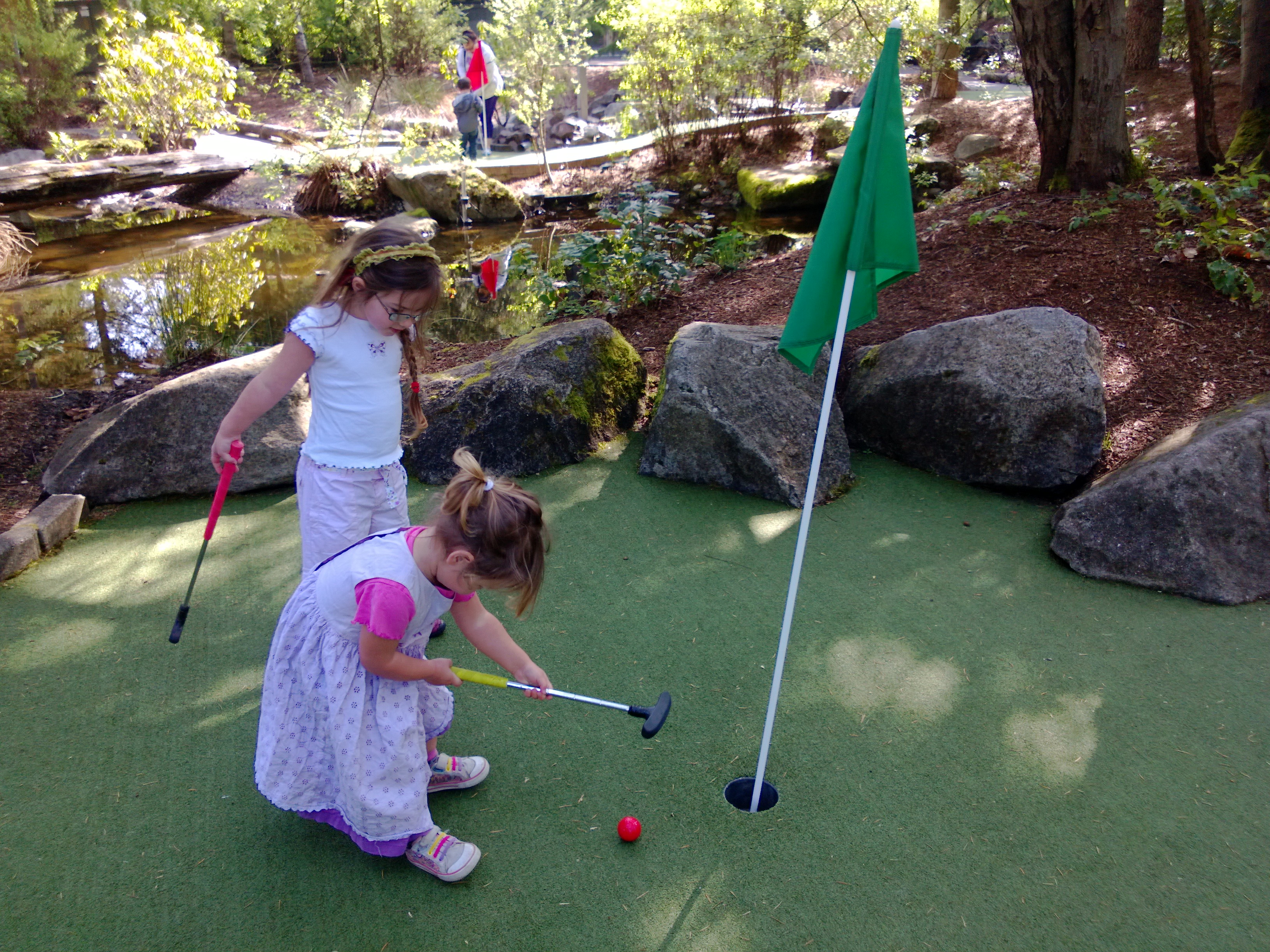
willows run put put courseToday I met with a group of mums and their toddlers to play golf at the pitch and put, Willows Road Golf Course. All of the children were new to golf and most of the children were below the age of 2.  My girls had a brilliant time – my 4-year-old even asked if she could come back tomorrow.

Before 11am under 12’s can play the 18 hole pitch and put for $5. The beautiful setting meant that my 2-year-old, who lost interest after a few holes had plenty to keep her occupied.

There were lots of opportunities for learning too:

  • Number recognition as we moved around the holes
  • Recognising colours – who has the red ball? What colour flag do we have this time?
  • Reading signs – Please rake your footprints, keep on the path.
  • Gross motor skills – how do you hold the club? You need to hit it hard to get it up hill.  What is the best way to get it in the hole?
  • Counting – how many shots did you take that time?
  • Writing – filling out a score card.
  • Vocabulary – What is the stick called again? I’m in the bunker.
  • Turn- taking and awareness of others.

We’ll definitely be doing it again, a great way to spend a sunny morning.

A Musical Family Christmas with Jingle Bells Music Book

mfk100089My idea of the perfect family Christmas is a little clichéd but involves mince pies, mulled wine, a roaring fire and singing around the piano. This is becoming a reality in our house.  With an array of instruments including piano, guitar, clarinet and saxophone and a whole family who enjoy singing and music, we are loving making and recording music together. When I was asked if I would like to review Jingle Bells, from music-for-kids, I thought it would be a good chance to add Christmas songs to our repertoire.

The Jingle Bells book and CD features 18 well-known Christmas carols and songs. The book is nicely presented with each song displaying the notes of the melody plus chords written along the top.  There is also a handy chord chart at the back of  the book for both guitar and ukulele. Being a beginner, I photocopied the chord sheet to make it easier to reference while I was playing guitar. With my basic guitar skill, I found that there were a few too many chord changes to play many of the tunes with confidence but with most songs you could leave some of the chords out.

The piano music is basic (right hand melody and chords) and was great for my 8-year-old to practice sight-reading and play a simple tune . The chords could be added by a more experienced pianist to play accompaniment, I even managed to sing along to my own rudimentary playing during silent night.

The CD contains all the songs in the song book and is a nicely sung collection of Christmas carols. Younger children may find the keys too high.

mfk100089_lb02_iMy little ones enjoyed filling out the sticker pages and singing along to Jingle Bells while their sister played the recorder.  I was disappointed that there weren’t more songs for the little ones like ‘Rudolph the Red Nosed Reindeer’, ‘When Santa got Stuck up the Chimney’ or ‘Away in a Manger’.  They joined in with Jingle bells and We Wish you a Merry Christmas and there are a few other simple melodies that they could learn but I would have liked to have seen more simple songs that weren’t carols.

If you are looking for a simple book and CD of traditional Christmas Carols, at £7.95 this is excellent value.


No payment was a received for this review, a copy of  the material was received for review purposes.

Proposed Changes for UK Childcare – For Better or Worse?

This week a BBC article Ministers’ Plan Childcare Change   outlined the UK governments proposals for reducing the cost of childcare.

Alongside making some provision tax deductible, other proposals include

  • increasing the number of children a childminder can care for.
  •  improving their qualification level in a bid to maintain quality.

It seems however, that there are a number of flaws in their thinking.

‘Ms Truss has pushed for reform to regulations imposed on child minders to
increase the number of child minding places. If more places can be provided for
parents, then the Conservatives believe prices might start to come down.’

Yet in a later paragraph:

‘Downing Street sources said Liberal Democrat and Conservative figures alike were
now convinced that looser ratios mean nurseries can take more children on which
could see staff paid more, and so greater quality staff attracted.’

I’m not sure that increased wages for early years workers and a lower cost to parents can be achieved without a significant investment of government funds.

It seems to me that the government believe that by increasing the number of children childminders can care for, they will attract more people to the profession, as they will be able to earn more.  However they are also proposing changes to the qualifications needed to become a childminder in a bid to maintain quality.

In my experience of working with childminders, this is what I think will happen. A proportion of very good childminders will be scared off by the thought of having to achieve yet another qualification, losing many of our oldest and most experienced childminders. Those that stay may take on extra children but once they are better qualified and have factored in the added expense of having more children (e.g. equipment, larger car) and the additional challenges of caring for a large number of children under 5, they are likely to quite rightly increase rather than decrease their hourly rate. Some childminders will decide that their quality depends on taking fewer children, therefore not achieving the desired increase in childcare places.  Some will be attracted to the industry I’m sure but how attractive really is looking after 5 children under the age of 5 on your own?

In my opinion these proposals reduce parental choice.  I like many women chose to send my children, in their first years, to a childminder.  I chose this for my children because I felt a home environment where my children could experience many of the things they did with mummy, would be the easiest transition.  I also chose a childminder because they could play with a few other children but have the individual, loving attention they needed from one adult.  My children love their childminder in the way they would an aunt or a close friend of the family. I’m worried that this would be lost once the number of children is raised significantly above the size of the average family.

My mother was a childminder when I was growing up. The children she cared for (never more than 2 at a time) became an extension to our family, they called her ‘aunty’.  Childminders these days take on far more children in a bid to fulfil demand for places and to earn a decent wage, if the ratio is increased again will there be any  ‘aunties’ left? Please UK government don’t take away parental choice.

These are my thoughts, what are yours?

Sign the petition to avoid changes to childcare ratios.

Christmas at Butlins

butlins christmas

This Christmas we decided to take a break from our traditional way of doing things.  We visited Butlins Minehead Resort courtesy of the Butlins Mums Ambassador Programme. We usually spend Christmas at home, but I can thoroughly recommend a Christmas Butlins break for taking the hassle out of Christmas and spending quality time with your family. We did many things on the break that are not unique to Christmas, these will feature in a later post.  This is our diary of the special things that are available on a Christmas Butlins break.

23rd December

We checked in at our Gold apartment and were immediately greeted by some lovely added touches.  The dining table was laid with a Christmas cloth, wine glasses, crackers and a bottle of bubbly and when the children checked out their bedrooms they found a lovely little gift each on their bed.

snowman
(Not pictured on a Butlins bed)

We then headed to the Yacht Club for dinner.  The children were given Christmas cookies on arrival while we were allocated our table (guests keep the same table for the duration of their break). The dining experience was a real highlight of the break.  Not only did I not have to cook but the quality, quantity and choice of food was excellent.  Food and drink were on a self-serve basis and the children enjoyed coming to make their own choice of food and using the machines to get drinks. The meals ranged from 3 -5 courses and included a bottle wine . Our meet and greet host Mark also deserves a special mention for his exuberance and energy and for going out of his way to make sure we were happy. The children loved his illuminated tickling stick.

Christmas Eve

Butlins had a special visit from 2 of Santa’s reindeer and we visited them in the morning.

reindeer

The girls and I spent the afternoon in the Skyline Pavilion. We watched the puppet show and danced with Angelina Ballerina but the highlight  was Bjorn the Polar Bear. This amazing animatronic polar bear was so responsive and lifelike that the children were captivated.

One girl was chosen to be the first to interact with Bjorn and when she called his name he turned and walked towards her.  All the children had a chance to hold their hand out for Bjorn to move towards them to be stroked and as a finale he rose onto his hind legs when the audience clapped and made a noise like a seal.

The snow globe looked like great fun with its simulated snowstorm, character photo shoots  were scheduled here during the day. Unfortunately, by the time we considered going in (on Tuesday) it had lost some of its juice and the snow wasn’t falling and blowing properly so we decided to give it a miss. Next time I’ll make sure we get in early.

During the afternoon the housekeeping staff visited with a bag each containing a carrot for the reindeer and a mince pie for Father Christmas.

The girls filled out their letters to Santa included in the welcome pack. We intended to post them on our way to Father Christmas but by this point the post box had closed and we were too late.  I believe had we been on time the girls would have received a personalised letter from Father Christmas.

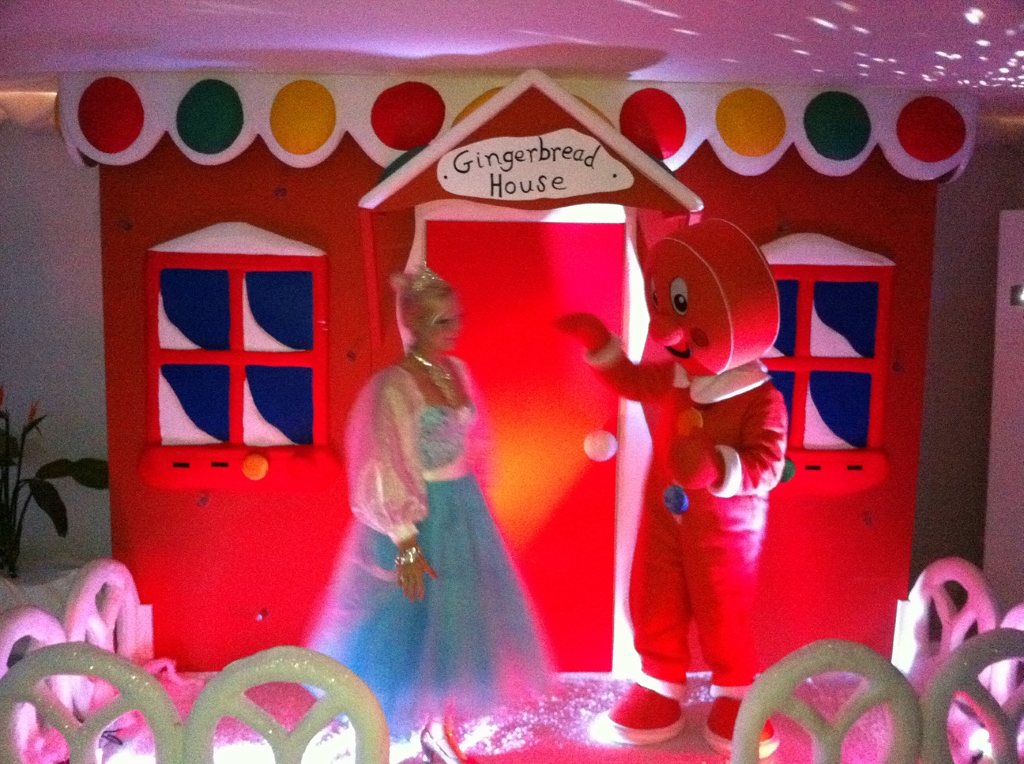
We had a pre-booked time slot to visit Father Christmas in his Enchanted Forest. The children loved being met by the Gingerbread Man and a fairy as we entered the  Forest and each had a good quality gift from Father Christmas (this incurred no extra charge).

On the way to dinner we caught the end of the firework display and my 3 year old who is afraid of fireworks was very brave.

After dinner  we headed to Reds for a few drinks, and to catch the Take That tribute band.  This was followed by an Adele tribute and Beatles tribute, but these were a little late for our kids.

When back in the apartment the girls hung their stockings on the tree ( we took a small table top Christmas tree with us) and put out the carrots and mince pies along with Santa’s magic key (Butlins apartments don’t have chimneys).

All of the Butlins staff went out of their way to help during our stay, this included the security man who helped carry presents to our chalet at 4am. As a minor suggestion if you are considering a Christmas break at Butlins, leave some of the presents at home. The time and space it took to load, unload and unwrap all the presents was a little overwhelming!

Christmas Day

The girls woke up very excited that Father Christmas had visited Butlins. Remarkably, we managed to get the girls to breakfast before opening any presents. On opening the door they found this note from the man himself.

The morning was taken up opening presents and we headed for Christmas dinner during the mid afternoon. Today the little table in the entrance was laden with chocolates, fruit and nuts and a glass of Bucks Fizz for the grown ups.  Our places were adorned with crackers, chocolates, a box of party poppers, rocket balloons and streamers, a bottle of fizz (yay!) and a little wrapped present for the baby.  We unwrapped it to find a Billy Bear bowl – very useful as I had been feeding her snacks from a china bowl in the apartment up until this point.

christmas dinner

The meet and greet staff soon arrived with children’s crackers and Billy Bear cups for each of the children. A traditional 5 course Christmas Dinner left us all suitably satisfied, before heading back to the apartment for my Christmas Dr Who fix.

In addition to regular Christmas television, the Butlins television channel showed the Redcoats favourite Christmas movies, this helped to keep the children amused.

Boxing Day

Today was our pre-booked time slot for the pantomime Aladdin. This was great fun and the girls really enjoyed it. It wasn’t too long and included plenty of catchy songs.

We spent the afternoon at the funfair before coming into the warm for coffee and hot chocolate while the girls enjoyed softplay.

carousel

For the evening entertainment we made our way to Reds for a Robbie Williams and Girls Aloud tribute and a bit of a boogie. The girls had made friends with some of the children we met at the restaurant and stayed up late dancing and playing with them.

27th December

Time to check out and say goodbye.  I can highly recommend a Christmas break at Butlins. It was great to focus on the children at Christmas rather than visiting and entertaining. I would love to do it again with a large family gathering …. I wonder if I can persuade my family to book for next year?

  • This Christmas break was in Gold Standard accommodation with the Premium Dining package (Dinner, Bed and Breakfast) at Minehead Resort.
  • At the time of visiting my children were aged 7,3 and 1.

Butlins and Happiness – New Online Resource for Families

Ahead of the Government publishing its own report on the state of the nation’s happiness next year, family holiday firm Butlins has launched its own barometer of harmony at home with a study of more than 3000 parents and children.

And while the majority of families in the UK describe themselves as happy and not allowing economic gloom to get in the way of their fun, both parents and kids just wish they could spend more time together. Parents say the need to work longer hours is getting in the way but children would rather forgo extra pocket money to get an extra hour with mum and dad. Interestingly the survey found that the biggest barrier to children’s happiness is spending enough time with their parents.  This reflects my daughter’s comments in a piece of work she wrote about herself.  When asked what made her happy, she wrote

Spending time on my own with mum or dad.

Parents admit that on average they spend just 68 minutes a day with their children, adding up to just 44 weeks in total before a child reaches adulthood.

This doesn’t reflect my own family situation, as a stay at home mum I probably spend too much time with my children for my own sanity.  My husband on the other hand works long hours and at some considerable distance from home so our time as a whole family is very precious.

Now Butlins has appointed its first Director of Happiness to help families overcome obstacles to “together time”. ‘Director of Happiness’ for Butlins, now that has to be added to my list of dream jobs.  Mark Hunter – one of the UK’s only Positive Psychologists – will advise the company on initiatives to help add extra sparkle to family life, starting with a new online resource for parents.

I checked out the happiness resource.  It is made up of 3 main sections:

  1. Financial tips from Family Budgeting Expert – Dan Plant
  2. Tips on looking great  in less time from Beauty and Make Up Expert Sarah Jaggar
  3. My personal favourite – tips from Life Coach Emma Ranson Bellamy  on balancing work and family time

The Key is about spending quality time as a family and Emma has some useful tools to help you reflect on the quality of your family time and some suggestions to make it more fulfilling below are a small sample.

  • Gain perspective: Make a list of the things that are important to you – everything from your children or partner to your car or phone. Then next to each thing write M for material or R for relationship. Then consider losing something from each list; how do you feel? Would losing things from the M list be a real inconvenience? But what about list R? How does losing these things feel? Make a plan to invest your best self in the relationships that are important to you.
  • Make a time capsule: Create a memory record for all the family to treasure in years to come. Your capsule might include family pictures and introductions to you all –  perhaps filmed and saved onto a CD; a newspaper from the day you put your treasure together; biographies of each family member with inside information on your favourite hobbies and TV programmes.

Agree to open it up at regular intervals, i.e. every 7 years and then add to it. This could become your own family tradition for years to come which grows into a unique and very modern family tree.

  • Reflect and wind down: At the end of each day find a moment to re-connect with each other. It might be finding out what your child did in one of their lessons or planning an evening out with your husband or partner.
  • Make a wish list: At the start of a new school term, get together as a family and make a list of things you all want to do. Good planning means that anything is possible!

A Happy Days game providing you  with the chance to win a Butlins break is also featured.