Alongside making some provision tax deductible, other proposals include
increasing the number of children a childminder can care for.
improving their qualification level in a bid to maintain quality.
It seems however, that there are a number of flaws in their thinking.
‘Ms Truss has pushed for reform to regulations imposed on child minders to
increase the number of child minding places. If more places can be provided for
parents, then the Conservatives believe prices might start to come down.’
Yet in a later paragraph:
‘Downing Street sources said Liberal Democrat and Conservative figures alike were
now convinced that looser ratios mean nurseries can take more children on which
could see staff paid more, and so greater quality staff attracted.’
I’m not sure that increased wages for early years workers and a lower cost to parents can be achieved without a significant investment of government funds.
It seems to me that the government believe that by increasing the number of children childminders can care for, they will attract more people to the profession, as they will be able to earn more. However they are also proposing changes to the qualifications needed to become a childminder in a bid to maintain quality.
In my experience of working with childminders, this is what I think will happen. A proportion of very good childminders will be scared off by the thought of having to achieve yet another qualification, losing many of our oldest and most experienced childminders. Those that stay may take on extra children but once they are better qualified and have factored in the added expense of having more children (e.g. equipment, larger car) and the additional challenges of caring for a large number of children under 5, they are likely to quite rightly increase rather than decrease their hourly rate. Some childminders will decide that their quality depends on taking fewer children, therefore not achieving the desired increase in childcare places. Some will be attracted to the industry I’m sure but how attractive really is looking after 5 children under the age of 5 on your own?
In my opinion these proposals reduce parental choice. I like many women chose to send my children, in their first years, to a childminder. I chose this for my children because I felt a home environment where my children could experience many of the things they did with mummy, would be the easiest transition. I also chose a childminder because they could play with a few other children but have the individual, loving attention they needed from one adult. My children love their childminder in the way they would an aunt or a close friend of the family. I’m worried that this would be lost once the number of children is raised significantly above the size of the average family.
My mother was a childminder when I was growing up. The children she cared for (never more than 2 at a time) became an extension to our family, they called her ‘aunty’. Childminders these days take on far more children in a bid to fulfil demand for places and to earn a decent wage, if the ratio is increased again will there be any ‘aunties’ left? Please UK government don’t take away parental choice.
Many of us provide elaborate parties for children under the age of 5 and then find that they are happy just ‘playing’. I’ve adapted my parties over the years. I found that before the age of 3 my children were happy to have one or 2 friends visit to play games and eat cake. Even when they were a little older they mostly enjoyed a few crafts, games and dancing.
According to a recent study by I CAN the communication charity, my children are not unusual. In a survey of 1500 parents they found that the top 5 party pursuits for under-5’s were:-
Dancing games like Musical Chairs, Musical Statues and Musical Bumps
Party games like Pass the Parcel and Pin the Tail on the Donkey
Playing outdoors with other children
Eating party food
Singing and rhyming games like the Hokey Cokey and Row, Row, Row Your Boat
I CAN Communication Advisor, Kate Freeman said “The top five activities all involve communicating and socialising with their friends – from pass the parcel, which boosts turn-taking and listening skills to singing and rhyming games like the Hokey Cokey. This type of activity enhances children’s understanding of the structure and meaning of language – and there is no better environment for a child to develop their confidence than with a group of friends and adults in a relaxed and fun setting like a party”. Furthermore, mealtimes and snack times are a fantastic opportunity for young children to continue to develop communication skills.
Fun games to play at parties to develop children’s communication skills include:
Singing and rhyming songs – a great way to help children learn vocabulary and have fun making music together
Playing clapping games (Pat-a-Cake) – to help children to develop their coordination, control and movement as well as learning vocabulary and social skills
Word Games (Simon Says and I Spy) – to help to develop children’s vocabulary about the world around them and to listen to instructions (These games can be adapted to easier versions for younger children)
Turn taking games (Pass the Parcel) – to help children to learn when to talk and when to listen
Games like musical statues to encourage children to listen carefully. Listening skills can be developed further by saying ‘Stop’ in a quiet voice instead of pausing the music.
Imaginative play like toys’ tea parties help children to expand their language.
When I was teaching in nurseries we often used to play ‘ring games’ like ‘Farmers in the Den’ and ‘Hokey Cokey’ if we had bad weather and it was difficult for the children to play outside. They were always a firm favourite. The children also loved playing picnics or tea parties.
I CAN is inviting nurseries, pre-schools, childminders or community groups to take part in their annual fun and educational event . This year I CAN is partnering with Entertainment One to make its pre-school character Humf the brand ambassador. The 2013 Chatterbox Challenge:Mad Chatter’s Tea Party with Humf asks groups to organise sponsored tea parties where children can join in with popular songs and rhymes to develop their communication skills in an enjoyable way. I organised an event years ago with my pre-school music group. We learned new songs and the children were awarded stickers and certificates for their achievements.
The singing and rhyming activities for the 2013 Chatterbox Challenge: Mad Chatter’s Tea Party with Humf have been developed by I CAN speech and language therapists and teachers. Lesson plans, which include Humf and his friends in the activities and illustrations, link to key aspects of the new Early Years Foundation Stage including Communication and Language, Physical Development, and Personal, Social and Emotional Development. All the activities are aimed at supporting and developing children’s speech and language skills.
Being involved with the Chatterbox Challenge: Mad Chatter’s Tea Party with Humf encourages children to think about communication, whilst helping support those who find talking and understanding difficult.
Chatterbox Challenge week is 1st – 8th March 2013 and most groups will be holding their Tea Party with Humf during this week, though groups can actually take part at any time during 2013.
To register and get involved in this year’s Chatterbox Challenge:Mad Chatter’s Tea Party with Humf, go to www.chatterboxchallenge.org.uk
A few years ago I ran training sessions for early educators and parents on communication, language and literacy. Many of the resources we recommended, including the excellent dvd Chatter Matters, came from the Communication charity I CAN. One of the key messages of this training was that ‘reading and writing float on a sea of talk.’
Kate Freeman, I CAN Communication Advisor and experienced paediatric speech and language therapist says:
Given the right support, many children learn to talk without too much effort. There’s a golden age for learning to talk – this is before 5½ and so skills learnt at this age bring great benefits later on. Evidence has shown the early years to be a vital time for supporting all children’s communication, as well as a time to identify any difficulties and put support in place to improve a child’s overall life chances.
I was very excited to review I CAN’s latest resource Chatting with Children. This is a really nicely presented set of 30 cards with activities for promoting speaking and understanding for children aged 3-5. The activities are simple and require no specialist resources. Some are copying or guessing games of the kind we often play in the car, some require household objects and a couple that I played with my 4-year -old and 2-year-old used our musical instruments box . These games would be great for including in my music groups.
Each card has ideas for making the activity easier if your child is struggling or more challenging if it is too simple. The activities are equally suitable for large groups or one child. They are a great resource for families and could provide a wealth of ideas for small group times at pre-school. Many of the cards remind me of games I played with the autistic children I worked with, helping them extend their vocabulary and comprehension and categorise language. These cards would have been an invaluable resource for these families.
The cards focus on a number of skills, listening, developing vocabulary, social skills and understanding what is said. The games are varied and can be played for a few minutes or half an hour or more. My 4-year-old loved the listening games, playing hide and seek with our timer and listening carefully for the soft tick to help us find it and making sounds with household objects and guessing what they might be.
Chatting with Children is also available as part of a brand new boxset being launched this month by I CAN – the Early Talkers Boxset (£19.99). The boxset contains the original Babbling Babies and Toddler Talk as well as the new Chatting with Children, and has been created especially for parents and Early Years practitioners supporting babies, toddlers and young children in learning to talk.
The three packs between them, contain activities for children from birth to school age. I was so impressedthat I am going to order the box set for my brother to play with his one year old twins.
Chatting with Children is available in paperback for £7.99 paperback and hardback for £12.99 .
All proceeds go towards I CAN’s work with the 1.2 million children in the UK who have long-term speech, language and communication difficulties. To purchase Chatting with Children or the Early Talkers Boxset comprising all three activity card sets visit http://www.ican.org.uk .
This is not a sponsored post, a copy of chatting with children was received for review purposes
Kate’s Top Tips for Chatting with Children aged 3-5 years old
• Be quiet Take time to talk to each other in a quiet room. Turn off the TV and radio, and shut the door to block out any other background noises. Children have to learn to block out background noises, so they need a quiet environment to focus on the sounds they hear.
• Be face-to-face Help young children to see your face – make sure you’re at the same level as them. Sit or crouch opposite them as they play, or sit them on your lap. Sit opposite the child so you’re face-to-face with them. Being face-to-face means that the child can see you and your facial expressions. Also, you can see them and their responses and reactions to the games you play together or the conversations you are having.
• Don’t rush – take plenty of time Young children take longer than adults to process what they hear – sometimes up to 12 seconds. They need plenty of time to respond to you.
• Be patient Young children can easily lose interest in what you’re doing – this is perfectly normal, especially for 3-year-olds. Don’t worry – just stop the game that you’re playing together and try again another time.
• Be prepared for anything Follow the child’s lead and adapt the game or conversation to fit in with what they’re doing. This can help maintain attention on particular games.
• Ditch the dummy A dummy gets in the way of attempts to talk during conversations and games. Children of 3 and over don’t need to use a dummy.
• Use the language you naturally use at home It’s important that you speak naturally to young children; this helps develop their language skills.
• Enjoy it This is a special time together, so have fun playing, chatting and learning about each other.
There has been a common thread on early education forums recently about how best to share information with parents. Parents are the child’s first educators and most good early education settings will look for ways to share learning journeys with parents. There could be barriers; some busy parents want to rush away without spending time conversing, other families are hard to reach, English is not their first language or they may feel uncomfortable about talking to teachers but it is important to understand a child’s home background and to support learning at home.
Put yourself for one moment in the shoes of a parent who drops their child to your setting at the start of the day and won’t see them again until it is almost bedtime. Imagine you are a parent who has stayed at home with your child for 5 years to suddenly find them in full-time school. Most young children will find it hard to remember what they have done during the day, leaving parents feeling completely out of touch with their child’s world. I remember when my daughter started school for the first time and feeling sad because I was no longer in control of her influences.
Many pre-schools are really good at sharing information. The key worker system means that staff know the children well and nurseries are generally happy to invite parents into the classroom and spend time talking to them. As Karin remarks
Thanks to the thorough keyworkers and pre-school staff we knew everything that went on every day.
Karin talks about the new learning journey parents experience when their children start school as she is learning to be a big school mum and asks
‘ how on earth can we find out what they are getting up to?’
As a parent there are a few simple things that can help. Start by asking very specific questions – Did you like the story you read today? What was your favourite thing that happened today? Who did you play with at playtime?
Chat to the other parents in the playground, children usually tell different stories and you may start to piece things together.
Encourage your child’s teacher to help you to find out by suggesting some of the things below. Start your discussion with it would be really helpful if …
As teachers there are things we can do to help. When parents feel valued and a part of their child’s learning and fully informed about what, why and how their children are learning, it is less likely that there will be a feeling of them and us.
Here are some of the ideas I have seen working well in practice
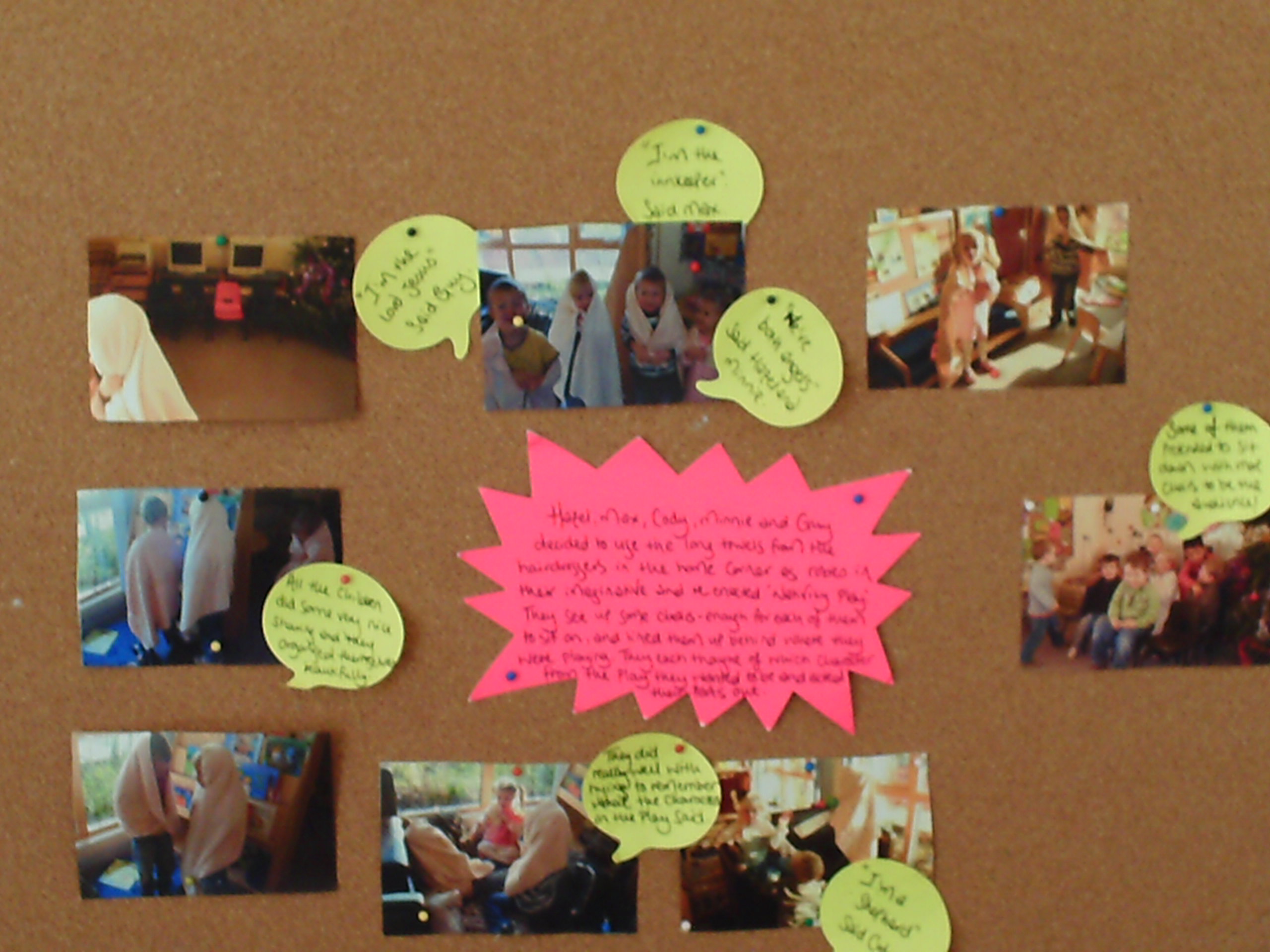
Documenting learning
The pink writing in the centre sets the scene, ‘ A group of children decided to use the large towels from the hairdressers in the home corner to re-enact the Nativity Play. They set up some chairs for each of them to sit on and lined them up where they were playing. They each thought of which character from the play they wanted to be and acted their parts out. ‘ The comments around the edge describe the learning in more detail, All the children did some nice singing and organised themselves carefully. They did really well at remembering what the characters in the play said. Some of them wanted to sit on chairs and be the audience. ‘We’re both angels’ ‘I am the Innkeeper’ ‘I am the Lord Jesus’
In my opinion this is the most effective way of showing parents what their children are doing. Documentation tells the story of what children have been doing by representing the stages of learning, using photograhs, anecdotes from the children, examples of work and teacher analysis. In this way parents can see what their child is doing, what they are learning and why they are doing it. Carlina Rinaldi president of Reggio Children in Italy says,
documentation is more than simply assessing or displaying the work of the children. “One of my definitions of documentation is that it is first of all an act of love,”
This describes perfectly the warmth that emanates from the documentation in Reggio Emilia – it is like shouting from the rooftops – look at what our children are doing. Isn’t it fascinating? Come and join in. Many good examples of documentation of children’s learning can be found in the projects of Sightlines Initiative.
Learning Diaries
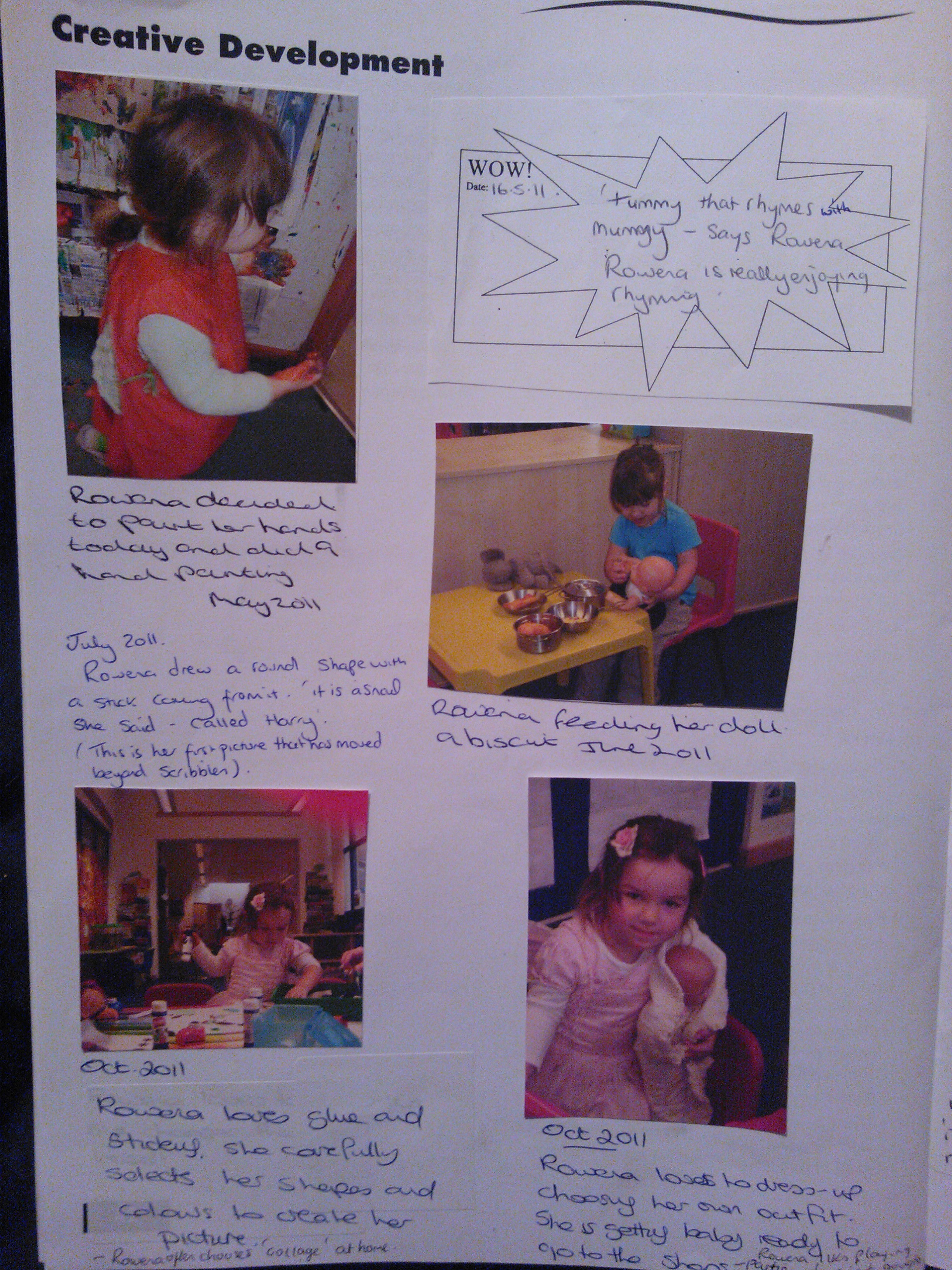
The pictures tell the story of the child’s fascinations and the teacher annotates explaining the learning that took place. The Wow moment was added by a parent about learning that had occurred at home. Parents can also comment on the learning at pre-school to show how this matches with what they do at home.
Learning diaries have been available for every Foundation Stage child (up until the end of their first year at school) in the UK since 2008. These show the learning journeys of individual children through photographs, children’s comments and teacher analysis of learning. The diaries are an excellent record of progress and should move with the children when they go to school. Parents should be made aware that they are available to be viewed at all times and encouraged to comment about learning at home.
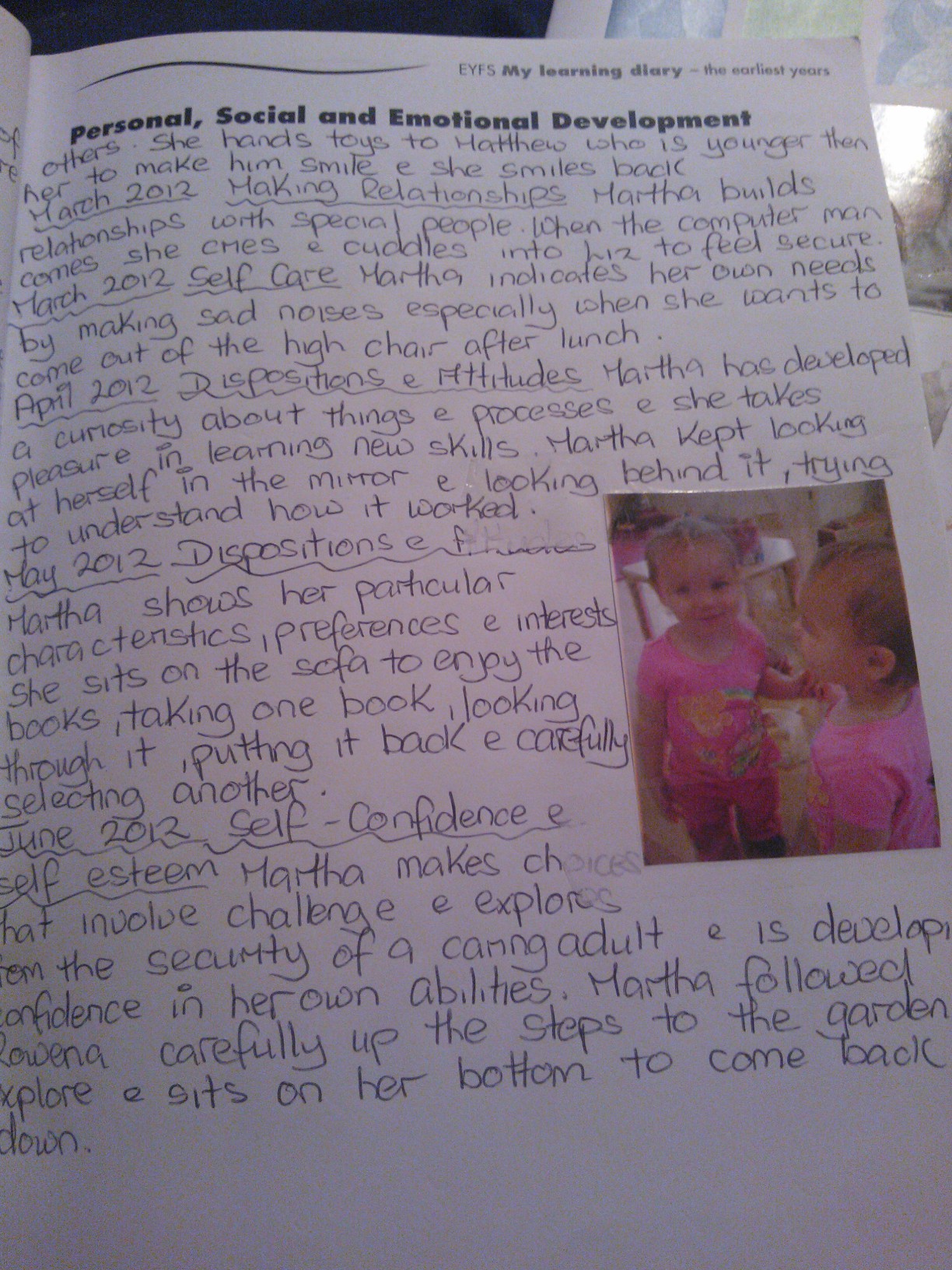
An example of a learning diary extract for a child under 2.
Learning diaries work best when they are, as the title suggests, a record of children’s learning. My first encounter with learning diaries was when working with children with additional needs, as a way of understanding what was happening at home and how that translated into their behaviour at school. In my experience this shared aspect of the diary is sometimes missed. Emphasise that this is the child’s book and it is important that everyone involved with the child shares information to build up a complete picture of the child.
Daily Timetable
If parents are struggling to get information from their children about the day at school it can be useful to display a timetable. Some specific information is also helpful, such as today we read this story or we looked at seeds and berries.
Using Technology
Not all will agree but I think that modern technology could revolutionise the way we build partnerships with parents. Allowing parents access to your email (preferably not your personal one) is a great way of sharing experience though I would suggest creating guidelines. Perhaps suggest that the email is for sending anecdotes about events or things they have been doing at home that they may like to share or build on in class. Teachers could send photographs to parents during the day of their children’s learning or maybe create an online version of the learning diary? I once had a childminder who even in the days before smartphones sent my daughter home with a sheet of thumbnail photos depicting what she had been doing that day. This meant so much and gave me a great starting point for talking about her day.
Open door policies.
In my experience most pre-schools and schools profess to have an open-door policy but in reality it means little. Many encourage parents to help at school and this is a great way of understanding what children are doing at school. However for working parents and those with younger siblings this is not always an option.
Most nurseries and pre-schools invite parents in to the classroom to collect their child. Parents have the chance to familiarise themselves with the environment, children can show their parents what they have been doing and there is a chance to talk to the staff. It surprised me when my daughter started at a school based nursery that children were handed to parents at the door and we weren’t invited in.
It can help parents to feel a part of their child’s day if the room remains set up at the end of the day and they are able to wander around with their child talking about what they have learned. Clearly this can be difficult if younger siblings start to play with toys or children don’t want to leave, so simply leaving one or 2 things out is sufficient. Outlining rules about this being a talking/sharing time not a play time should also help along with setting a clear time for leaving. Not all children/parents will want to stay every day. Perhaps encourage a parents’ rota for helping clear away.
The benefits of the above are plentiful
Parents will not continually demand information from you about their children as they will feel better informed.
Parents will be less anxious about their children if they feel a part of their life at school/nursery.
The children will be more likely to share what they have done with their parents by proudly showing their documentation and learning diaries.
Children can encourage parents to contribute to learning diaries creating a clear picture of the child for the teacher.
Photographs are a wonderful way of sharing information with families for whom English is not their first language.
Parents will feel better equipped to support their child’s learning at home.
With thanks to North Somerset Early Years advisory team, Liz Maggs, Hilltop Pre-School and Early Birds Nursery – Long Ashton for images and learning diary extracts.
Those of us working with young children are familiar with the term Foundations of Learning. What does that really mean? For me, it means everything that gives us the capacity to learn, think, create, behave, communicate and build relationships. The things that you learn in the first 5 years remain with you for life, whether they are physical skills, values and beliefs or ideas and knowledge. This is why for me,early education is the most important and exciting phase.
With this in mind, I would like to share an excerpt from Robert Fulghum’s book All I Ever Really Need to Know I Learned in Kindergarten . This was first introduced to me during my Master’s Degree. When I look at my own children and the way they develop and learn every day, I am reminded of this piece.
Most of what I really need to know about how to live, and what to do, and how to be, I learned in kindergarten. Wisdom was not at the top of the graduate school mountain, but there in the sandbox at nursery school.
These are the things I learned: share everything. Play fair. Don’t hit people. Put things back where you found them. Clean up your own mess.Don’t take things that aren’t yours. Say your sorry when you hurt somebody. Wash your hands before you eat. Flush. Warm cookies and cold milk are good for you. Live a balanced life. Learn some and think some and draw and paint and sing and dance and play and work every day some.
Take a nap every afternoon. When you go into the world, watch for traffic, hold hands and stick together. Be aware of wonder. Remember the little seed in the plastic cup. The roots go down and the plant goes up and nobody really knows why, but we are all like that.
Goldfish and hamsters and white mice and even the little seed in the plastic cup – they all die. So do we.
And then remember the book about Dick and Jane and the first word you learned, the biggest word of all: LOOK. Everything you need to know is in there somewhere. The Golden Rule and love and basic sanitation. Ecology and politics and sane living.
Think of what a better world it would be if we all – the whole world – had cookies and milk about 3 o’clock every afternoon and then lay down with our blankets for a nap. Or if we had a basic policy in our nation and other nations always to put things back where we found them, and cleaned up our own messes. And it is still true, no matter how old you are, when you go out into the world, it is best to hold hands and stick together.
So next time someone discredits you as ‘only playing’ or says ‘she’s just a mum’ or she only teaches little ones, stand firm in the knowledge that ours is the most important job in the world.
Have you ever wondered where would be a good place to take your children to play, eat, spend a day out or meet friends for coffee? Are you a new mum who is finding it difficult to meet other mums?
According to a recent survey a growing number of new mothers feel isolated and find it difficult to meet other mums. Toddler groups are often very busy and noisy, this is not always the ideal place to meet other parents. I was lucky to find a small friendly NCT group where I made some good friends, but these are not always available. Even with friends I remember as a new mum trawling my local town looking for venues big enough to accomodate a number of prams and with good baby changing facilities. This new app could be very useful to mums in a similar situation.
Meet Mums Now is a new app available free from app stores which takes the mystery out of choosing kid-friendly venues and offers social networking for mums who want to meet others.
With over 400 locations in London already listed, users can find child-friendly cafes, restaurants, pubs and attractions near them which have been endorsed by other mums. I notice that the app has also recently updated to include venues in and around my local area of Bristol and Bath.
The app not only identifies locations, but also allows registered users to contact other mums who have recommended a local venue. It’s a great way to share information and meet other mums, especially for those without the luxury of a group of NCT friends in the area.
It’s an idea that was born out of necessity when Nik Dewar, the man behind the app was on holiday with his wife and two young children. Searching for an app which would show them child-friendly locations for lunch in an unfamiliar area, they were surprised to see that what they were looking for didn’t exist, and set out to fill the gap in the market.
At the moment, most venues in Meet Mums Now app are in London, but it’s an idea designed to grow as more destinations in the UK are added. Future versions will allow users to add location of their own, but if you know a great kid-friendly locations now you can email meetmumsnow@gmail.comor send your tip off to twitter @meetmumsnow.com.
Some time ago I was asked to review ‘Your Baby Can Read’, a system for teaching babies from 3 months old to read. The system aims to introduce the written word at the same time as a baby is developing a verbal vocabulary. As today is International Literacy Day I felt I should bite the bullet and go for it.
So why the procrastination? My initial thoughts were that such a system goes against my beliefs. I have seen many parents who focus far too early on reading and writing and become both stressed and competitive about it. A baby has so much to learn in the first years is it really necessary that we add reading to the list? I also feel that a lot of the time a focus on learning to read and write means that many of the underpinning skills necessary to achieve this are overlooked. However, I felt that it was important that such products are reviewed by someone with an early education background. I was interested in seeing the products to help make an informed view.
The materials in the programme include 5 DVD’s, 5 lift the flap books, 5 sets of sliding word cards, music cd, 82 double-sided word cards, a sliding windows board book, word game cards, a parent’s guide and early learning workshop DVD.
To be honest, I liked the materials more than I thought I would. My biggest reservation about the whole programme is that reading is taught through DVD’s. There is a firm emphasis on how interactive the DVD’s are but there is no requirement to sit with your baby as you watch them. I watched the DVD’s with my 10 month old and 2 year old, the 2 year old was mildly interested and the 10 month old paid no attention at all. Personally I don’t see that there is anything that the children can learn from the DVD’s that they couldn’t learn from sharing the books with an adult. I may be wrong, but I feel that this is an easy way for parents to avoid feeling guilty for not spending time with their children. The DVD’s themselves are watchable and encourage the children to interact. It is unfortunate in my opinion that they are American, I think some of the pronunciation of words may be difficult for young British children when listening to American accents and some words like colour use the American spelling. I feel to transfer the programme to a UK market it would be beneficial if the DVD’s were remade with British accents and spelling.
I really like the lift the flap books. These have the word printed on the flap and when the flap is lifted there is a photograph to illustrate it and a number of interactive questions and instructions eg. How many dogs are there? Point to your elbow and What is your favourite thing to eat? My 2 year old particularly liked these and enjoyed focusing on the words, pointing to them and ‘reading’ them with me. I can imagine that with her interest in books and the written word, having read them a number of times she will begin to read the words in the books. The same words are used in the sliding word and picture cards and word cards (flashcards). The word game cards have 2 of each word so that you can play matching pairs games with the words. I can imagine my 2 year old enjoying this, although I haven’t tried it yet.
The programme suggests that you begin by reading the parents’ guide and watching the early learning workshop DVD. The parents’ guide explains how to use the books with your child and gives practical ideas for sharing other literacy related activities with your child. I thought the DVD was excellent, with a lot of sound advice about early language acquisition and literacy. My worry is that it is very long and I wonder how many parents would actually sit through it before embarking on the programme.
Dr Robert Titzer the creator of the programme begins by explaining how the programme originated. He explains that he created the DVD’s to occupy his baby daughter in those times when she was ‘doing nothing’ while he was making dinner or reading the paper. I found this a strange choice of phrase – I don’t think I have ever seen a baby ‘doing nothing’. He also talks about early brain development and the rapidity of brain development in the first few years of life. This is a perfect reason for interacting with babies, but I’m not sure it is a justification for the need to read at this age.
Having said that there are a number of very positive points about babies and learning that Dr Titzer makes.
Parents should be active as the child’s first educator
Spend lots of time interacting with your baby
Children have receptive language (the ability to understand the meaning of words) before they can speak.
Talk to your baby, talking about what they are interested in.
Babies learn through movement
Play games with babies in the mirror and follow their lead building on the things they instinctively do.
Don’t let children watch too much television, it is far better to read with them.
The concept of number needs to be taught in practical situations
Children are ready to write when they can master the physical skills – there is no particular age at which this will happen and it should not be introduced too soon.
The children in the case studies shown on the DVD have clearly learned to read both individual words and whole books. They enjoy reading, are happy and engaged. I have no doubt that the programme works but I question the appropriateness of teaching young babies to read.
The main argument for teaching babies to read is that the earlier a child learns to read, the more educational advantages they will have later. There is a wealth of research that shows that the size of a child’s vocabulary at the age of 3 is the biggest predictor of how easily they will learn to read . The programme encourages the development of vocabulary through the introduction of 164 key words. It gives opportunities to introduce other words related to the children’s interests, by providing blank cards and a wipe clean marker pen. However, surely it would be as beneficial to focus on spoken language and oral/aural skills (such as rhyme, identifying sounds, alliteration) in the first 3 years, accompanied with fostering a love of books, story, song and rhyme?
Dr Titzer explains that the earlier a child learns to read then the more likely they are to love it. From personal experience with my own children I disagree with this. My 2 year old has been obsessed with books since she was around 6 months old but cannot read yet. At almost 3 she is beginning to show an interest in words and is keen to read some for herself. My 7 year old went to school without being able to read but with a huge vocabulary, an interest in books, the ability to recognise rhyme and alliteration, a love of singing and poetry, the ability to keep a steady beat and some knowledge of the alphabet. Within weeks of being in school she learned to read, she is now a well above average reader, an avid bookworm and reads aloud with more expression than most adults (including myself). Based on my 2 year old’s extensive vocabulary, love of books and ability to recognise rhyme I expect her to go the same way. From this experience I question the necessity of programmes such as ‘Your Baby Can Read’.
I think if you have a pre-school child who has built a good vocabulary, oral and aural skills, loves books and is showing an interest in the written word then this could be a useful tool in the journey to learning to read. Personally I don’t like the idea of teaching reading using DVD’s because reading is as much about sharing a special time and ideas with your child as it is about the act of decoding words. I will use the rest of the materials with my 2 year old daughter if she shows an interest but I wouldn’t choose to use them with my baby. For those who would like their baby to read I have no doubt that the system works and that if the system is followed according to the comprehensive guidance the babies and toddlers will get great pleasure from it. From the perspective of an early educator, I would let babies be babies and use it when the children are a little older.
Party season has arrived again in our household. My eldest has just had her 7th birthday and most of her class are spring and summer born babies so we now have an endless run. In her book bag today I found 3 thank you cards, some written by the child and some by the parents. What will I do with them? Look at who they are from and put them straight in the bin. To the mums who spent hours writing them or the poor children who have been made to sit for hours signing their name, I am sorry. Though I agree that it is right that children should be grateful for what they are given, when they go to so many parties is it really necessary that we get a thank you card from every one? I’m probably known as the ungrateful or disorganised mum because I don’t send them. At the weekend we visited friends and my daughter decided she wanted to write a thank you card for them, this one was written because she decided it was a thoughtful thing to do rather than because I had told her to do so – surely that means far more.
Women’s Hour today discussed children’s parties and most of the views expressed were either that they were a huge headache both financially and in terms of organisation, or that they were a thing that the parents relished organising. I have a friend in the latter category, who will throw a party at the drop of a hat, hand making everything to fit the theme including party clothes and food. A part of me would like to be like that but time and inclination hold me back. Besides which, I’m sure my children would be just as happy with a trip somewhere nice and a shop bought cake. We have tried various things from overcrowded parties in the house, hiring a big hall, not having a party but taking a few children to the theatre and this year an ice skating party. My 2 year old is yet to have a party as she doesn’t really have enough friends to justify one . Parties in the house are far too stressful for me, the combination of noise, overcrowding, mess and organising food is a nightmare. The big hall party was fine on the day (a joint party with 30 children) but organising what I was going to do with them, sorting food and all the things we needed to entertain them took a lot of time and energy. The last 2 were relatively easy. Ice skating with a group of 7 year olds was surprisingly stress free. The children had a lesson and then were given penguins to hold to help them balance if they needed them. There were plenty of adults around to help out so that even the 2 year olds had a turn. The food was prepared by the venue and all I needed to provide was the cake. Party bags included a free ticket to come back and ice skate – so much better than the usual tat (though some of that was still there).
Why do we feel the need to provide party bags at children’s parties? We all hate the little bits that come out of them that usually end up scattered around the house. Some people substitute the bags with presents but all children somehow expect to come home from a party with a present these days. When we were kids this was never contemplated, if we were lucky we came home with a prize from a game. Even pass the parcel now has a present in every layer – I remember the days when each layer had a forfeit rather than a prize. My children so don’t need anymore stuff. Call me a humbug, but I’m not going to do it anymore and hopefully lots of like minded mums will join in the boycott.
I usually approach such reading with trepidation, however when Jonathan Douglas Chairman of the National Literacy Trust described it as ‘exhilarating’ my ears pricked up.
The Review recognises the success and popularity of the EYFS and that it will be some time before this will be fully embedded in practice. It therefore does not recommend radical change, but maintaining EYFS in its current form whilst fine tuning certain aspects. I’m sure this will be a relief to many who are only just getting to grips with the EYFS and dread being faced with even more change. The tone of the report feels very much as though Dame Tickell has listened to the many individuals and organisations involved in the consultation and shows a commitment to the importance of early education. The review supports learning through play, active learning, creativity and critical thinking as characteristics for effective teaching and recommends that the EYFS remains inclusive and mandatory.
There are a number of recommendations in the review including:-
A greater emphasis on parental partnership . The EYFS should be more accessible to parents by making sure it is in plain English. I also think this would really help with the wide range of people that use it and help to remove any ambiguity . In addition an online interactive version of EYFS is recommended that would be accessible to parents.
A reduction of the Early Learning Goals from 69 to 17, with a simple scale defining the skills needed for emerging, expecting and exceeding each goal. Anything that reduces targets has to be a good thing in my opinion and the examples of the simple scale are very clear.
A commitment to greater clarity on the level of paperwork required, alongside the suggestion that paperwork should be reduced. This sits alongside the recommendation that Ofsted and the Local Authority work together to ensure that no unnecessary demands made.
There continues to be an emphasis on formative assessment based on observations of daily activities to illustrate children’s learning. Summative assessment (the Foundation Stage Profile) will be significantly reduced and there is a call for stronger links between EYFS and KS1.
A call to investigate as a matter of urgency the suitability of a ratio of 1:30 in reception classes.
A commitment to recruiting a professional and highly qualified workforce including a review of Early Years training courses and a clear progressive structure for qualifications. I just hope that this quality is maintained by providing financial incentives.
A recommended change to the areas of learning. This would create 3 Prime areas – Communication and Language, Personal, Social and Emotional and Physical and 4 further areas through which these will be applied. These would be Literacy, Maths, Expressive Arts and Design and Understanding the World. I am undecided as to whether the separation of Communication and Language from Literacy will lead to a greater emphasis on speaking and listening or whether it will detract from the interdependence of reading, writing, speaking and listening. I hope that there will be clear advice as to what early literacy is . I am a little disheartened that literacy is defined in terms of reading and writing and that definitions have not been reframed for a new technological age. I am also unsure about the change from Creativity to
Expressive Arts and Design. I am certain that it has been changed to avoid ambiguity, but creativity encompasses so much more than art and design, that I would hope that this would be fostered in diverse ways. It is good to see that technology has a specific mention in Understanding the World.
A review of children’s development at aged 2-2.5 sharing knowledge from all agencies.
The examples of good practice in the appendices make good reading and there are some thought provoking quotations interspersed throughout. Reading the whole document takes some time, but is worthwhile. If you didn’t want to read the whole review the summary of recommendations in Annex 2 will give an overview.
I watch with interest to see how policy makers will adopt these recommendations for the new EYFS.
A recent TED talk about the limitations of experts led me to pose the above question. In the education of our children – who are the experts? For some it is the teacher’s job to teach reading , writing and good behaviour and it is felt they cannot be questioned because they are the experts. For some teachers it is the parents’ responsibility to teach their children to behave properly and encourage enthusiasm for learning, so when this doesn’t happen it is the parents’ fault.
As parents we are all experts on our own children, we know them best, their likes , dislikes, strengths and weaknesses and what makes them tick. The expert teacher may say, ‘he doesn’t join in at music time, I don’t think he likes singing. ‘ The expert parent may reply – ‘he sings the songs all the time at home, he just isn’t comfortable in a large group.’ In contrast, the parent may question their child’s inability to write his name and the teacher is able to explain all the things that their child is doing in their play that will build the underpinning skills that are necessary before this will occur.
This highlights to me that we are all experts and as experts together, we need to question and challenge each other to provide the best possible education for our children. If we believe that we are the only expert with a valid opinion and don’t listen to those who question us, we limit the possibilities for our children.
Of course this creates challenges for schools, nurseries and parents. In a busy school day it is difficult to find time for parent/teacher discussion so we need to challenge ourselves to find new ways to share expertise.





 Right from the Start