Once children are helped to perceive themselves as authors or inventors, once they are helped to discover the pleasure of enquiry, their motivation and interest explode. – Loris Malaguzzi.
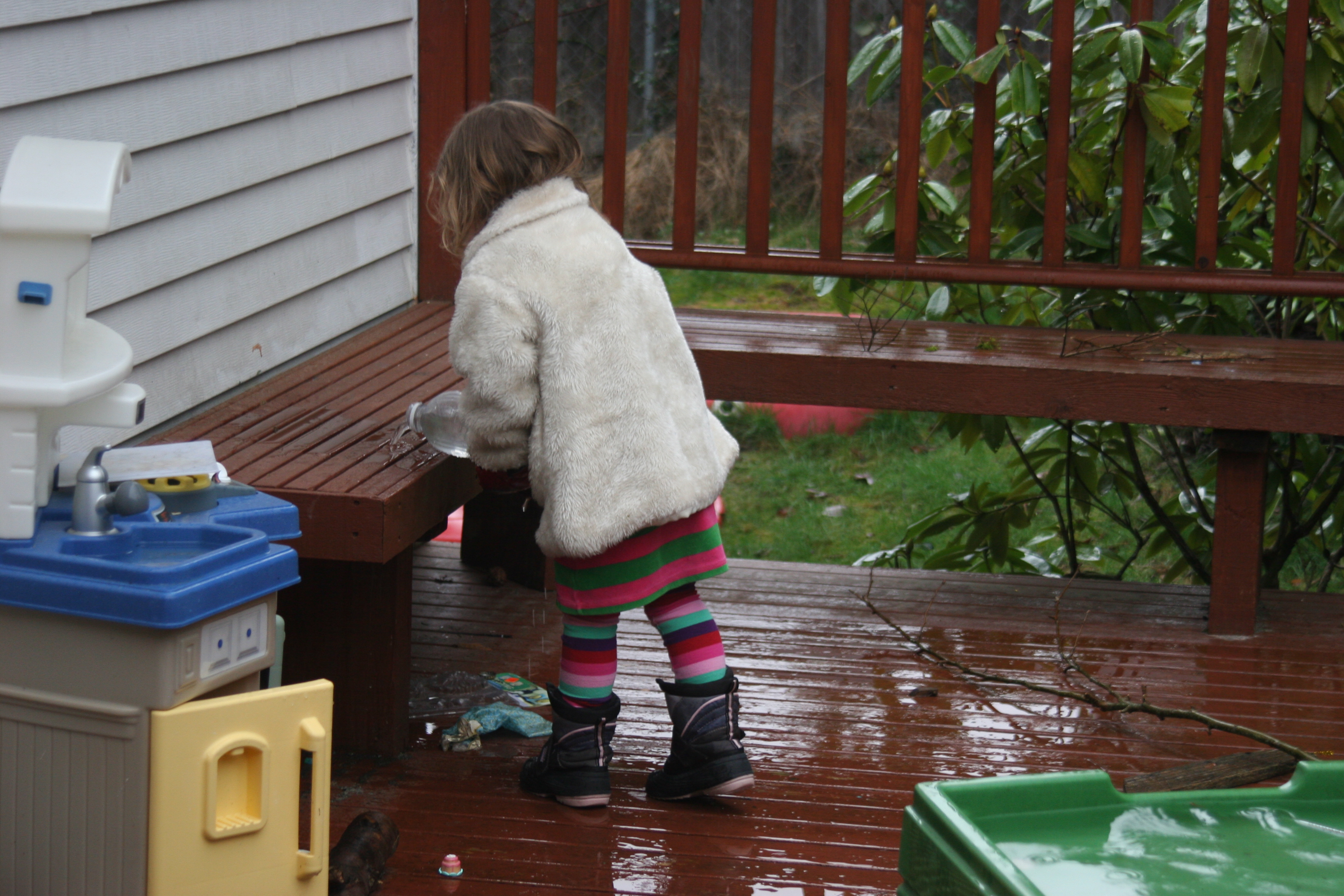
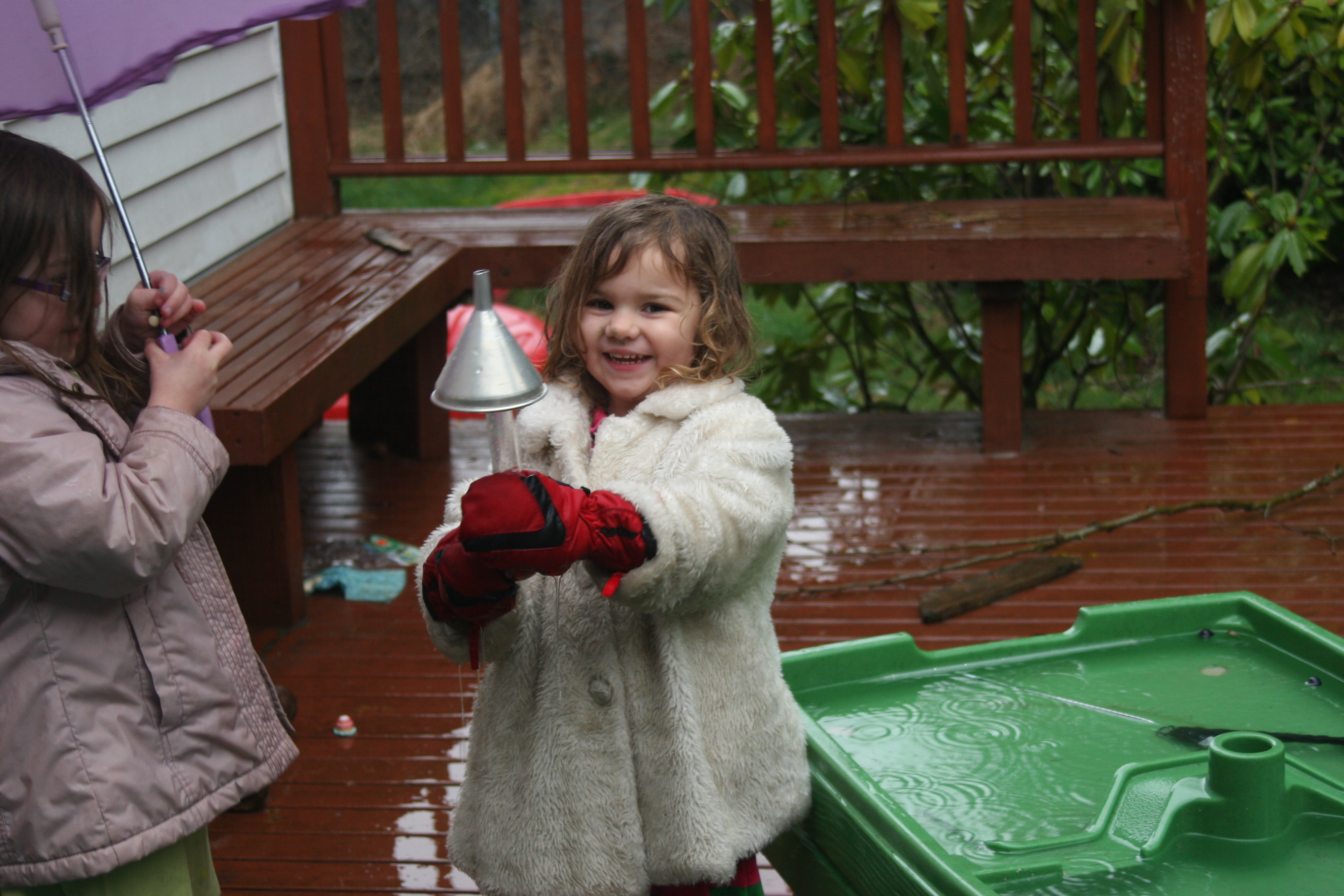
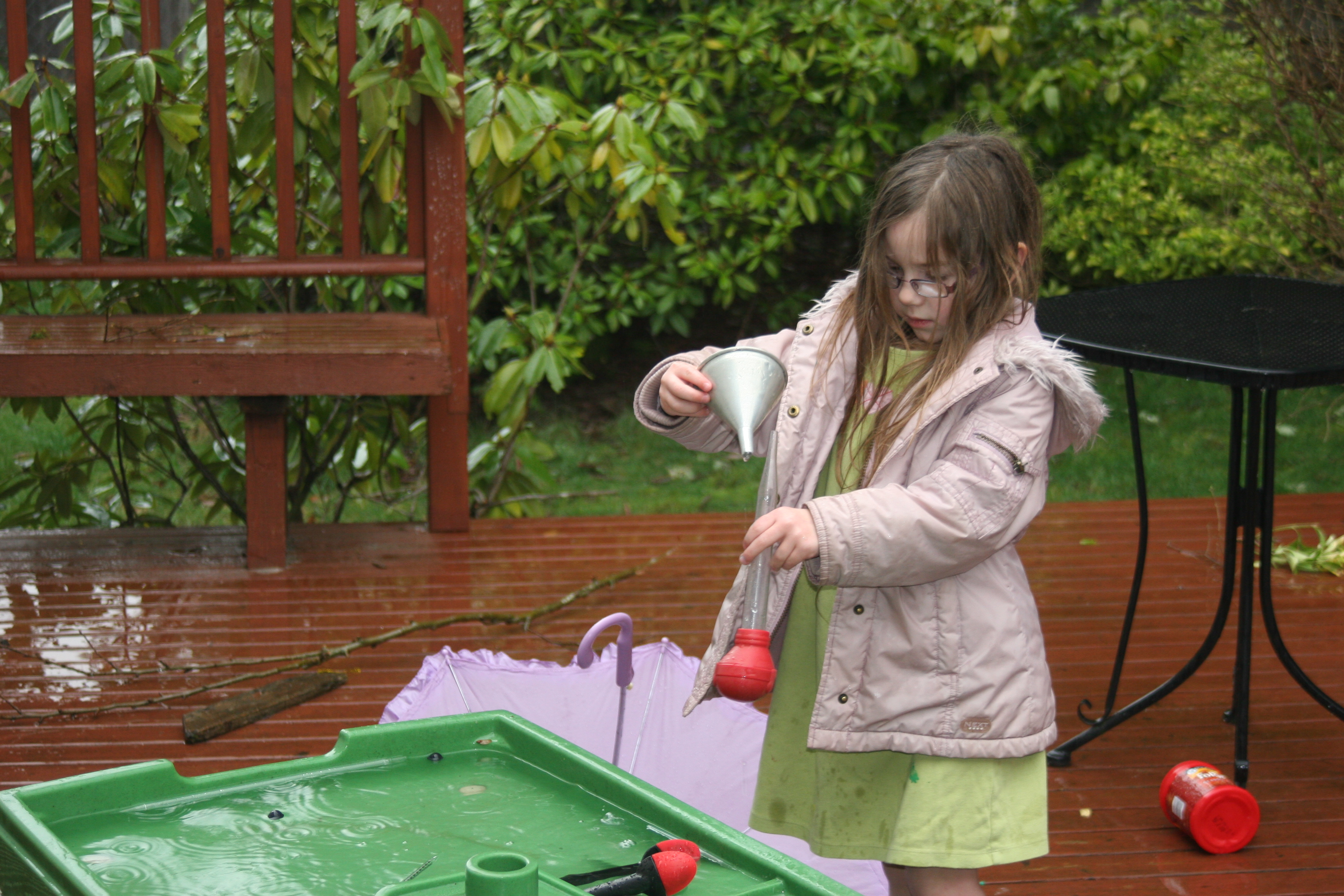
We’ve had a few rainy days so I decided to leave the lid off the water table to catch the rain. We’ve had so much rain that it was nearly overflowing. My girls looked out at the rain and decided to play in the water. They know from experience that rain water is very cold so my youngest put on her waterproof gloves so that she could tolerate the cold water for longer.
I gave her a bottle and a funnel to add to the other materials. I have recently noted her eagerness to transport things from one place to another and predicted she would probably use the bottle to empty the water from the table. True to form she filled the bottle, carried it to the bench and poured the water through the slats before returning for more.
Her sister is less eager to play outside but loves umbrellas so when I suggested she take her umbrella outside, she was out like a shot. Of course her sister needed her umbrella too.
It looks like winnie the Pooh’s boat
Bob needs to stay dry
I can’t quite reach…
Here you go
Perfect.
I want to make an invention
What kind of invention?
Like we made before for serving drinks.
Last summer the girls had inserted a straw into a hole in a milk carton and made a drink dispenser. They worked out how to turn the tap off and where to place the tap so that they could drain the container of all the water.
What do you need?
A cup – this will be good (finding a coffee container) a tube or something and some small cups.
I found a piece of plastic tubing and plastic wine glasses.
I need another pipe. One to blow into and the other one for the water to come out of.
I gave her another piece of tubing that her sister had been using to make a contraption the previous day.
It’s not working mummy, when I blow nothing happens.
Are there any bubbles coming when you blow.
No
The air isn’t getting through the pipe.
We put the container onto the floor so that she could keep the pipe straight without any kinks and still reach to blow into it.
I have to be honest I didn’t expect it to work but look what happened.
You have to blow so, so hard to make it work that it hurts your mouth, but that’s okay.
Meanwhile her sister was trying to catch floating objects with the tongs.
I’d never heard of a Children’s Museum before I moved here but as I entered the door I was greeted by a little bit of play heaven. I think I was more excited than the girls. My 9 -year-old remarked
It’s not really a museum is it?
True not in the traditional sense.
According to Wikipedia, Children’s museums are institutions that provide exhibits and programs to stimulate informal learning experiences for children. In contrast with traditional museums that typically have a hands-off policy regarding exhibits, children’s museums feature interactive exhibits that are designed to be manipulated by children. The theory behind such exhibits is that activity can be as educational as instruction, especially in early childhood.
In essence it’s like walking into a really well- resourced nursery or pre-school. I loved that many of the exhibits used simple, cheap materials that could be replicated at home, like a blackboard with a pot of water and brushes. I particularly like these; they would be a great addition to a child’s bedroom wall, garden fence or in a toddler room at nursery.
The girls loved this one and played with it for ages – even my 9-yr-old was fascinated.
The water area was a huge hit with my youngest. My favourite was a water bath with a transparent window so that you could see what was happening under water.
This slideshow requires JavaScript.
Behind the glass is an area for art based activities – musical instruments, painting, movement with ribbon sticks and scarves and drawing. The metallic walls made it so easy to dry and display pictures. What a great idea for a messy play room.
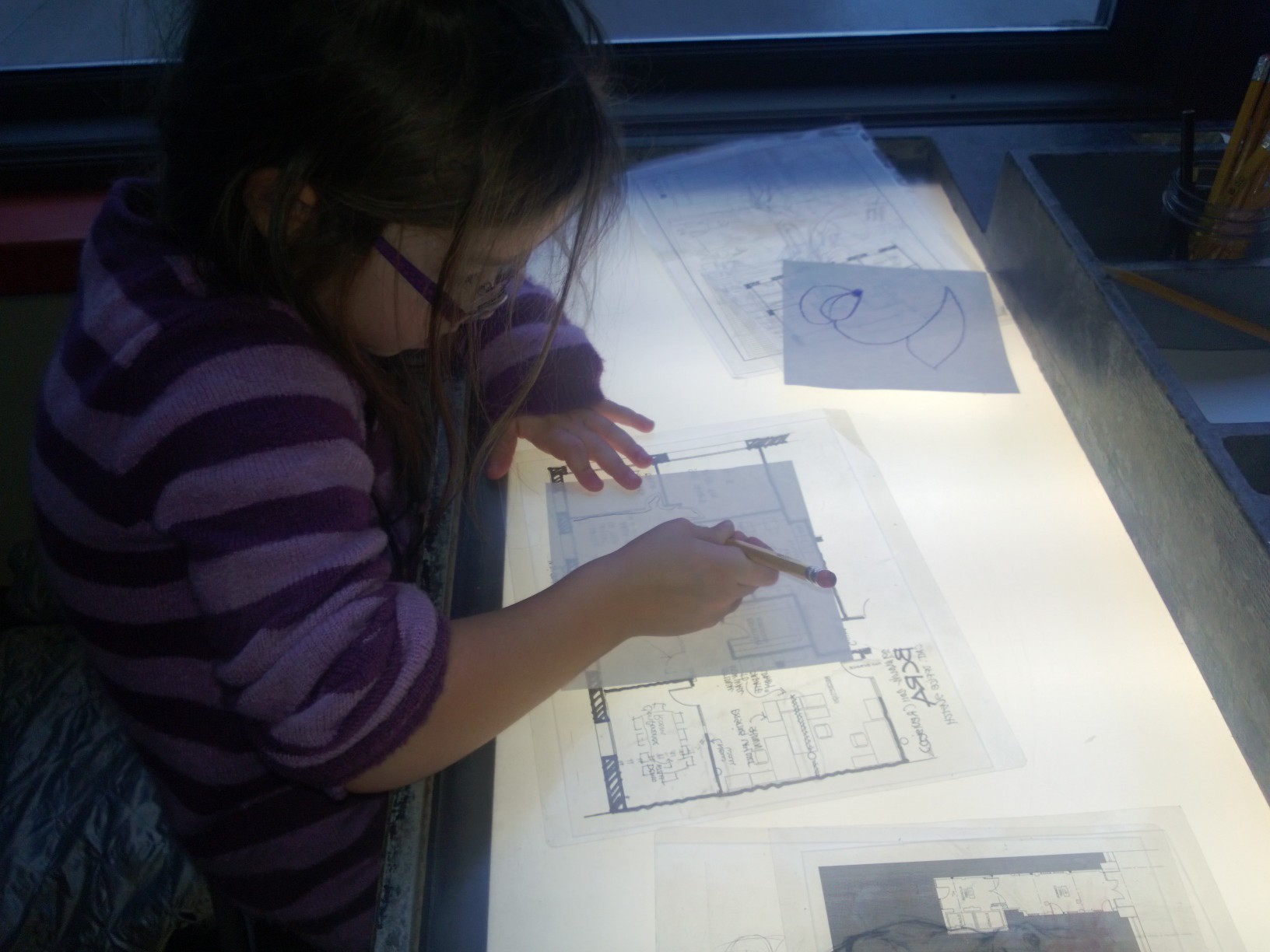
There were 2 light tables in the space with very different activities, the girls chose to trace and draw.
My eldest loved den building best of all. The smaller structures were not very stable so she negotiated with the other children in the space to create a big den together.
It isn’t very good – it keeps falling down
We built one together
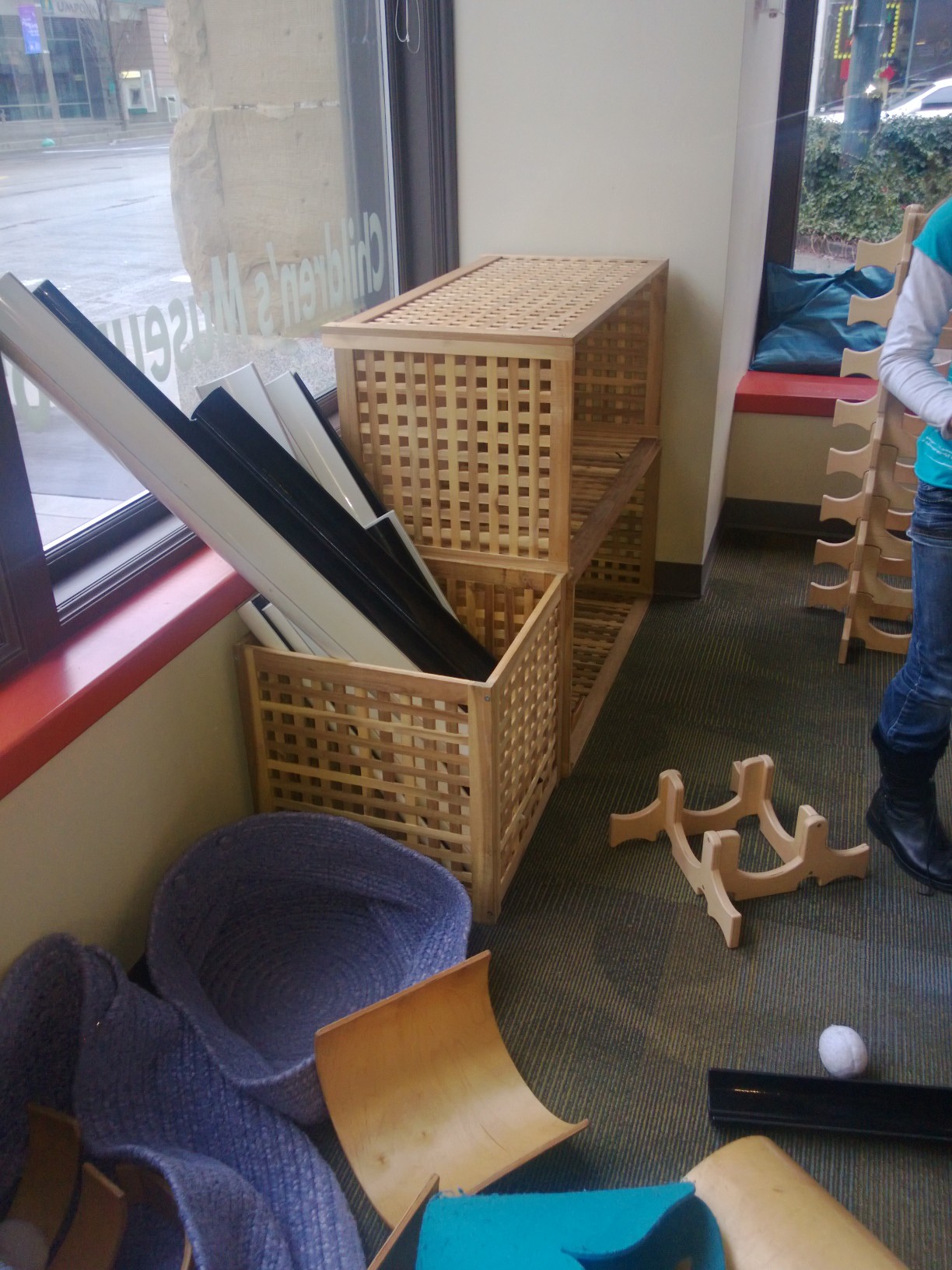
More building – drainpipes and gutters
I’m so glad we discovered Children’s Museums and I’m looking forward to visiting the others in the area and sharing more ideas.
When considering the question of how to teach preschool art it is helpful to first consider the meaning of ‘art’ for our youngest children.
What is Children’s Art?
As adults, artists are generally referred to in terms of the product they create – painters, sculptors, musicians or dancers. When we create ‘art’ we might think about what we are going draw or make before we begin.
When children explore art there is much less emphasis on the finished product – they might say they are going to draw or make something specific but often this evolves into something else during the process.
As I watch my children involved in what we may traditionally term ‘art’, I find that creative expression isn’t their only interest and there is certainly very little focus on the finished product. Sometimes they are practising skills. My youngest for example likes to snip paper into tiny pieces but if I suggest she might like to make a picture with the pieces, she isn’t interested. As children get older the finished product becomes more important. My pre-schoolers will often remark that they don’t know what it is going to be yet, whereas my 9-year-old often has an idea before she starts. Does this change occur naturally or do adults teach them that this is what ‘art’ is?
My younger girls’ ‘art’ is about exploration. They ask questions like ‘what happens if?’ Through this exploration they see themselves as competent in the knowledge that there is no right or wrong way to do things. This give them the confidence to explore further.
The Salad Spinner Project
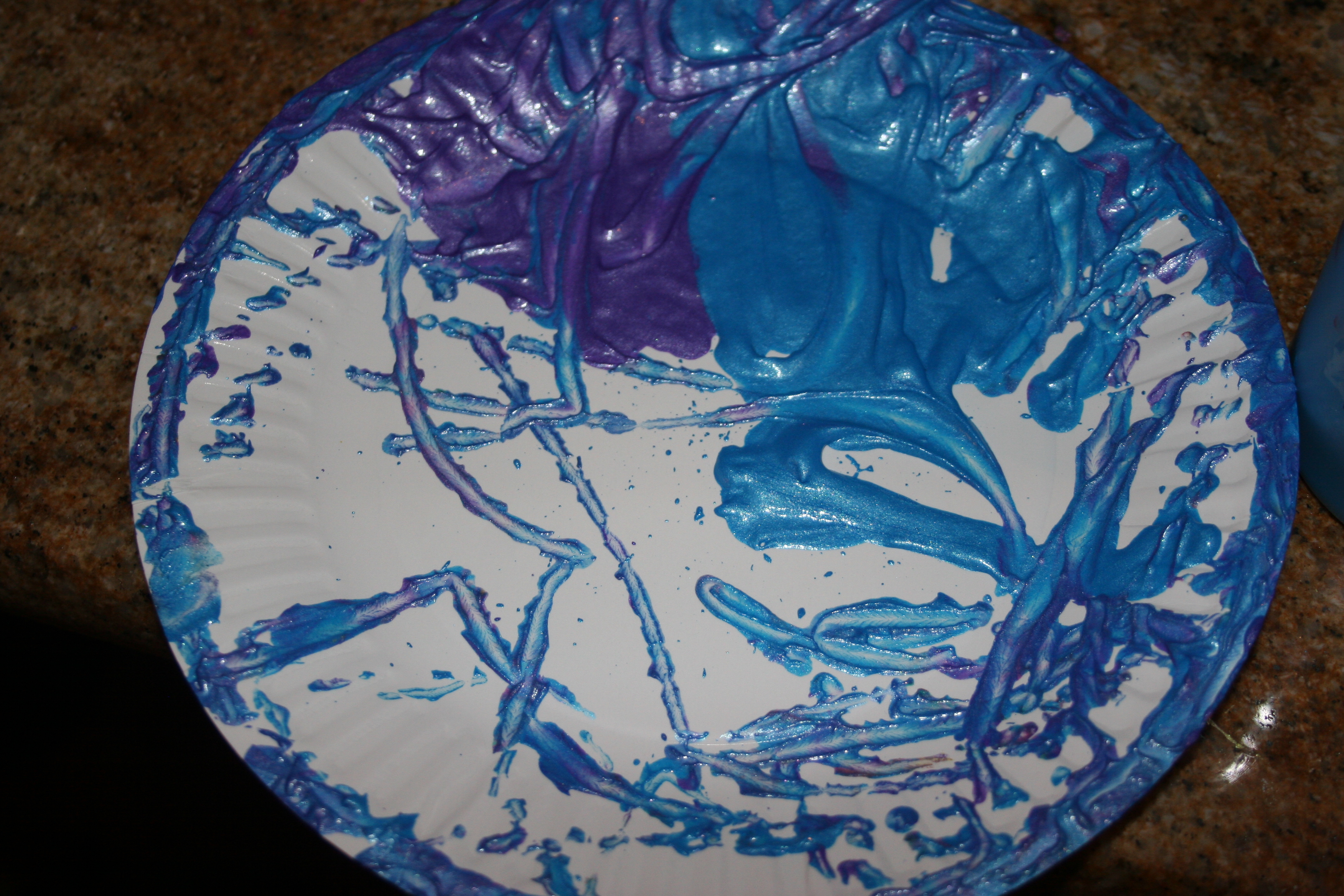
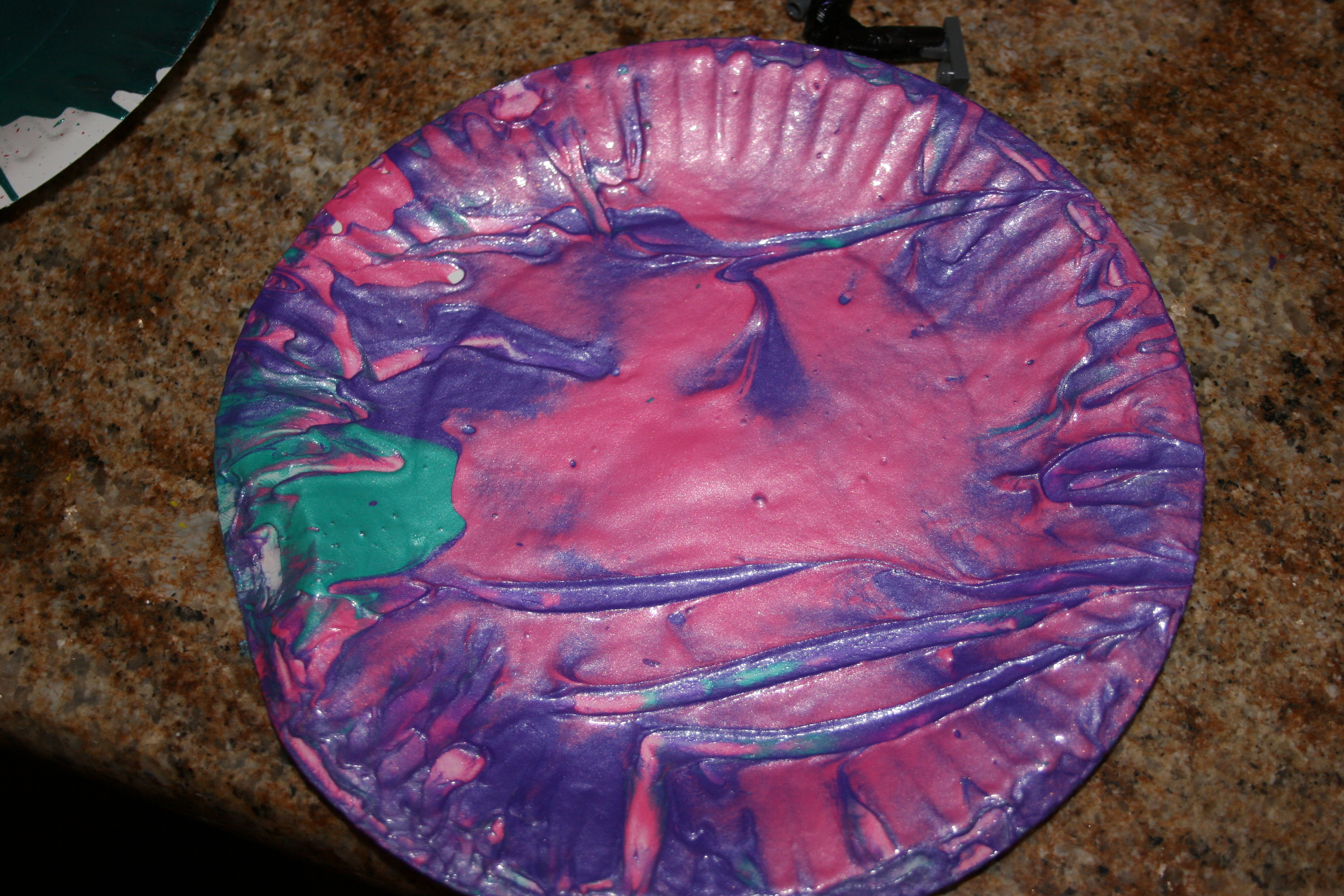
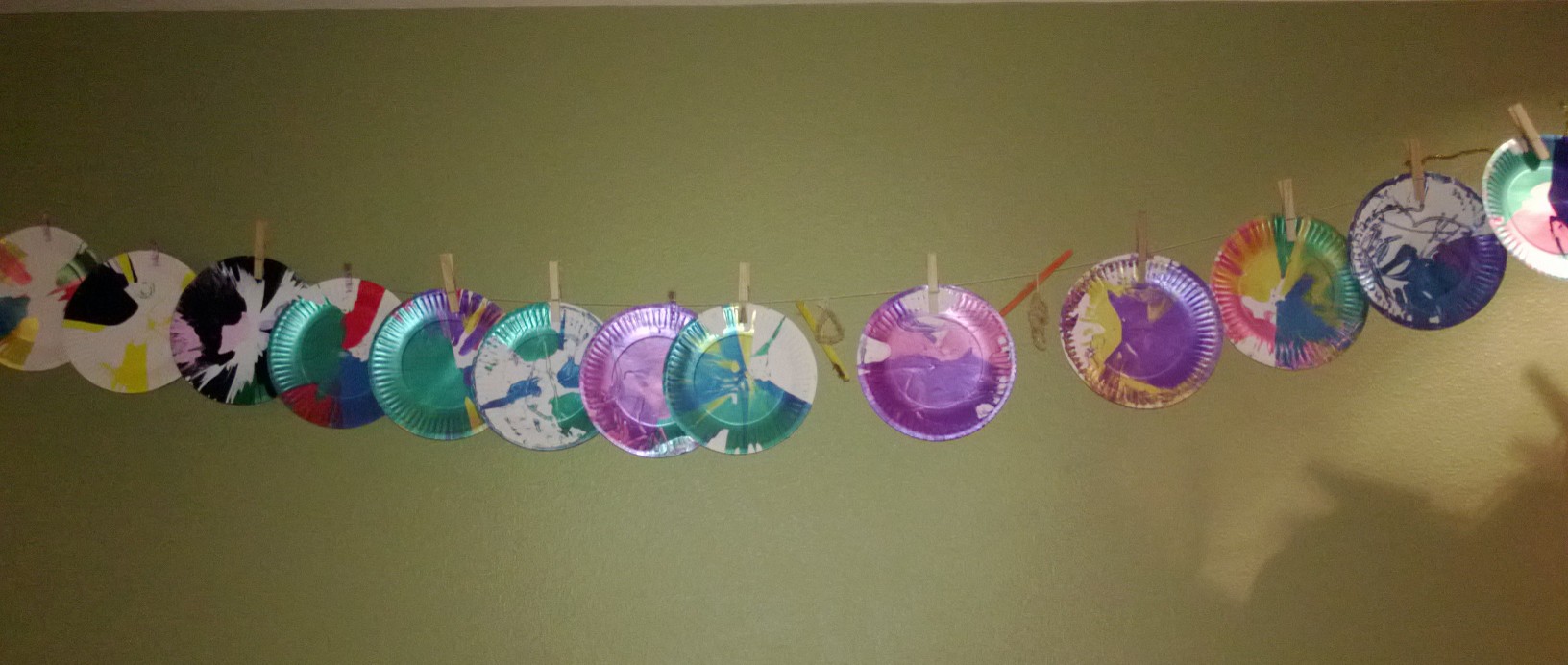
An example of a process oriented art project was inspired by a visit to the Children’s Museum where the children made pictures using a salad spinner. The directions were simple:
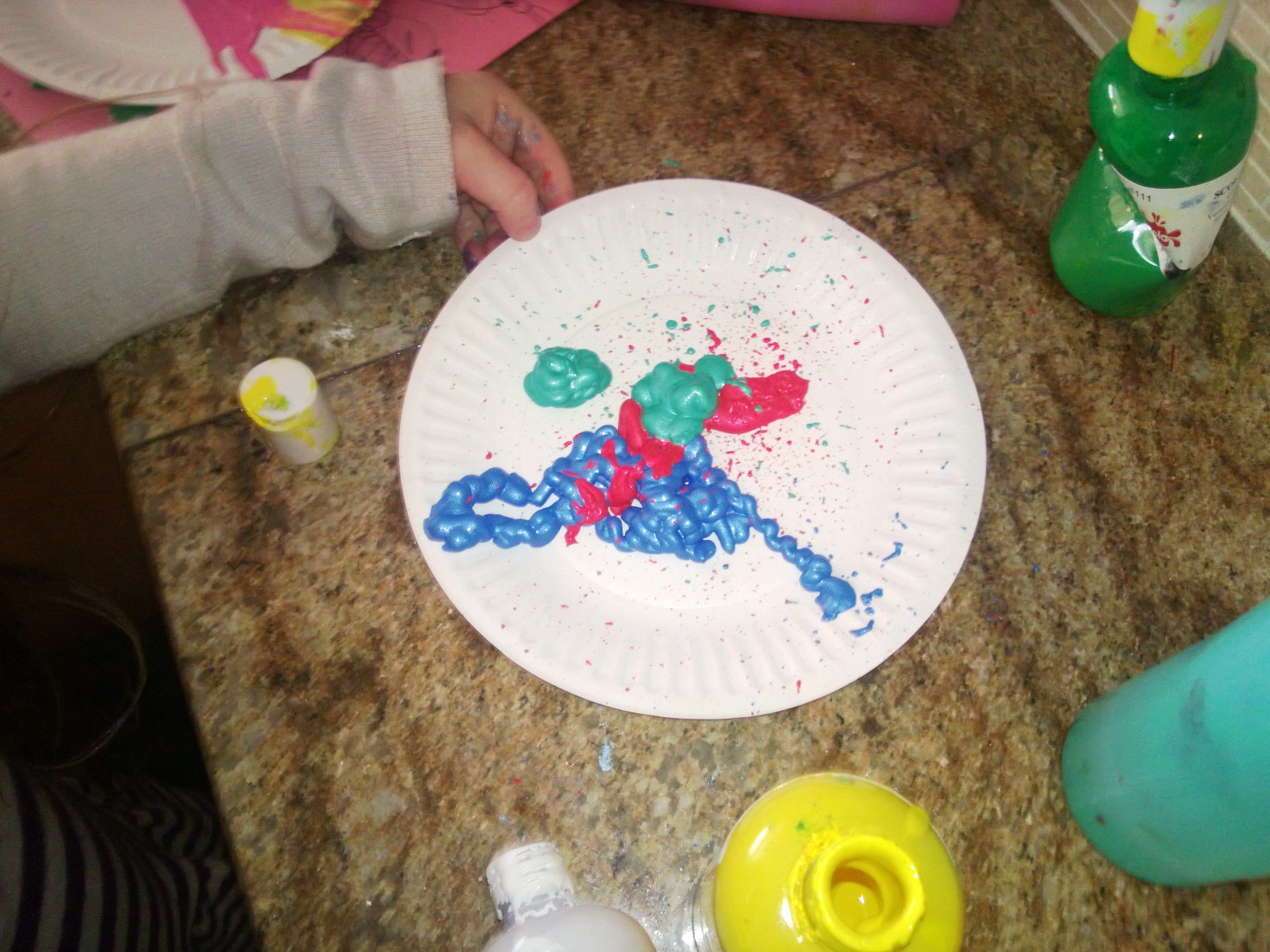
1. Put paint onto a paper plate
I’ve chosen 3 colours
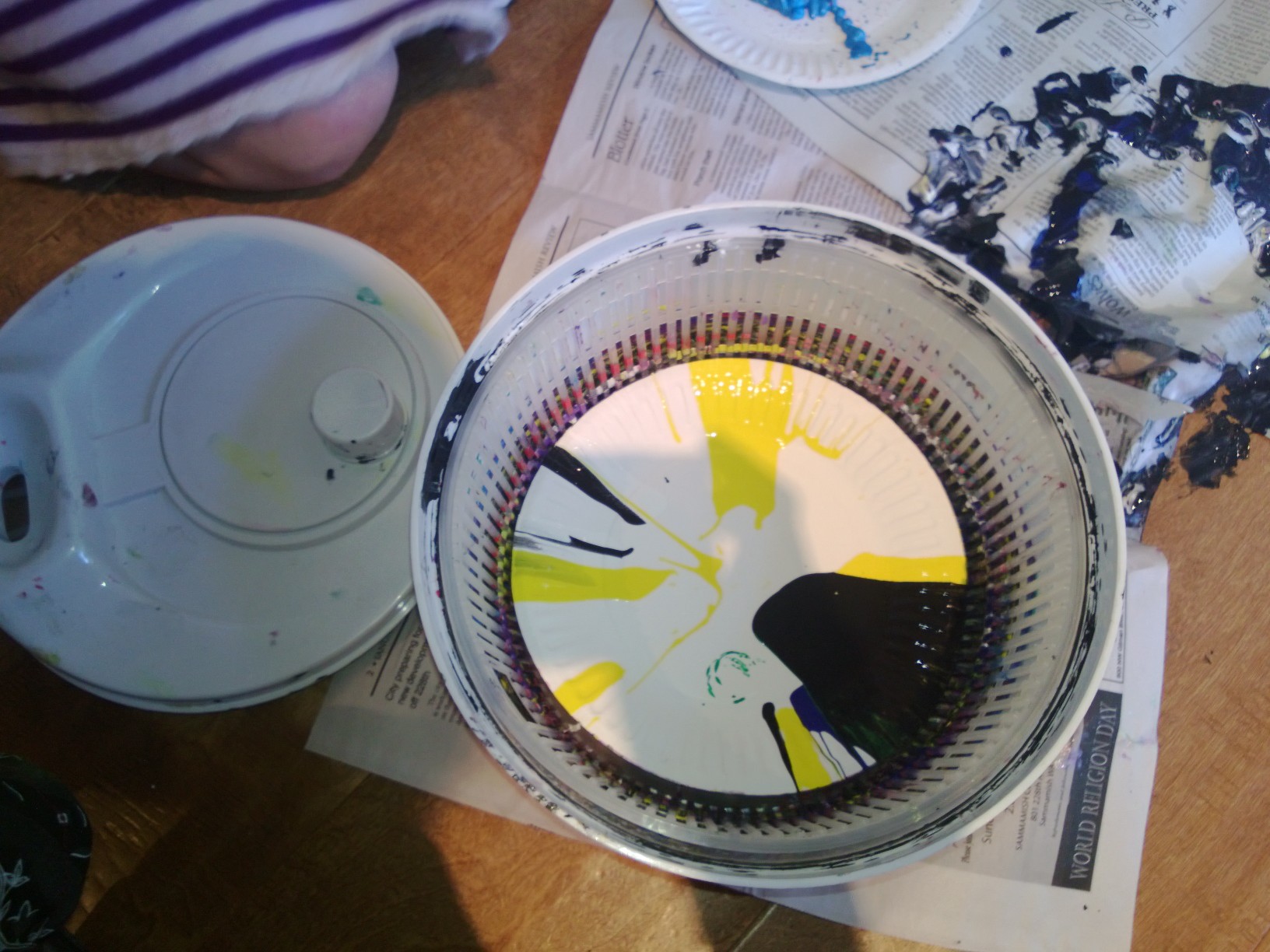
2 .Place the plate inside the spinner and put on the lid. Place the spinner onto a cloth or newspaper, the holes in the bottom of the spinner allow the paint to come through.
3. Spin
4. Check results
They watched as the pictures took shape changing according to the colours chosen and how much paint they put on.
There is potential for this activity to become a product oriented if the adult takes over. The key to making it process oriented is to offer choice and allow the children to freely explore the materials.
How the Project Evolved
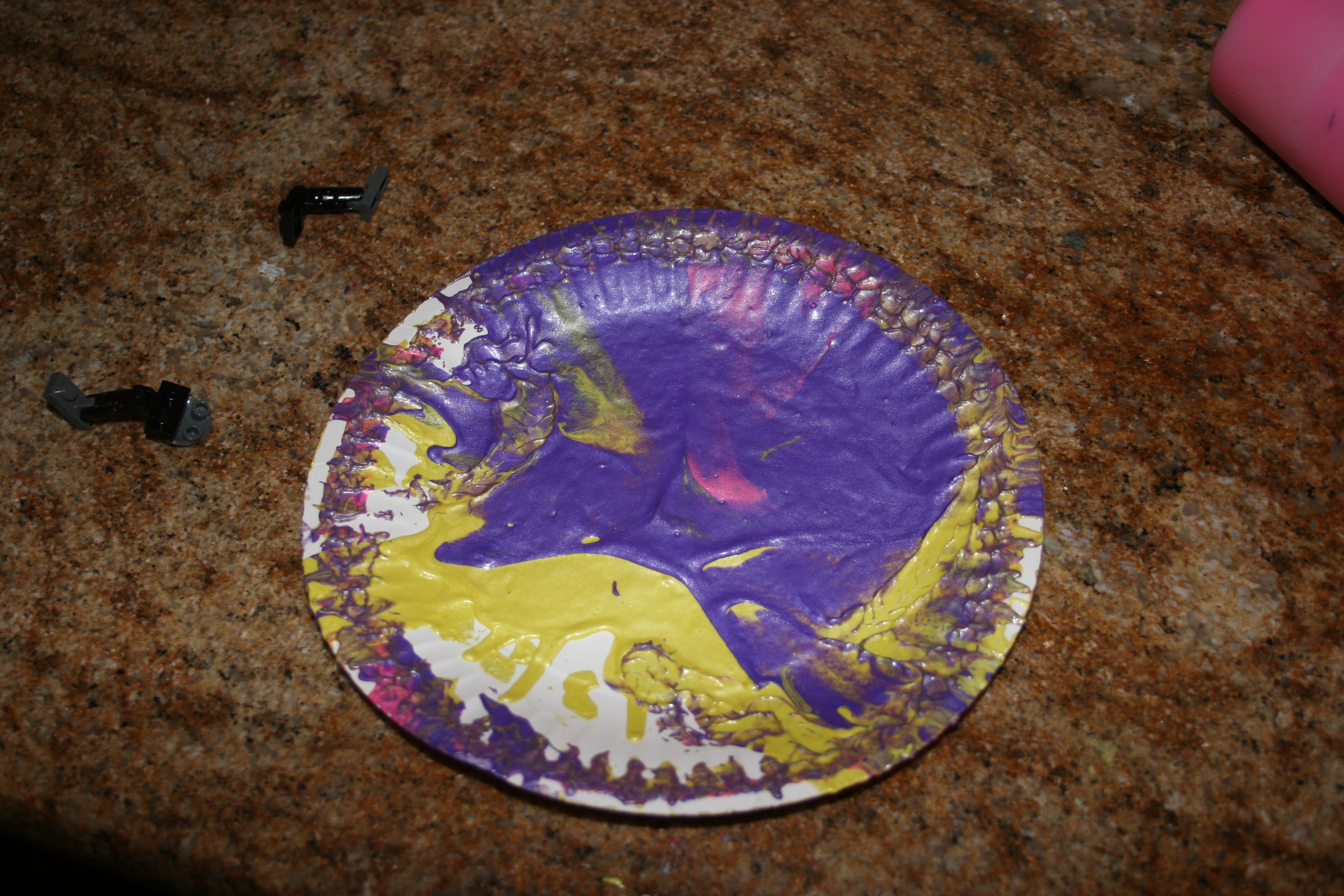
The pictures the girls had made at the museum had colours that ran into one another producing a marbled effect but the paints we used at home were thicker so produced very clear lines with little mixing.
They explored all the possibilities:
I’m choosing two colours.
What if I just put a bit of paint on?
I’ve put lots of paint on this one.
Which one is your favourite?
The next time we got the salad spinner out I suggested they might like to add things to the spinner to see what happened.
I know lets put balls in.
First they tried a golf ball
It makes a kind of bumpy pattern
They put it back in a number of times spinning the spinner at different speeds to see how the pattern evolved.
Next they tried marbles. The marble made tracks across the plate
It looks like a puzzle
The next attempt came out differently
When we put marbles in it makes a noise. Sometimes they get stuck in the sides and we have stop.
Hmm, Maybe if I spin it faster
Still no change.
I could try more marbles
Still no change.
Suddenly my 5-year-old had an idea
I know; it’s because I used too much paint. The one with tracks on didn’t have so much paint on so I need to use less paint.
The learning and creative thinking in this project is clearly evident so why would we plan art with a finished product as our starting point?
Process v Product
Sometimes as early educators and parents it is difficult not to plan art projects in terms of the finished product. Certainly years ago when I worked with older children we would often plan workshops and sessions in terms of what we would make. We all like our children to come home from preschool with something they have made. Teachers sometimes argue that parents expect their children to come home with something at the end of the day. It is difficult to be enthusiastic about yet another drippy painting or cardboard box construction.
This is often given as a justification for producing heavily adult directed arts and crafts. Starting from an adult viewpoint in this way often means that the children don’t do very much themselves. I have observed teachers presenting children with pre-drawn templates, ready cut outlines and telling them what they need to stick where – sometimes the child isn’t even allowed to do the sticking themselves. The children may come home with something pretty to put on the wall but what have the children learned, how much enjoyment have they had and have they actually made it themselves? Furthermore, if we show children at a young age that there is only one way to do things we destroy their enthusiasm to do things for themselves. Is this why we often hear older children say ‘I can’t draw’, ‘ I don’t know what to make’ or ‘It doesn’t look right’.
When you allow children to freely explore materials they begin to understand the properties of media, they learn that art can be a series of explorations and they are allowed to become absorbed in the joy and relaxation of the artistic process. Sometimes they will want to make something specific but allow them choice in the materials and tools they use and encourage them to try out things for themselves.
Creative thinking isn’t neat and tidy. An artist will paint many sections of a painting exploring colour texture and shape before finally coming up with a finished product. Think about the work of an author who writes and rewrites many times with crossings out, arrows and notes all over the paper. A finished product will come eventually but it is a long way off. Allow children to explore in this way, let them make a mess and do things their own way.
As Peter Dixon puts it
Your children are at a stage where the process of doing things
LOOKING, SEEING, FINDING, FEELING, INVESTIGATING etc.
is far more important than the end product sought by some parents. …The process of their work – might look messy, scribbly or completely unrecognisable to us but to your children it is utterly meaningful and an essential part of their mental and physical growth and development. Please honour – please respect your child’s own way of thinking. It might seem unusual but it is their birthright. It is the foundation upon which they will build all future understanding.
The Adults Role
Process oriented art doesn’t mean that you leave children alone with a huge amount of materials. The adults role is to organise the materials so that the children can find what they need easily. Sometimes this means setting out particular materials for example you may want them to explore with charcoal and erasers. It can also mean setting up an organised art station with neatly labelled pots and drawers that the children can choose materials from.
If the adult works alongside the child creating their own projects then they can inspire children and demonstrate techniques. They will be able to encourage children to develop their projects by asking questions
What happens if…..?
Have you tried this……?
What else could you add?
persuading them to try different materials and techniques.
If you log children’s comments and questions, displaying them alongside finished pictures and photographs of the process, it will help to show the value of process oriented art.
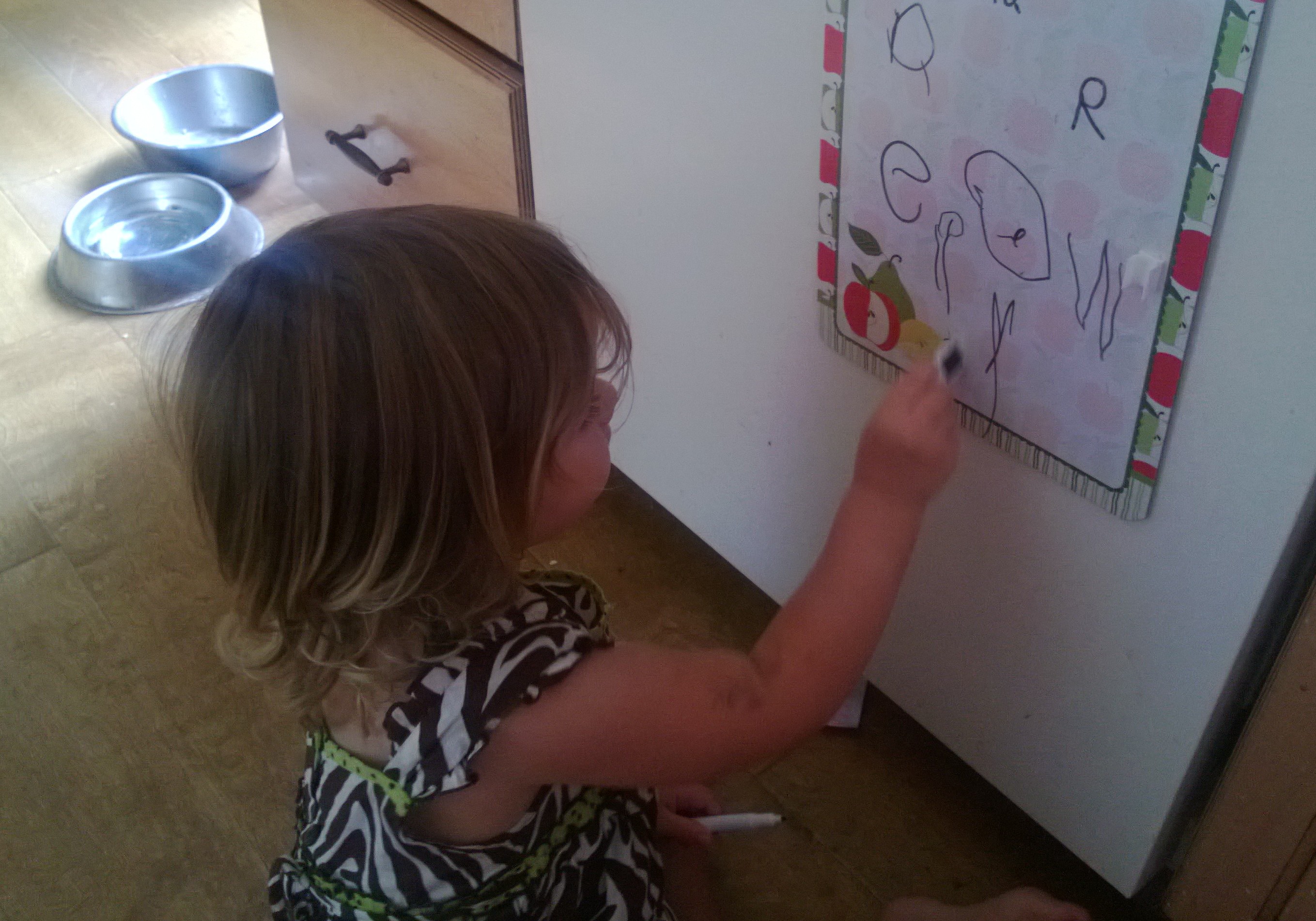
The lead up to Christmas was a great time for writing messages in our house. Our visiting elf Christopher Poppinkins left notes for the girls and they responded with their own notes, we made gifts for the neighbours with a little note attached, wrote Christmas cards for the family, shopping lists and yesterday the girls helped me write a list of songs for my music class.
As children approach school age, parents are often anxious about their children’s emerging literacy and how best to support them at home.
When is the right time to introduce writing?
Does my child need to be able to write their name before they go to school?
How do I start?
Do they have to form letters in a particular way?
Writing is a complex skill involving much more than the correct formation of letters. I can’t guarantee that my girls will continue to love writing but I think we are headed in the right direction.
If you are interested in finding out how I encourage the girls to write and keep it enjoyable I am sharing some of my experience in a guest post for ‘What to Expect.’
What had originally been an icy art project, unexpectedly turned into a fascinating science investigation.
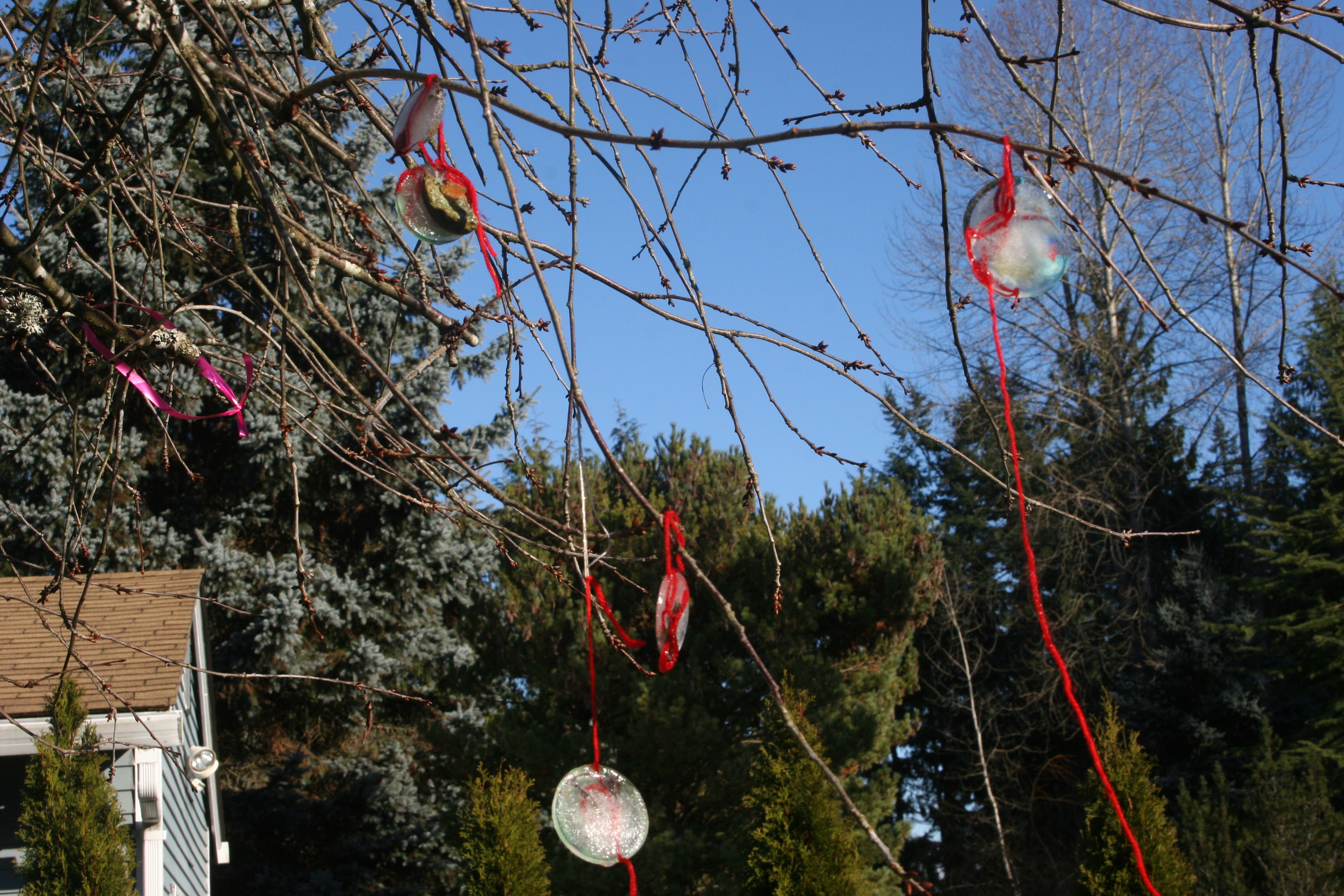
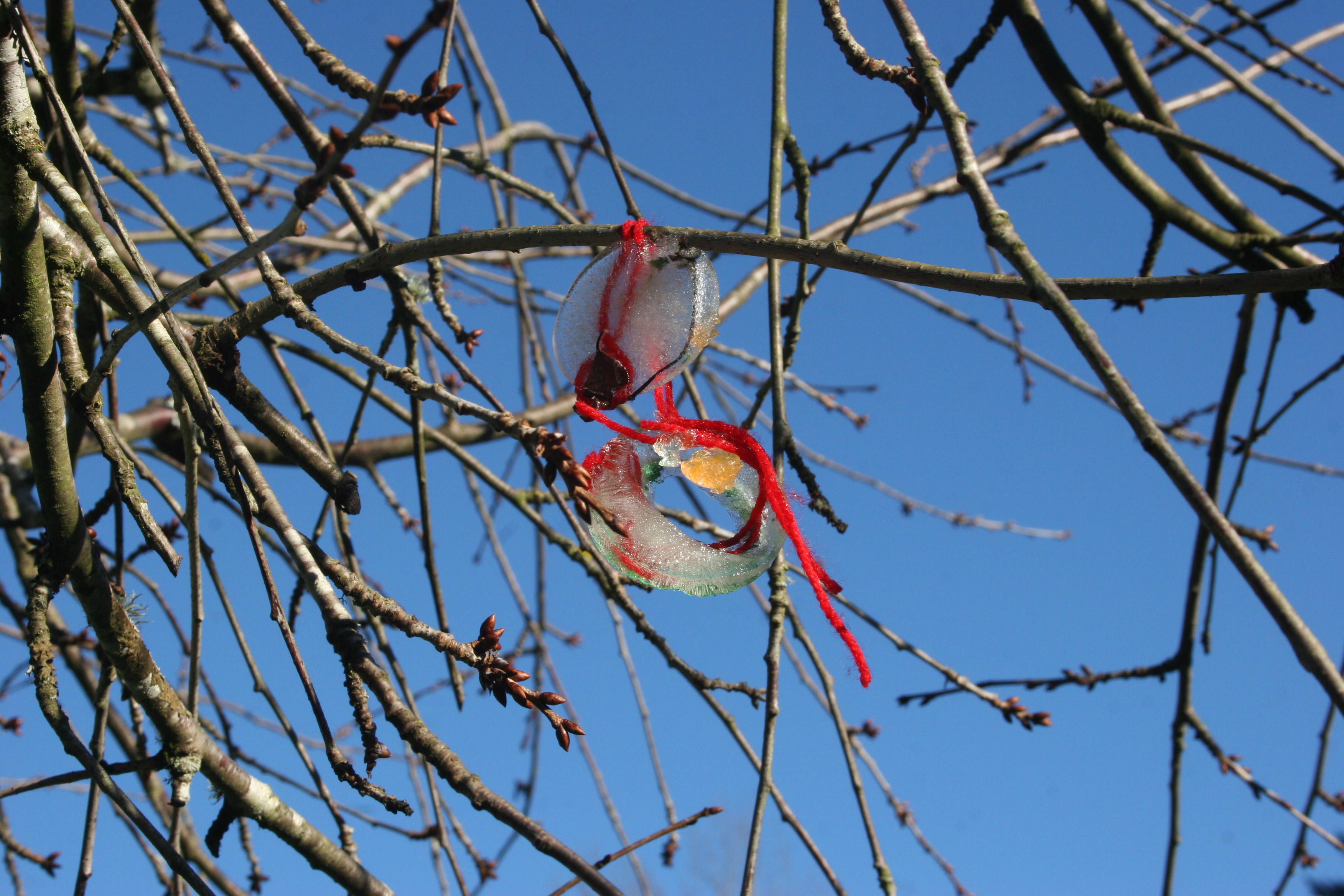
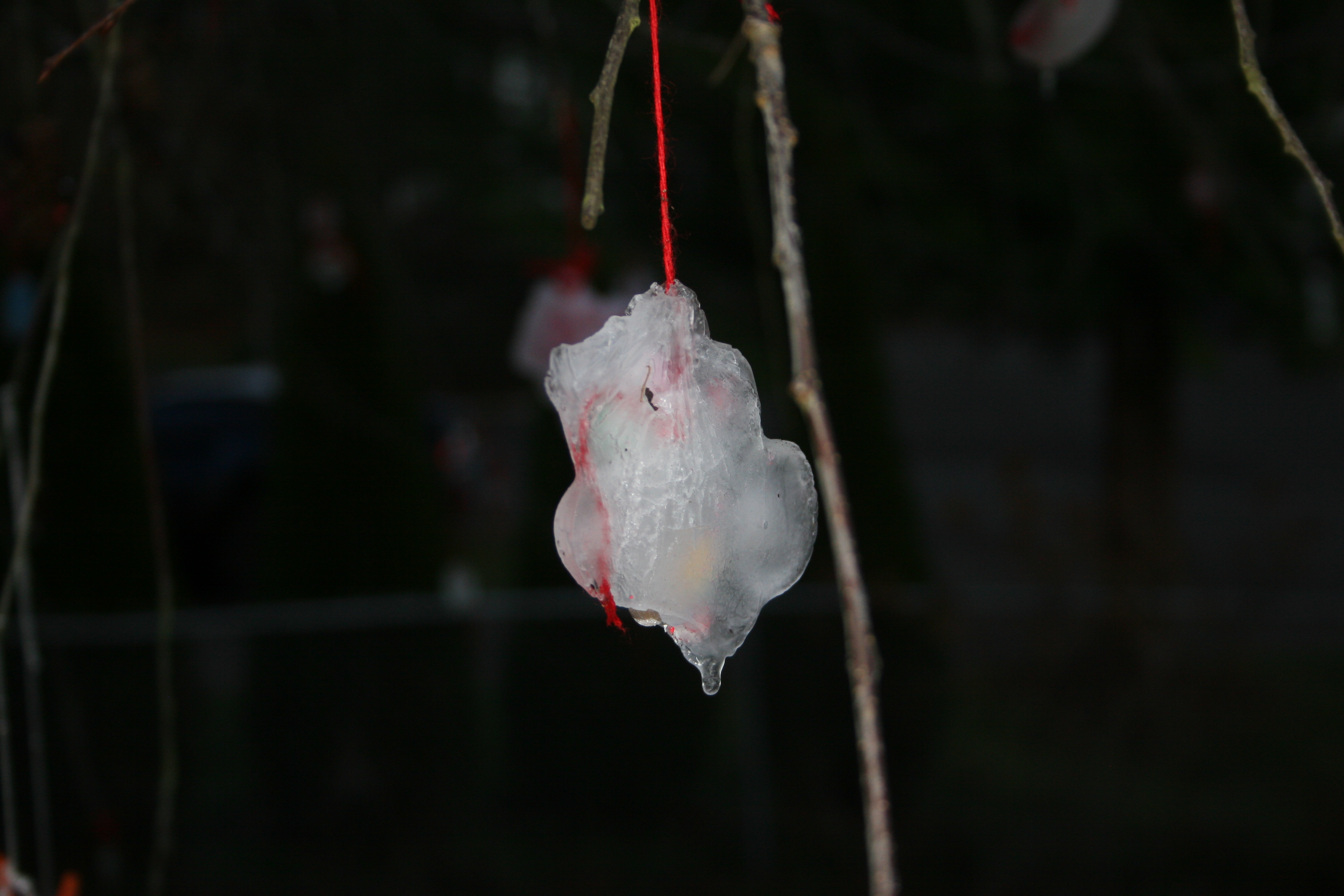
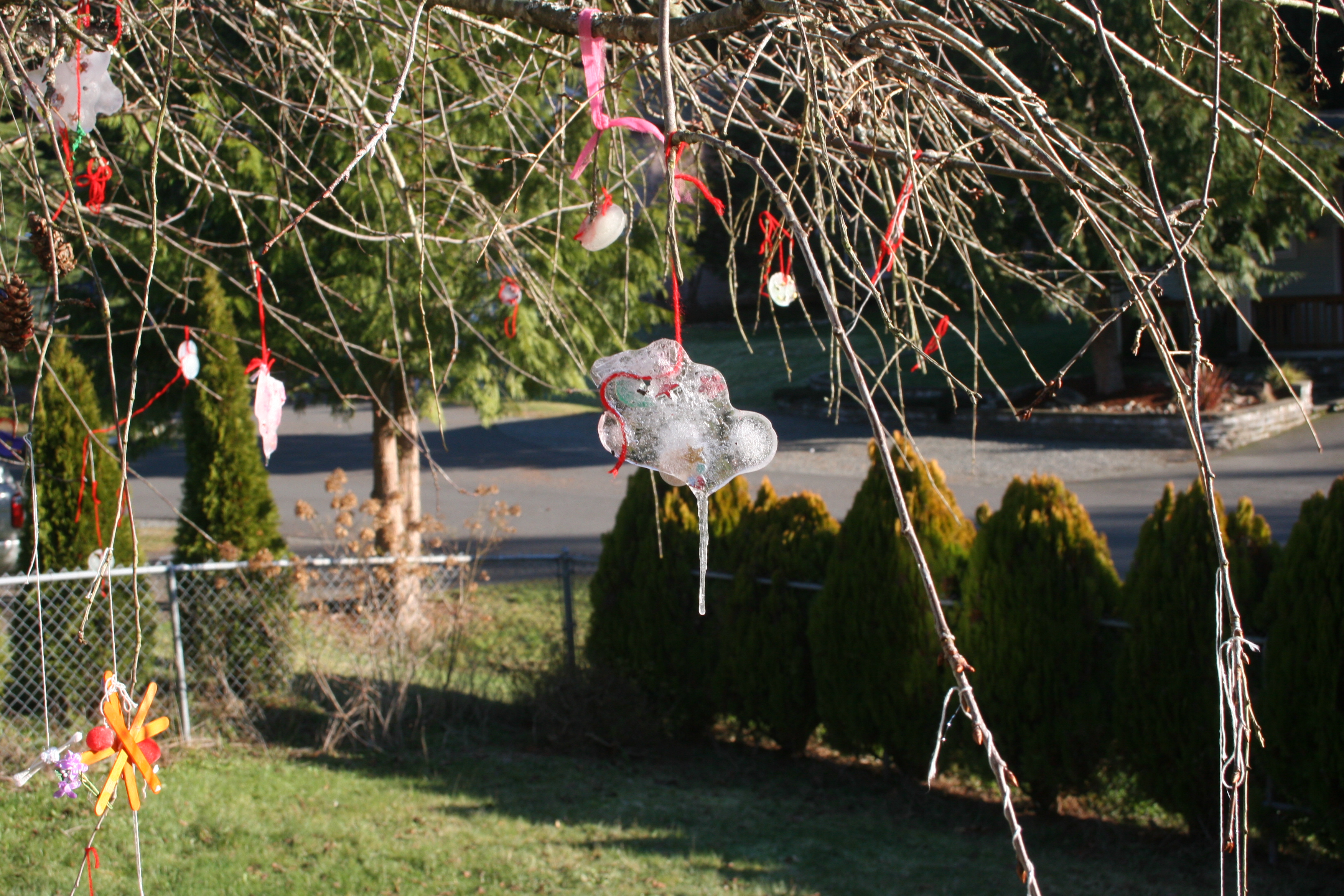
A few weeks ago we filled up my baking tins with water that we coloured with powder paint and dropped all manner of things into them. Shells, berries, leaves, sequins, buttons and even a stone were placed inside to make ornaments for our tree. The weather unfortunately instantly became warmer, so we had to wait some time before they were ready to hang. Even then, only the top layer of ice had frozen and within an hour of hanging them on the tree they had melted. We also discovered that if you colour water with powder paint it separates once it begins to freeze, so most of the ornaments were not the lovely colour we had hoped for.
The girls have been peeking outside every morning to check if there is any ice. This week they were rewarded with below freezing temperatures. The ice ornaments were finally ready! We hung them on the tree. The sun was shining and the tree stands in the sun until mid afternoon. I wasn’t sure how long they would stay this time as ‘plop’ one fell down from the tree.
Let’s put it by the door. That’s in the shade – it might make a nice present for Father Christmas.
A present for Santa
As we went inside I asked the girls to watch the ornaments from the window.
They are melting.
How do you know?
They’re wet and they’re dripping down.
What do you think will happen as they melt?
I don’t think it will fall off the string because the string is attached. It will just melt and the floor will be wet.
When we went out later there were more interesting observations
Look this one has holes in it. It might break not melt.
Can I touch one?
Yes sure.
It’s cold and wet.
Within an hour or so the tree was in the shade and the temperature was beginning to drop. We noticed that the drips were starting to turn into little icicles.
The girls thought this was really cool and the next day even more so when we saw large icicles had formed.
They rushed outside to feel them, touching them gently so that they didn’t break off.
A Winter Pirate Treasure Hunt
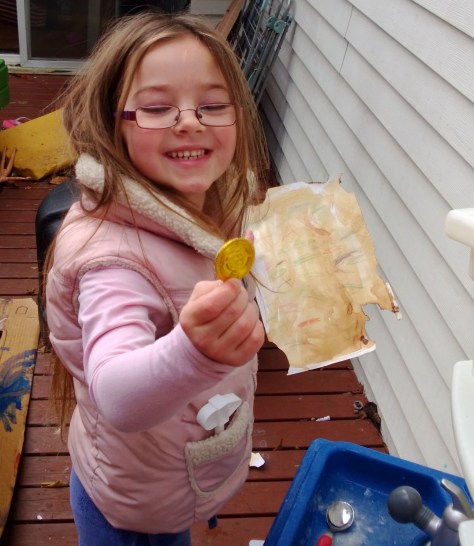
The weather was so cold that during the late afternoon I sneaked into the garden with a jug of water and some pirate coins. I put the coins in various containers and poured a little water on the top.
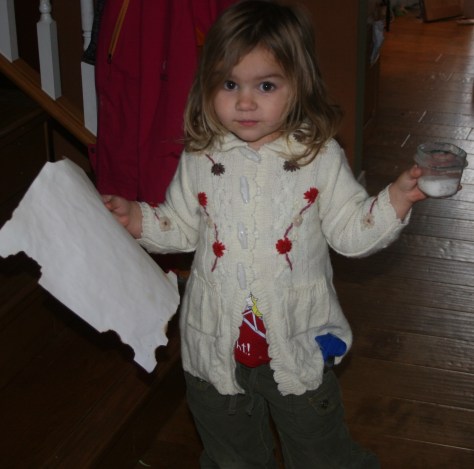
In the morning I invited the girls on a pirate treasure hunt. First they needed to make a map. I had some coffee stained and singed paper that in true Blue Peter fashion I had prepared earlier.
Next they needed their pirate toolkit:
A hammer
A spoon
A pot of pirate sea salt
Ready Mummy
Out they went and quickly found coins. The hammers were their first choice. They weren’t very successful so then they tried the salt. They found that if they used the spoons and the salt they could gradually get down to the coin and hook it out.
Got it!
This could take ages, if we got a jug of hot water it might be quicker.
The ice is still there you just can’t see it.
Drop it in the water
We were talking about the sea salt later in the day.
How do the pirates get salt from the sea?
Good question. The salt is in the water so how do you think they could get it out?
I don’t know.
Shall we try it?
Yes.
Little Scientists
What do we need to do to make the salt disappear into the water?
We need to dissolve it
How? Do you remember how we made jelly dissolve or the sugar water we make for the hummingbirds?
We put hot water on it. Let’s be scientists and do an experiment.
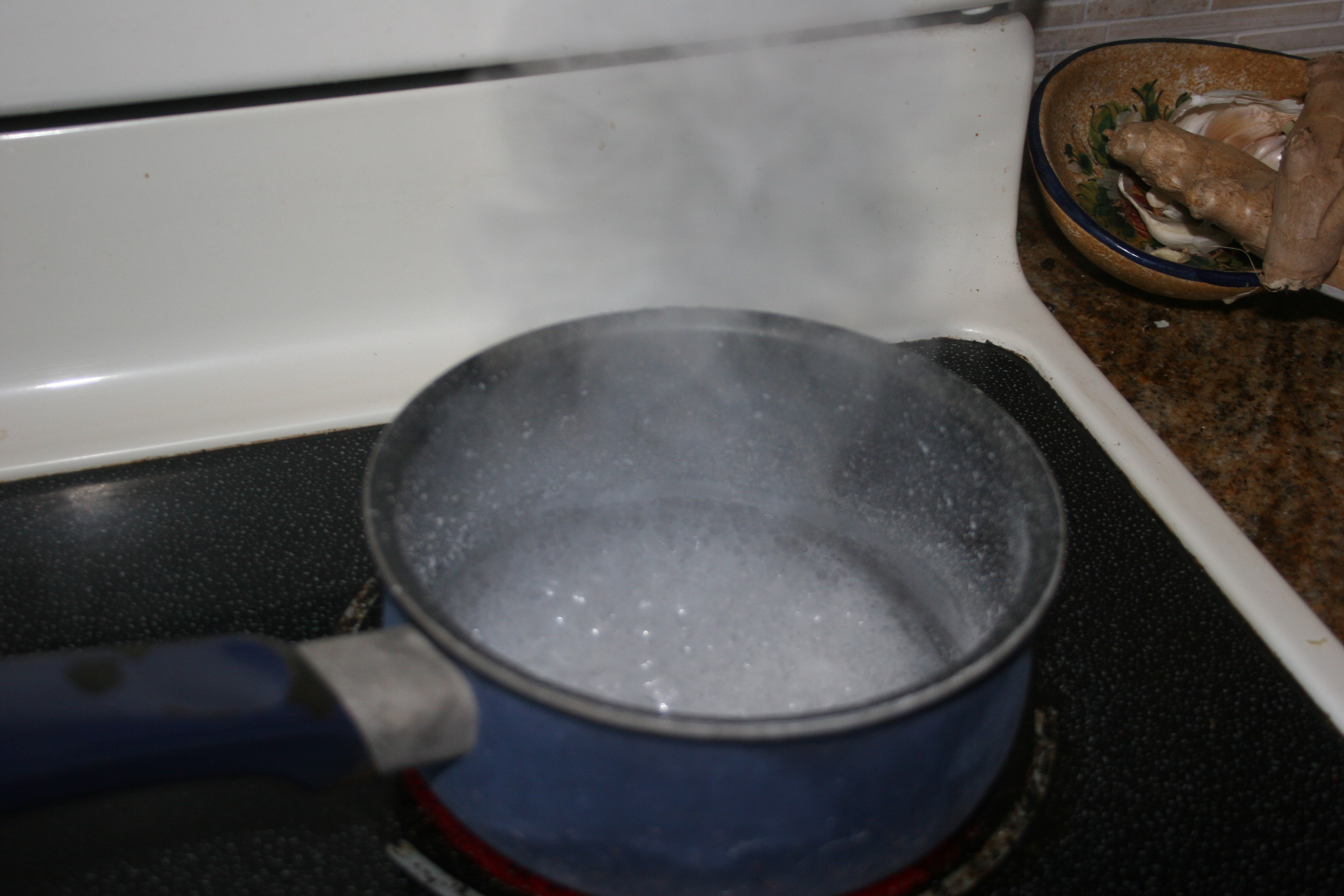
The girls helped to stir the mixture until all the salt had dissolved. We poured the mixture into a pan and put it on the stove.
What happens to water when it gets cold?
It turns to ice
What about when it gets hot?
I don’t know.
Watch. What can you see.
steam
If I put this spoon over the steam what can you see on the spoon.
It’s wet – water.
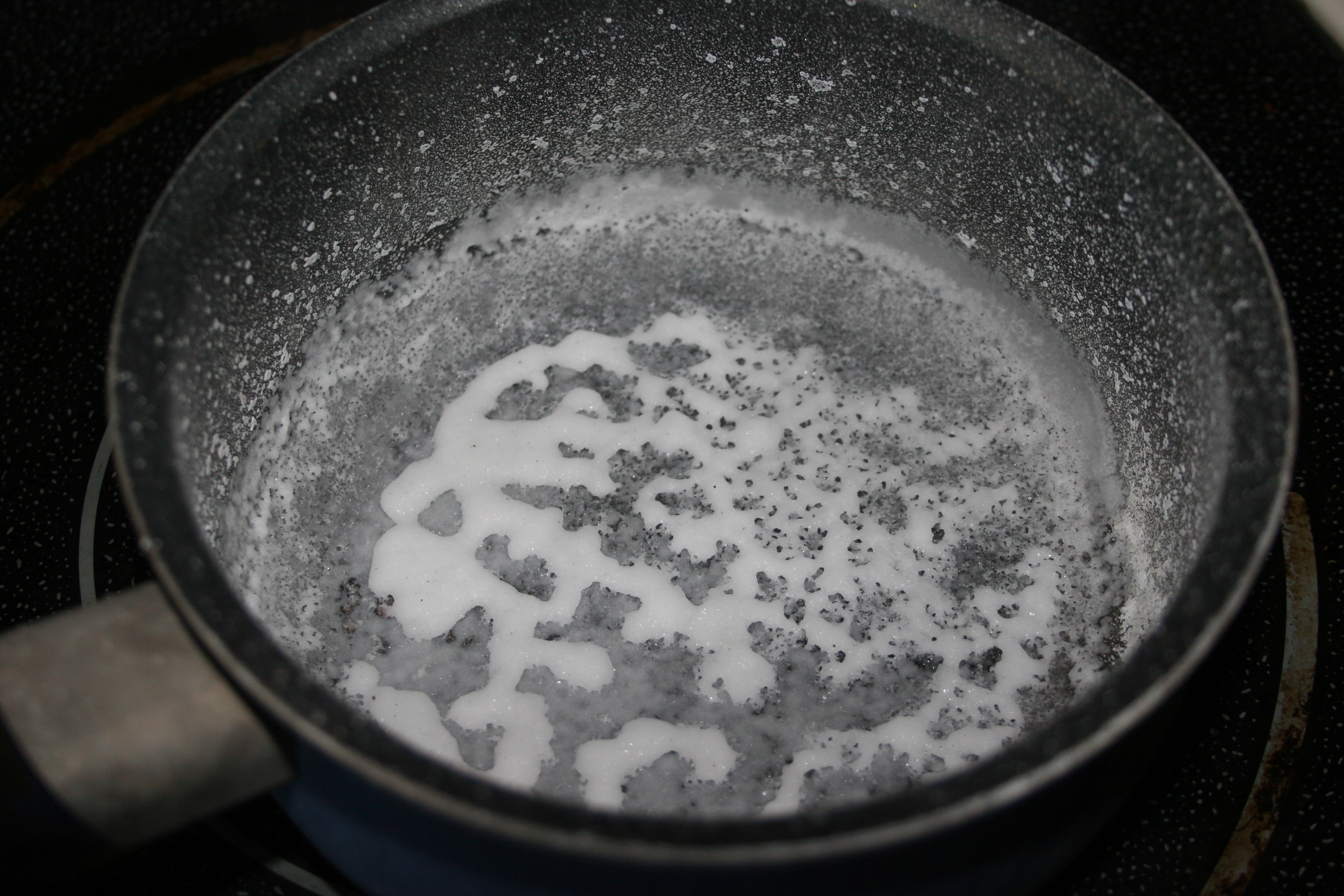
Yes the water is turning to steam. Now look what’s happening in the pan. What do you think the white stuff is?
I don’t know. Is it steam.
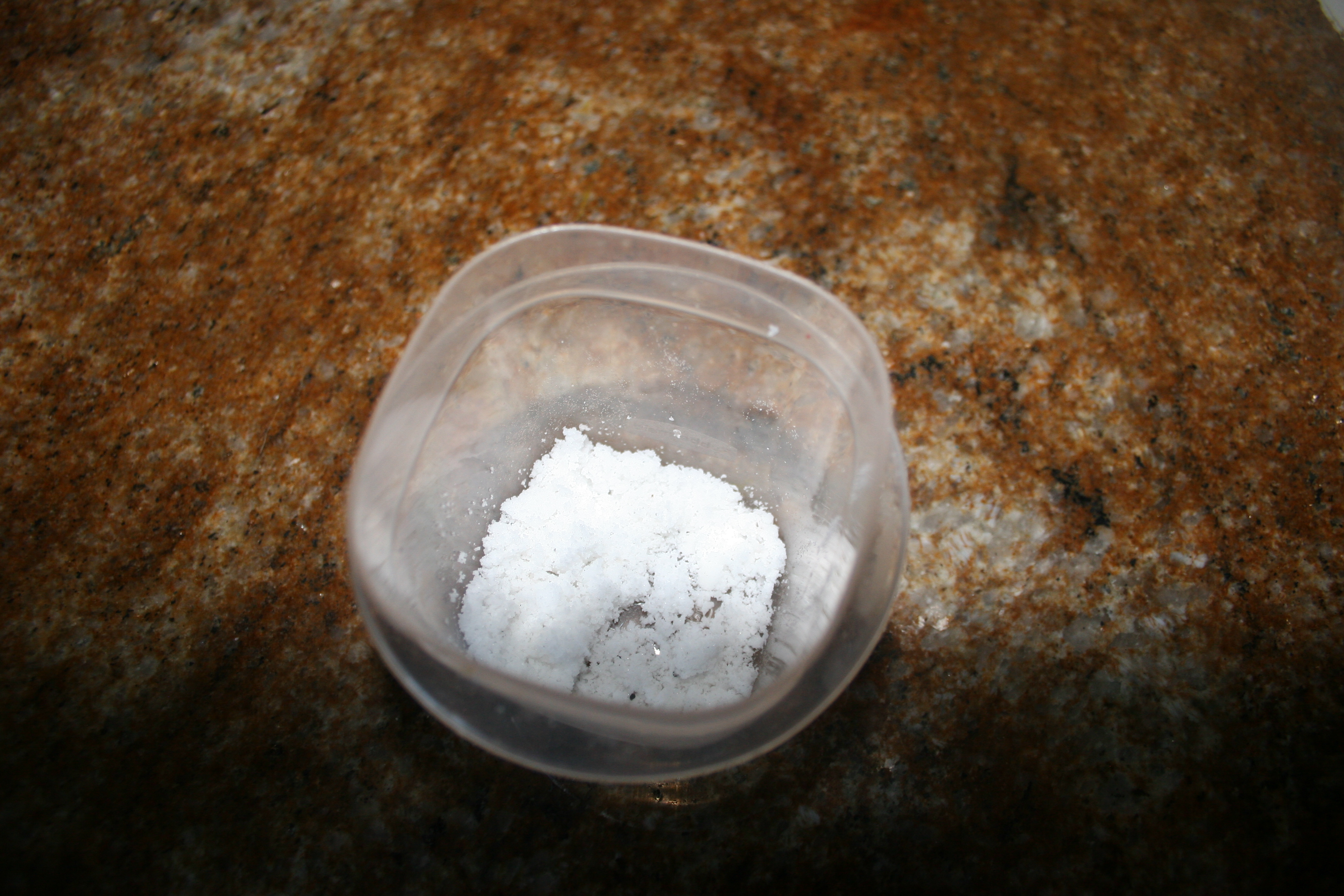
No. The water has gone now so what is left?
salt.
We had another idea for an experiment. If we put the salt back in water and then left it outside would it freeze?
I used to love frosty days when I was a kid because we could play on the way to school pretending to ice skate or breathe like a dragon. The same sense of wonder came over my girls when they looked out on a clear frosty morning. They dressed quickly and rushed outside to see if they could find ice . They found ice on top of the water table and in containers that we have on the deck.
They soon learned that ice is very cold!
Later in the morning the girls put on their gloves to go out on an ice hunt.
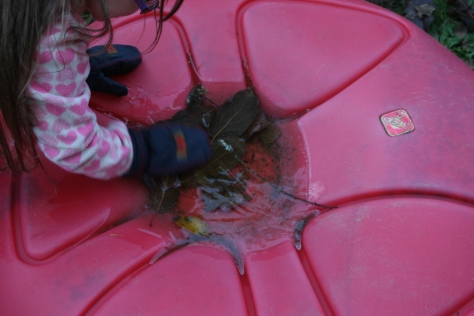
Look there is water and a leaf is floating. The ice has edges, I think there is water underneath.
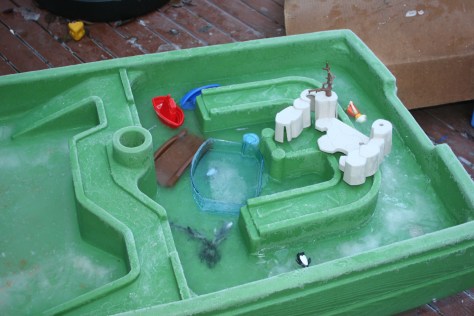
I removed the lid from the water table. The girls were very excited to find ice inside there too. We added the penguins play set and a few whales.
We made a slide for the penguins with some of the broken ice.
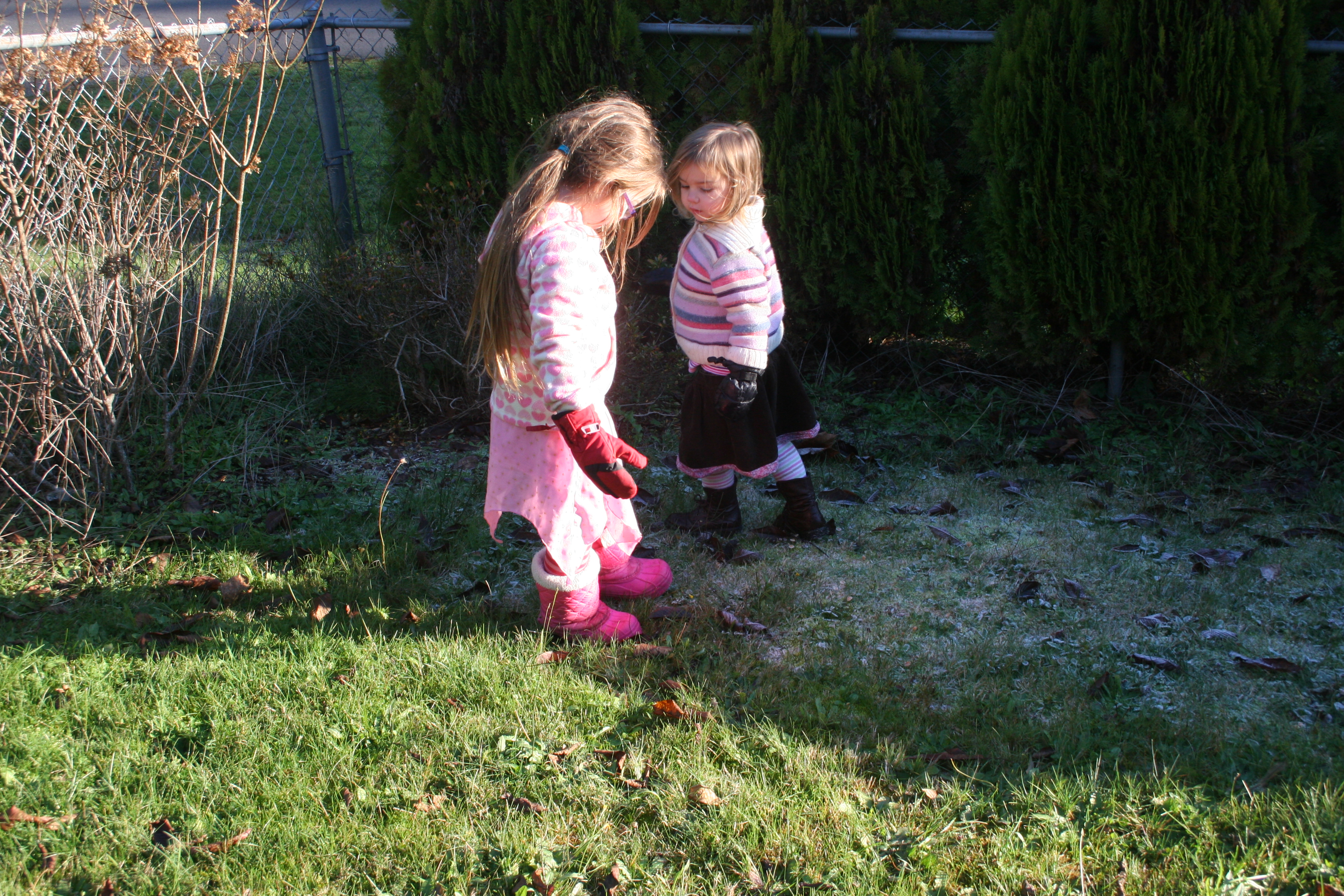
When we got to the front of the house we found a small patch of frost.
Why is it frosty here and not anywhere else?
Because the sun made it melt.
So, why didn’t this bit melt?
It was in the shade.
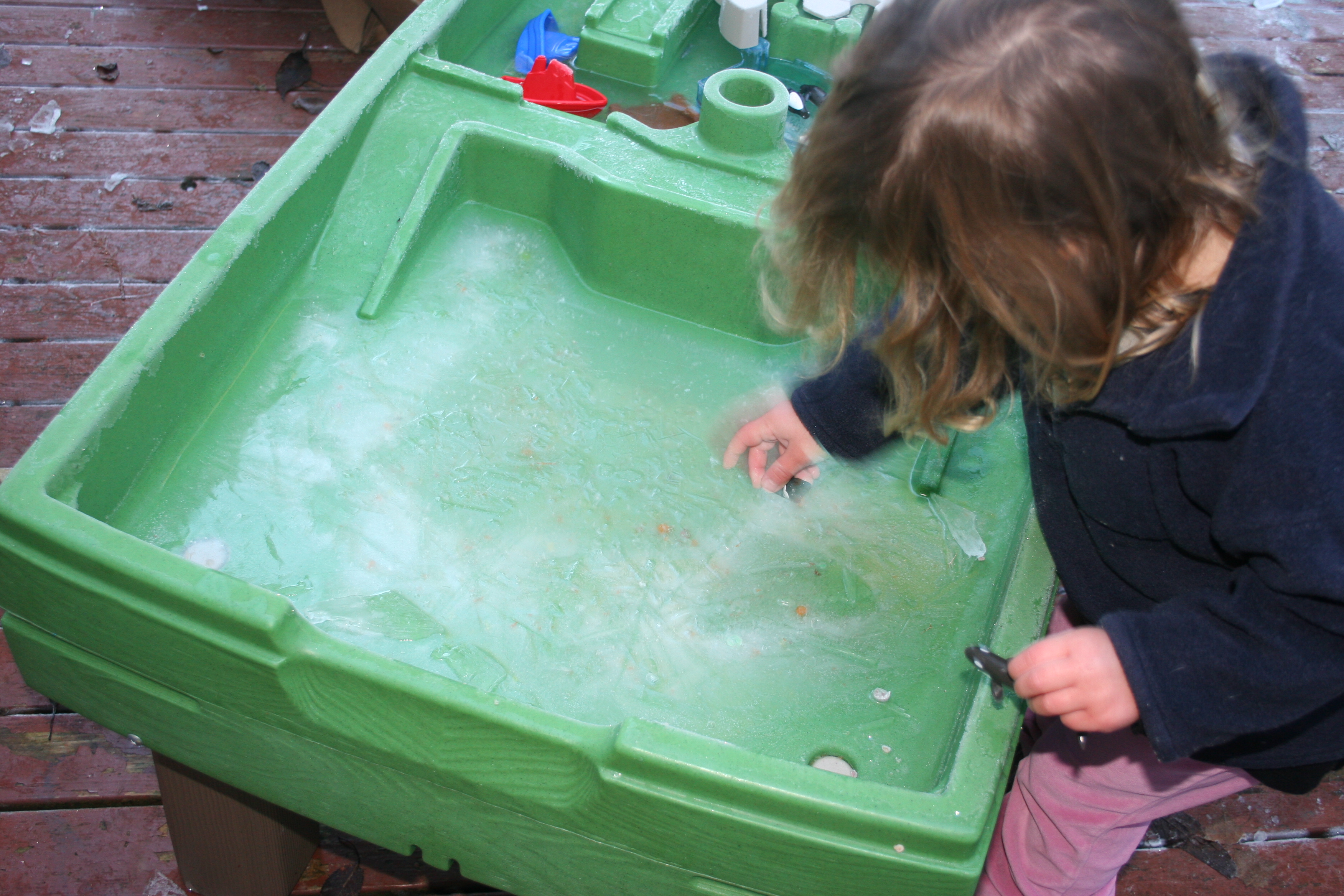
We decided to leave the lid off the water table to see if we could get even more ice the next day. When they woke up the next day the girls were desperate to get out before any of the ice had melted.
First they checked the water table.
The ice was thick and some of the penguins were buried underneath.
Let’s see what else we can find.
This slideshow requires JavaScript.
We went back to the water table where the girls found 2 scoops filled with ice.
We can’t get it out.
Shall I run it under the hot tap like I do with the ice lollies?
Yes please
Next the girls turned their attentions to the animals stuck in the water tray.
Please can we get them out? Can we put hot water on them too?
Yes. I’ll get some.
We poured water onto the ice to free the animals, they could feel the hot water making holes and as we poured more on they were able to free them.
The other side of the water tray made a perfect ice rink for the penguins.
I’m so glad we are home pre-schooling on days like this. Our next project is to make ice decorations for the tree at the front of the house and using pirate treasure maps they made earlier in the week, hunt for coins buried in the ice. My pirate obsessed girls will be armed with special pirate tools and a bit of magic sea salt. Arrrr.
Autumn is a time for woodland walks, collecting interesting things along the way and looking out for animal homes and habitats. As a child we had nature tables at school and we were encouraged to bring in conkers, sticky buds, acorns and leaves. I used to love to walk in the woods and collect things. We’d put nuts and conkers in their cases in the airing cupboard until they opened. I used to lie in the grass scouring the leaves for 4- leafed clover. I found one when I was about 6 years old. I looked after it all weekend and on Monday carried it to school as the prize exhibit for the nature table. The temptation to fiddle with it however, was so great that on the way one of the leaves fell off. I turned up with an ordinary clover and a loose leaf and so no-one believed me.
We’ve been foraging for Autumn things this week. In the garden we have an abundance of Fir Cones, Maple Seeds and coloured leaves but we wanted to find other things like acorns and conkers. I asked a friend where we might find conkers.
Conkers? What are they? was her reply.
I found a single, solitary conker that had managed to make its way with us from England.
Oh, it’s a bit like a chestnut.
Yes, a rounder chestnut and the casing is different, with larger more spaced out spines and they are poisonous.
Outside the girls ballet class we found a variety of different pine and fir cones from tiny ones in clusters to great big narrow ones. We walked in the woods to see what else we might find. We found….. more pine cones, …. more maple seeds,… more maple leaves but nothing different. I suppose we often take the things we have in our environment for granted – I love the towering Evergreens we have here, mixed in with the colours of the Maples but I do miss conkers and acorns.
Wild animals on the other hand are extremely varied. We watched huge salmon jumping in the river, saw enormous yellow butterflies and watched a small snake basking in the sun. Our favourite visitors are hummingbirds. The first time I saw one I thought it was a dragonfly but when it rested on a flower I was so excited to discover it was a hummingbird. I had no idea hummingbirds were native here. I read up about attracting them to the garden and bought a hummingbird feeder that we fill with 4 parts water to 1 part sugar. We now have regular visitors outside our window.
This slideshow requires JavaScript.
Of course there are also the more scary types of wildlife. The ‘ballet moms’ were talking about finding bobcats, cougars and coyotes in their garden and black bears on woodland walks, especially near the rivers now that the salmon are spawning.
RSPB Get Outdoors
As I was musing about our appreciation of the natural world and the things we miss from home, a new report from the RSPB was brought to my attention. Connecting with Nature presents the findings of a three-year RSPB research project measuring just how connected to nature the UK’s children really are. Connection to nature is measured in 4 areas:
Enjoyment of Nature
Empathy for Creatures
Sense of Oneness
Sense of Responsibility.
You can take the questionnaire to see how connected your children are. If you are outside of the UK, the report also gives you the criteria used for the questionnaire so that you can investigate how connected children are in your area.
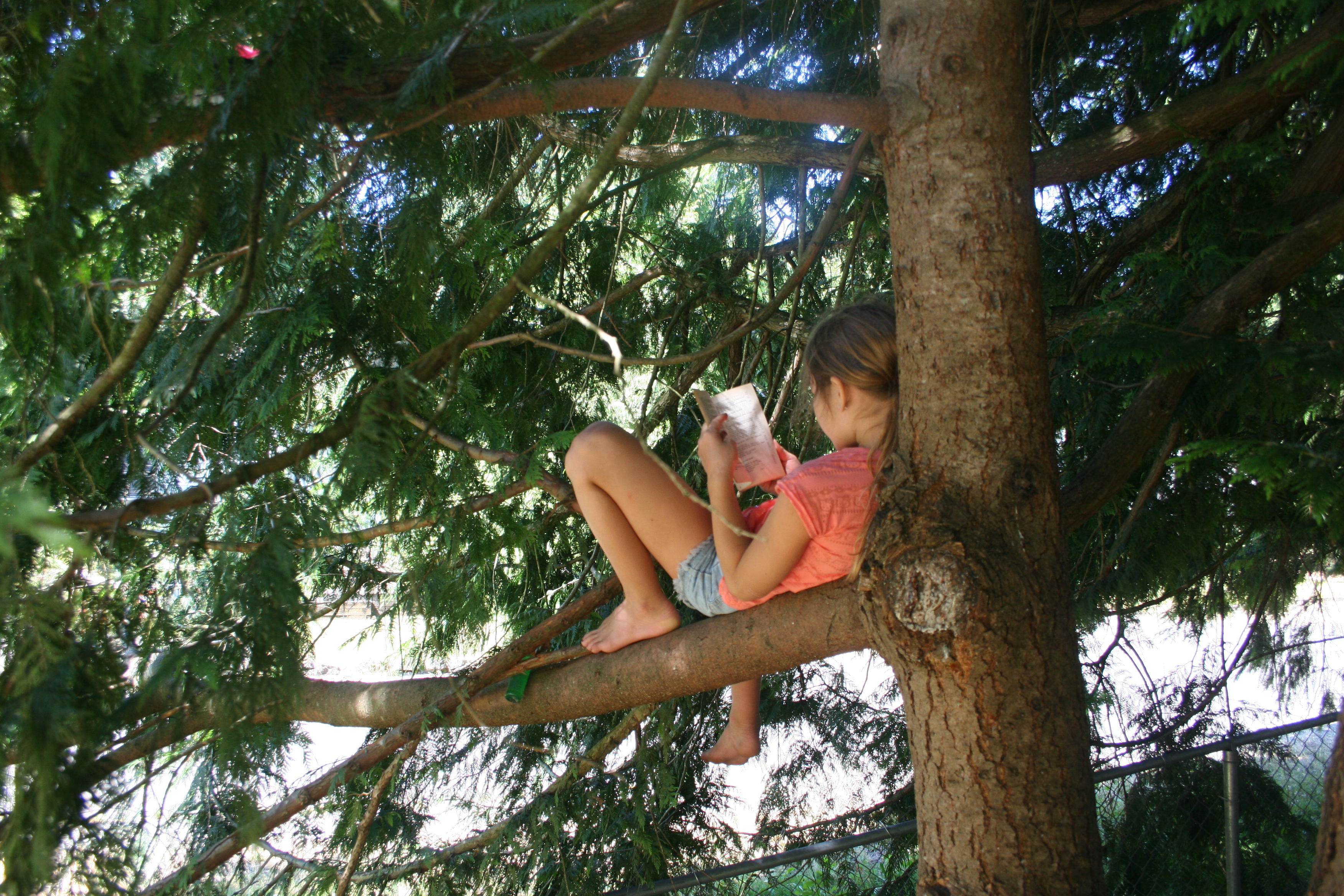
I think the sense of oneness is an interesting one. How young was I when I first felt a sense of oneness with nature? I know my youngest daughter will always choose to go outside collecting sticks, pouring rainwater and arranging stones – is this an early sign of oneness with nature? My eldest daughter emphatically announced that she felt peaceful when she was in a natural environment. In a household with 2 noisy pre-schoolers her favourite haven is reading a book in a tree in the garden.
I know for me, I feel at peace by the sea or in a woodland, both places I spent a lot of time in as a child. I can’t wait to visit the National Parks here in the US, to see the amazing diversity of the natural world here.
Connecting with nature has many benefits from physical activity, mental health and a sense of well being, education, social interaction, empathy and the impact on the sustainability of the natural environment. The study found that only 21% of children aged 8-12 in the UK have a connection with nature at a level that is realistic to their age.
“ There are statistically significant differences between children’s connection to nature at a national level across the UK, as well as between boys and girls, and British urban and rural homes.”
Surprisingly girls are more likely than boys to connect with nature and urban children more likely than rural children. Further studies will be undertaken to determine why this might be. Looking at the questionnaire I think it may be that the questions are angled at more feminine pursuits, feeling peaceful in nature, collecting shells, listening for sounds and taking care of animals are not exactly cool for young boys.
The research will add to the growing evidence base about children and nature. This includes a study by Natural England which suggested that factors contributing to connection are in decline. It reported that only 10% of children in the UK played regularly in natural places in 2009, compared to 40% in the 1970s.
Getting children out in the natural world when they are young won’t guarantee a continued interest once the world of school, clubs, homework and computer games takes over but it will certainly put them on the right track.
The environmental identity developed by children between the ages of 3 and 7 is an emotional affinity towards a specific aspect of nature which had been strengthened by providing positive experiences with nature on a regular basis. (Karls and Ittner 2003).
Some researchers also believe that there is an optimal moment usually between the age of 6 and 12 which form a person’s attitude to nature; perhaps the 4 leafed clover was mine.
When I started this blog I wanted to share my ideas and knowledge of early education but I also used it as a way of expressing the realities of life with 3 young children.
As I browse through my more recent material, you could be excused for believing that I have an idyllic life. The sun is always shining, my kids roam around outdoors all day, I come up with amazing things to do with the kids, I take them out to interesting places, they are creative, funny, clever and well-behaved, we bake, pick fresh produce and make fresh juices………
I find many inspirational articles from other blogs but for all the thought-provoking stuff I read, there are also a proportion that make me feel inadequate. I hope I’m not turning into one of them.
The amazingly organised Reggio inspired playrooms put me to shame. My boxes are neatly labelled, everything has its place but I am by nature a messy person so there always seems to be something that doesn’t quite fit or is not put away properly (if it is put away at all ).
Some positive parenting blogs show everyone acknowledging their child’s feelings, talking in a calm whisper and never using the word ‘don’t’. It’s great in theory but I sometimes need to read stories of people whose kids are too loud or women who are struggling to make it through each day.
The reality is:
When I’m trying to sort out paying a bill, finish a spreadsheet or manage a booking and the kids keep nagging me for food over and over – I shout.
When I’m almost at the end of my task and one of them knocks something over, needs help on the toilet or they start arguing with each other I get exasperated.
At the end of the day when I’ve just about used up all my resources and they are still running around challenging every instruction, I speak to them in a frustrated tone.
When I’m trying to keep a train of thought in my head for more than 5 seconds and they have asked me yet another question – I discourage their inquiring minds.
When I’ve stayed up late and I just can’t seem to get going in the morning I allow them to sit and watch television for a lot more than the recommended 30 minutes.
When I rush them around from place to place and they stop to admire a stick, a bee or a flower, I tell them to hurry up.
When I feed them pasta and pesto for the 3rd time that week because I’m not organised enough to prepare food in advance.
When my eldest wants to read me a chapter of Harry Potter, I’ve always got something more important to do.
So, if you feel inadequate when you look at the things we do, remember they are just a snap shot and really I am just like you.
If I’ve burst your bubble and you’d really like to think I’m perfect that’s okay too, the things we do are real, but who can be perfect for 24 hours a day?
I laughed to myself as I watched my 2-year-old playing in the borders, hiding a stick in the bushes and drawing in the dirt. A few feet away was a very expensive sensory playground with musical instruments, water features and a little bear cave. It was very impressive, but the lure of a stick was just too great. Given the choice I’m sure regardless of the expensive equipment we provide, most children are happy with a stick, a pile of stones, or a tub of water.
My eldest was obsessed with tiny stones when she was small. Everywhere we went she would stop to pick them up or take them home in her pockets. If we were in the garden she would make collections of little stones and spend hours moving them from one place to another. She was very young at the time but I never stopped her for fear that she may swallow them. I simply made sure I was sat nearby so that I could see what she was doing.
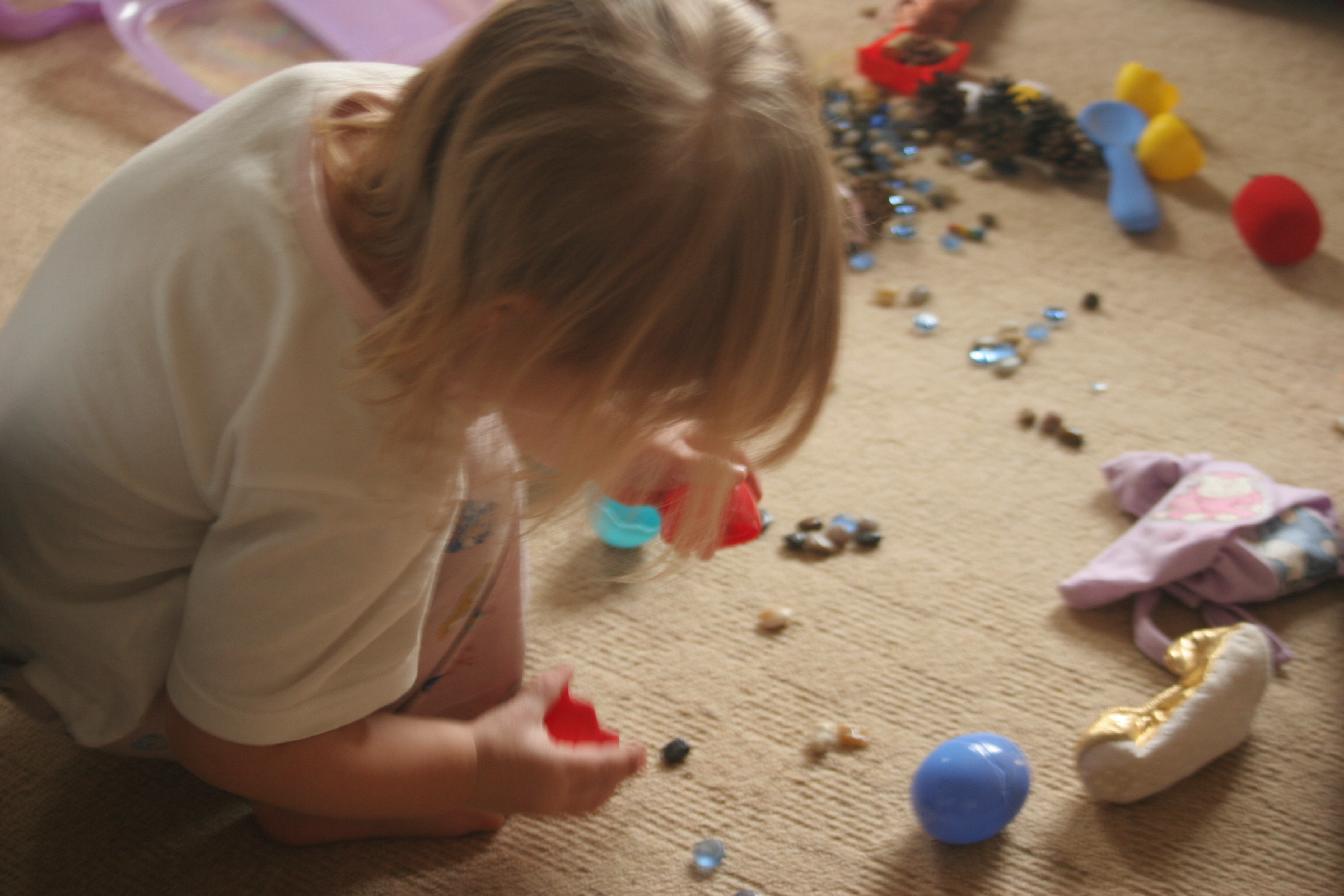
filling eggs with stones and glass beads.
My 2-year -old loves sticks. We have 2 rules:
No sticks in the house
Do not point sticks at people’s eyes.
Sometimes they are magic wands, Sometimes fishing rods or sometimes simply something to carry around. Every stick is greeted with equal excitement.
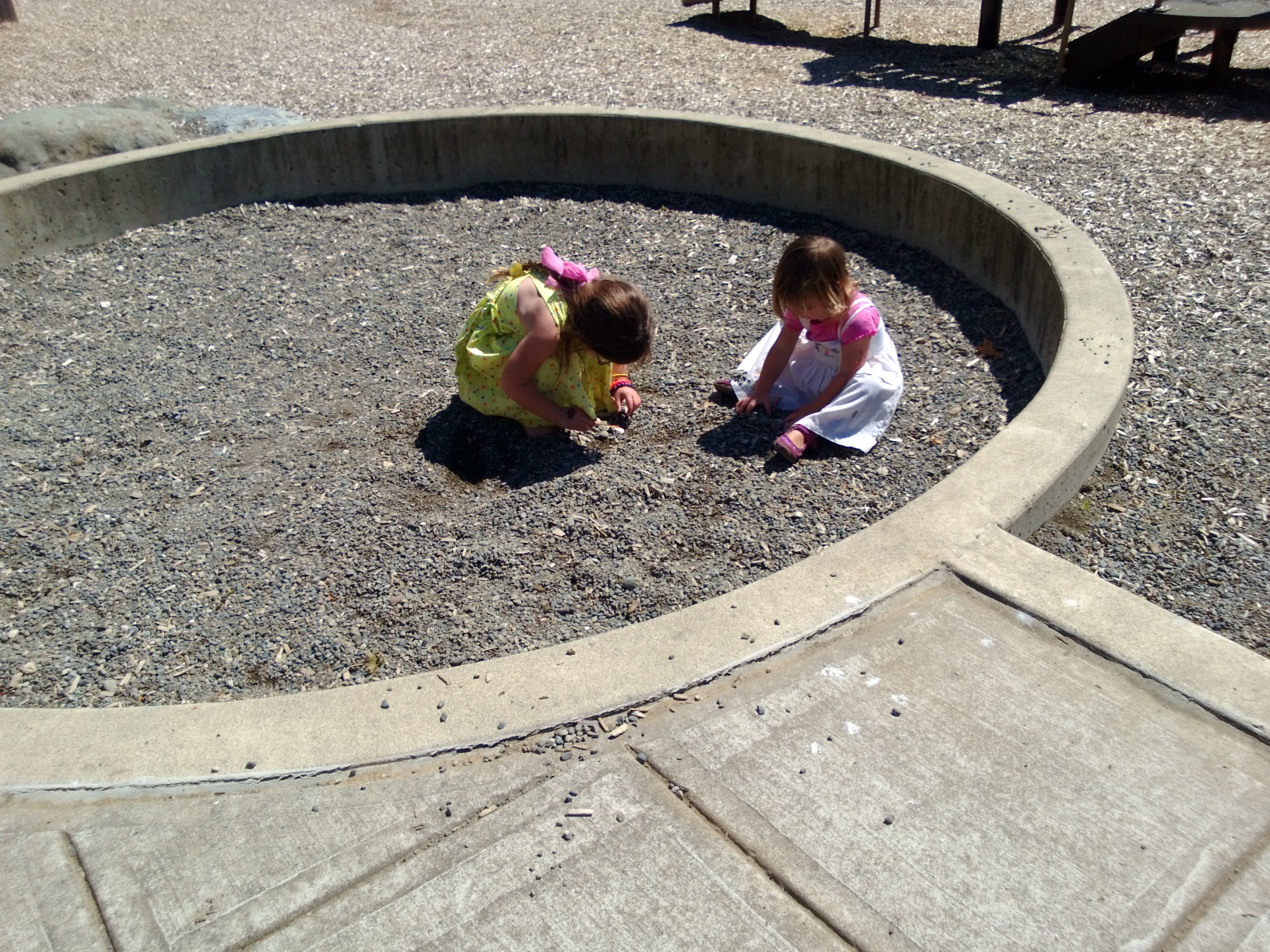
All 3 children play for hours in the sand pit. When I first moved to the US I didn’t think the girls would like the grey, gravelly play sand they have here. I was wrong, they love it as much, if not more than the fine golden sand we had in the UK. Even at the park they chose to play in the dirty gravel rather than on the equipment.
The Theory of Loose Parts
In 1972 the architect Simon Nicholson devised the Theory of Loose Parts. It grew from the notion that all children love to interact with variables. Variables can be anything from materials and shapes to media such as gases and fluids and are used to discover, invent and have fun. The theory of loose parts is as follows
‘In any environment, both the degree of inventiveness and creativity, and the possibility of discovery are directly proportional to the number and kind of variables in it. (Nicholson 1972)
Put simply, the playground with static play equipment will not offer a child the opportunity to discover and create their own scenarios as freely as one that is less predictable or restrictive and offers moveable objects that can interact with the child’s play. A swing is a swing but the gravel can be a home for a bug, fairy dust, a cake, something to draw in, a track for a car and other endless possibilities.
We have the perfect garden for playing with loose parts, with an abundance of trees, pine cones, stones, dirt etc. I decided to organise these a little to see if it would change the way the children played with them.
Storage for Loose Parts
We had an old clothes horse in the garden that was waiting for a purpose. I bought a few hanging baskets and hung them on the clothes horse along with a few other baskets I had found. I also clipped a variety of containers to the clothes horse using an underwear dryer (we also use this for drying paintings).
Using the clothes horse means that it is fully portable making it easy to move out of the rain or to the sandpit, paddling pool or lawn .
The Slide show illustrates some of the things we collected .
This slideshow requires JavaScript.
Other ideas for loose parts that can be stored outdoors
sticks, twigs
glass beads, marbles, buttons, bells, beads
feathers
lolly sticks
pegs
acorns, conkers and seeds,
string
large things like pallets, tyres, flowerpots, fabric, boxes, pots and pans, tubes, guttering, bamboo canes, bricks, planks, logs, driftwood.
I love to see the children using their environment to stimulate imaginative and creative play. Here are some of my favourites.
We could build a boat
Carrying a rock to build a boat on the beach (the family were sailing). Moving heavy objects around was a key part of the play.
Come on row faster!
What happens when I bang the stick with a pebble?
The youngest became absorbed in pebbles and sticks, abandoning the project for a while.
Let’s ride on a horse together
Using loose parts with a large piece of clay
I’m putting them on the top
The finished product
1 year old transporting pistachio nut shells
moving from one container to another
Making a bed with magazines
Let’s put the stones in here and make a magic potion
My eldest daughter has been an avid potion maker all her life. We are always finding concoctions in her bathroom and when she was young she would leave them on the windowsill of her bedroom or on the side of the bath and if you knocked them off whilst having a relaxing bath the cold would give you the shock of your life. She is now a huge Harry Potter fan, having read all of the series 4 times and her potions are taking on new meaning. Her younger sister is following in her footsteps. Now that the weather is nicer I set up a little potion station for them in the garden – they love it.
It is a great sensory play activity and science experiment, they got their hands in, testing and smelling the potions and used all kinds of things from the garden. Best of all I love how the imaginary play scenarios evolved. I suggested to my 9-year-old that she might like to make a book of potion recipes.
‘Yes’ she exclaimed excitedly, ‘ But we’ll need about 70 pages, the McClary recipe book’
























 Right from the Start