Category Archives: education

Woodland Park Zoo for Under 8’s

zoo offer

When I ask the girls where they would like to go, a popular response is the zoo.  In the UK we were members of Bristol Zoo and visited there regularly.  Having membership made our visits more relaxed, we didn’t have to run around trying to see every animal and if the children wanted to play in the playground all day that was fine too.

Woodland Park Zoo is more spacious than the zoo back home so we are able to see larger animals. Recently, we were invited to Woodland Park to see some of the activities available  in the Zoomazium  – a nature inspired play space for the under 8’s.  To be honest we have always avoided Zoomazium during previous visits, expecting it to be a large, noisy soft play.  I was pleasantly surprised however, to see a mix of play spaces and activities.  There is a designated space for toddlers, fully enclosed and safe, with a library  area to the side.  The children can also explore the cricket exhibit.

toddler play space
toddler play space
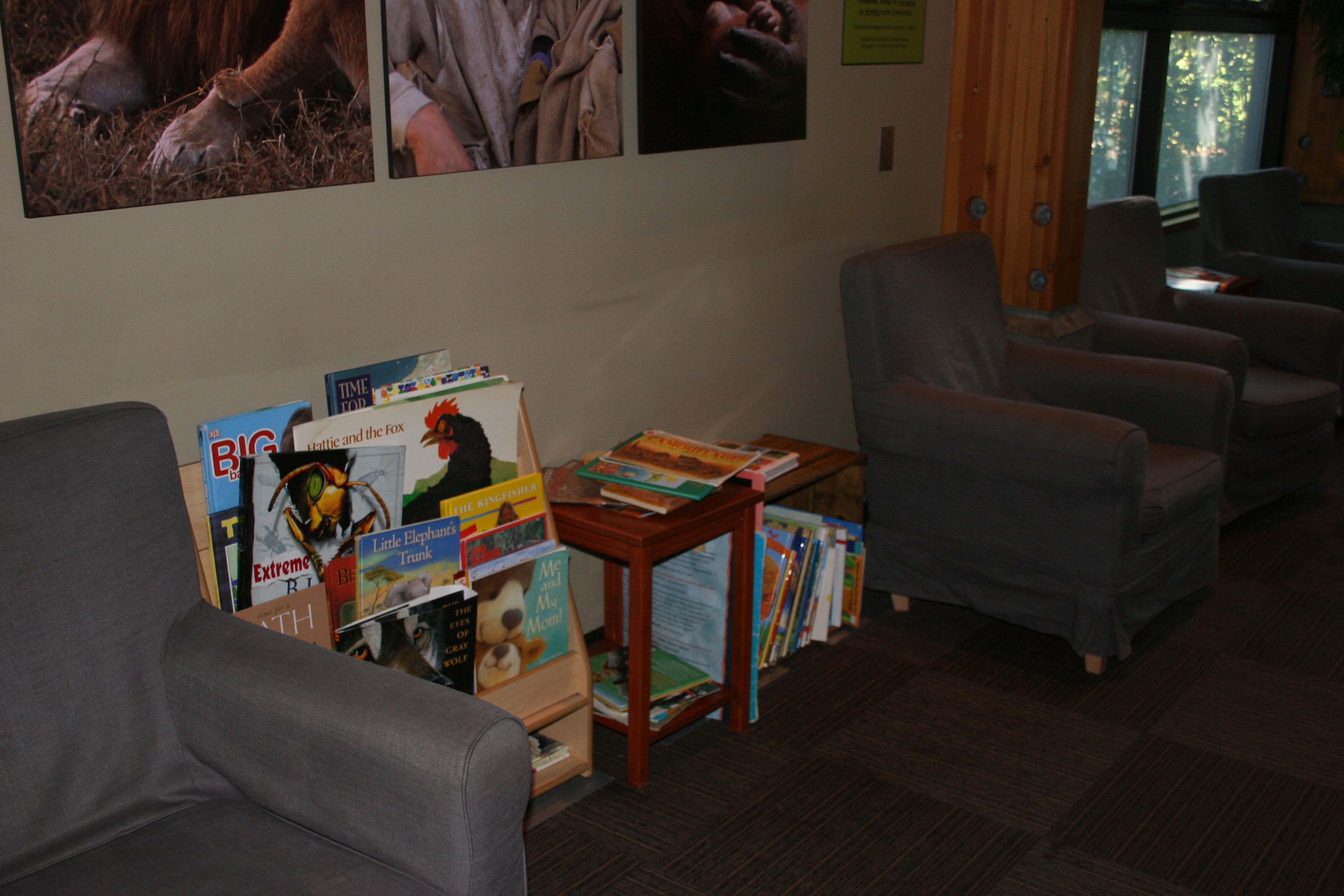
library area
library area
cricket exhibit
cricket exhibit

The play area for older children has rope bridges, places to climb and lots of little caves that are perfect for hide and seek.  There are also tables with toys for building, a stage area and a sensory area to explore.
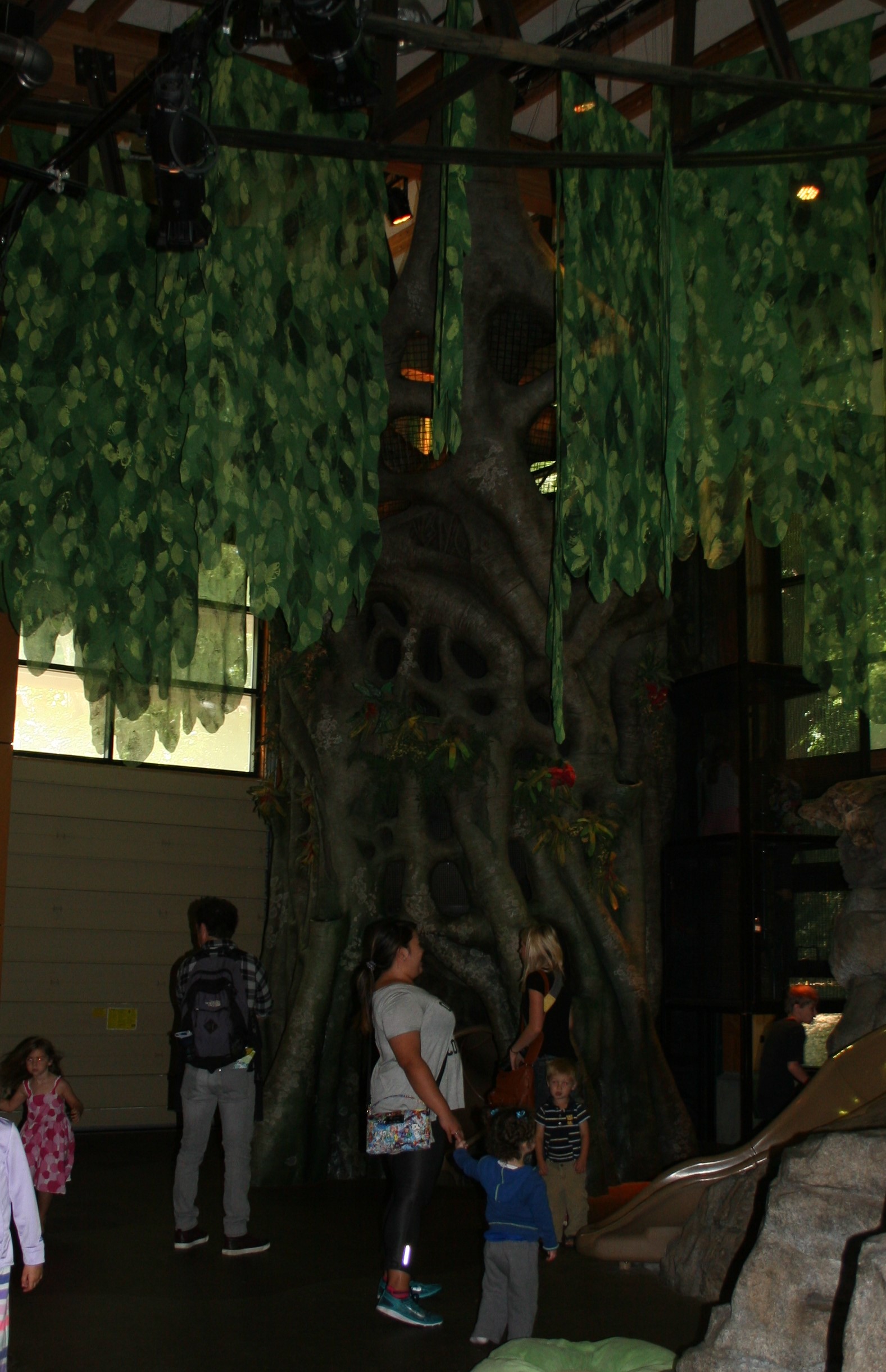
IMG_0756

IMG_0755

Zoomazium is the perfect place to explore if you want to escape the heat (or cold) for a while but it is also a good starting point for your visit to the zoo.  Creature Feature occurs every morning at 10.30 and encourages children to get close to some of the smaller animals at the zoo and learn about them from zoo staff.  Our visitor was an armadillo.

armadillo

My favourite Zoomazium offering was activity backpacks that the little ones can take with them around the zoo.  Each one has a different theme and they are packed with activities, toys, books, magnifiers and things to look out for during your visit.  After a lot of deliberation,the girls chose one each; the back yard and big cats.
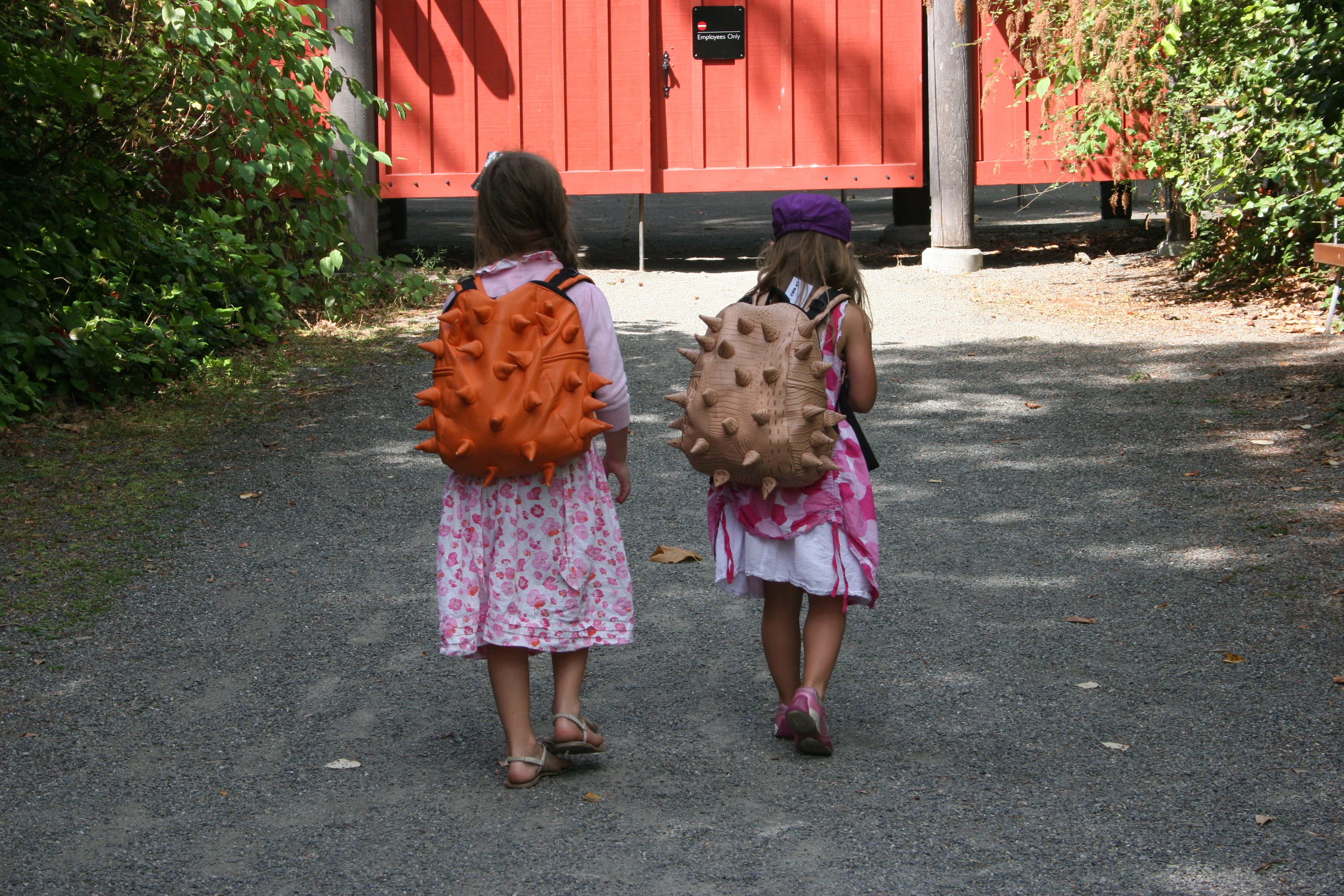
zoomazium backpack

I love the design of the backpacks, they look so cool and we had lots of comments as we wandered around.  The backyard backpack had a number of activities to complete in the backyard of the Zoomazium or  when exploring the rest of the zoo.

Can you find these things?
“This feels smooth”

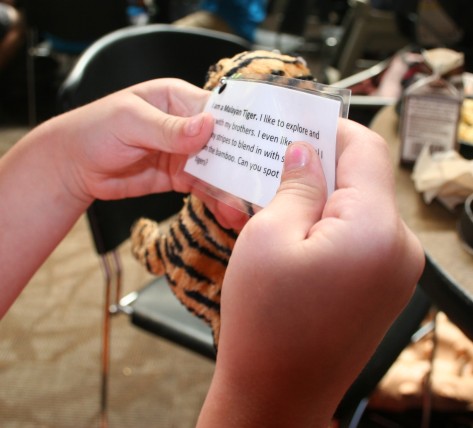
The big cats backpack was a good starting point for exploring the new Banyan Wilds exhibit.

finding big cat markings

tiger markings
I found a tiger.

Having the backpacks, encouraged us to take it slowly as the girls wanted to stop and take in the contents of their packs.
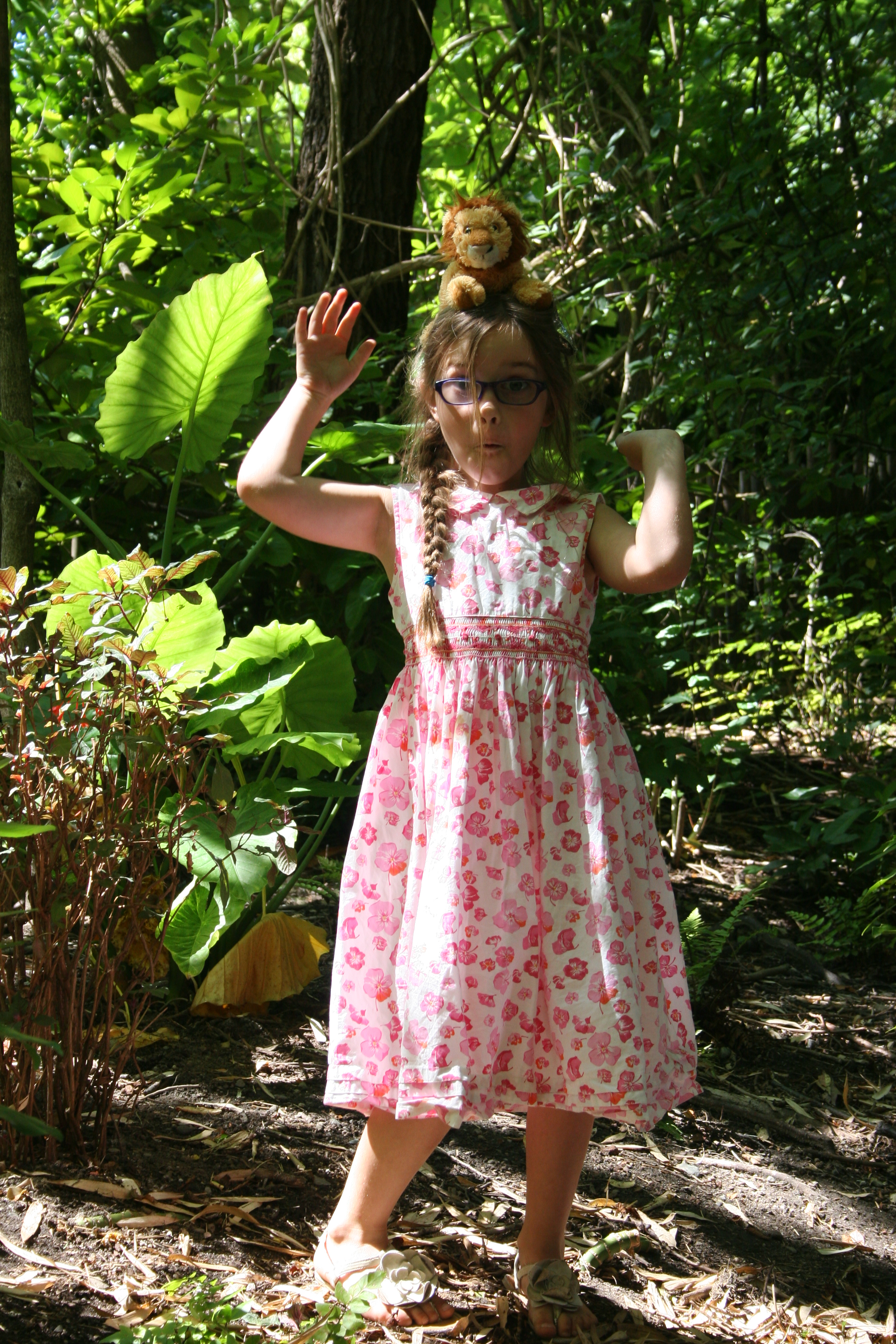
IMG_0793

IMG_0803

The squirrel puppet from the Backyard pack was a definite favourite and was a constant companion.
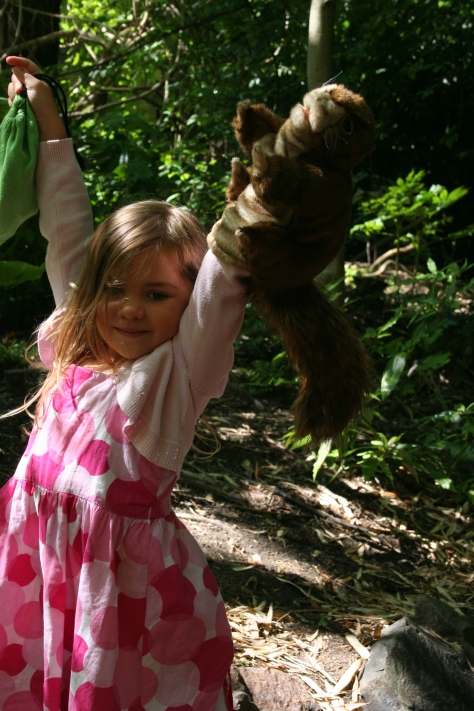
IMG_0802Completed activities can be traded for Nature points at Zoomazium’s Nature Exchange.  The points can be exchanged for interesting, rocks, fossils and natural materials on display.  Nature loving children can also create projects at home to earn additional points. Older children are not left out, there are activity sheets to suit all ages. My eldest chose a worksheet relating to the otter exhibit.
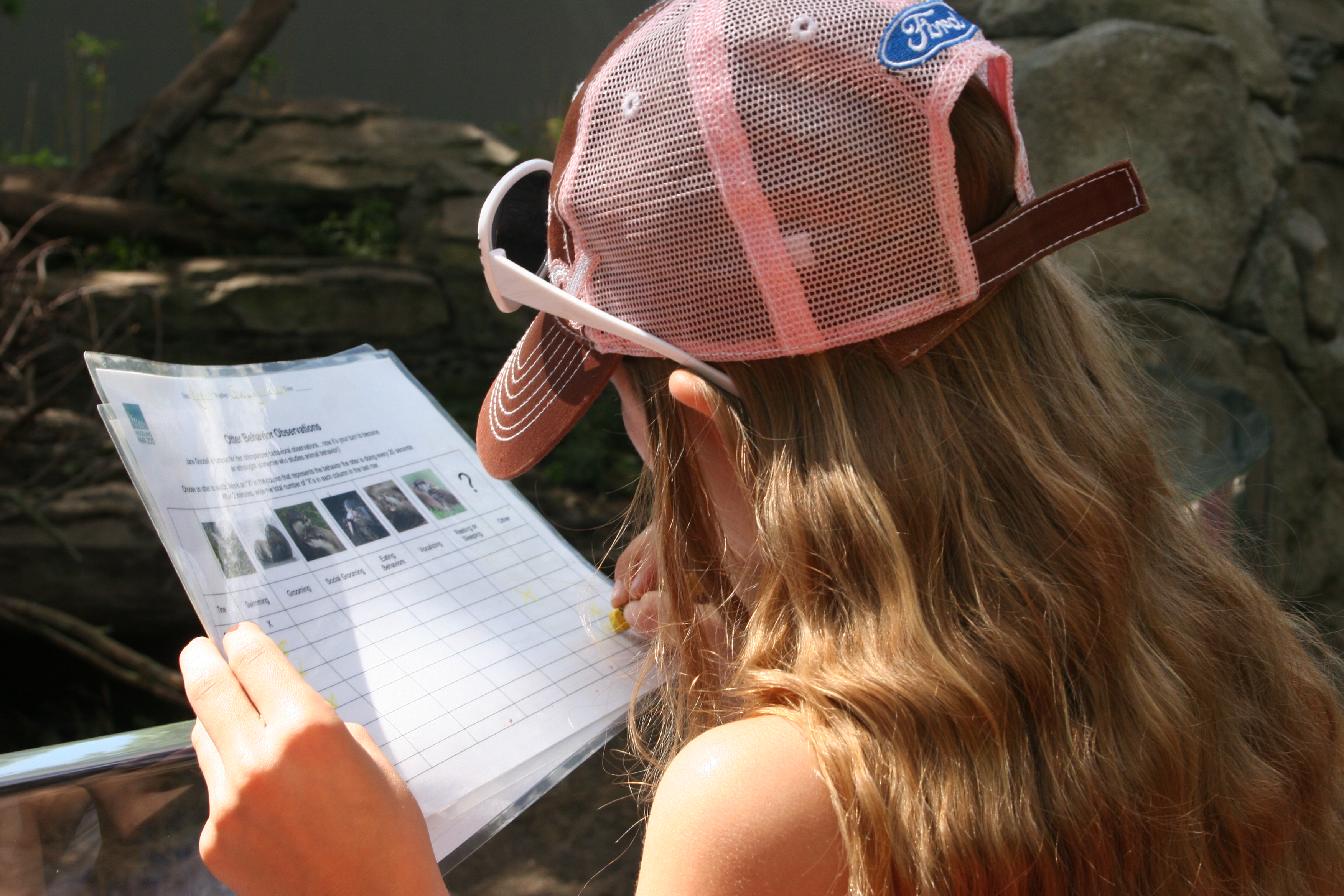
otter exhibit worksheetOur favourite part of the day was having the opportunity to feed animals.  Bird seed on sticks can be purchased for $1 and the birds fly down to feed from your hand.

Feeding the birds

The best experience of all though was getting close to the giraffes and hand feeding them. The keeper was great at encouraging the children to ask questions and it was a truly memorable experience for all that I will definitely do again.  Giraffe feeding is $5 per person and under 5’s go free with a paying adult.
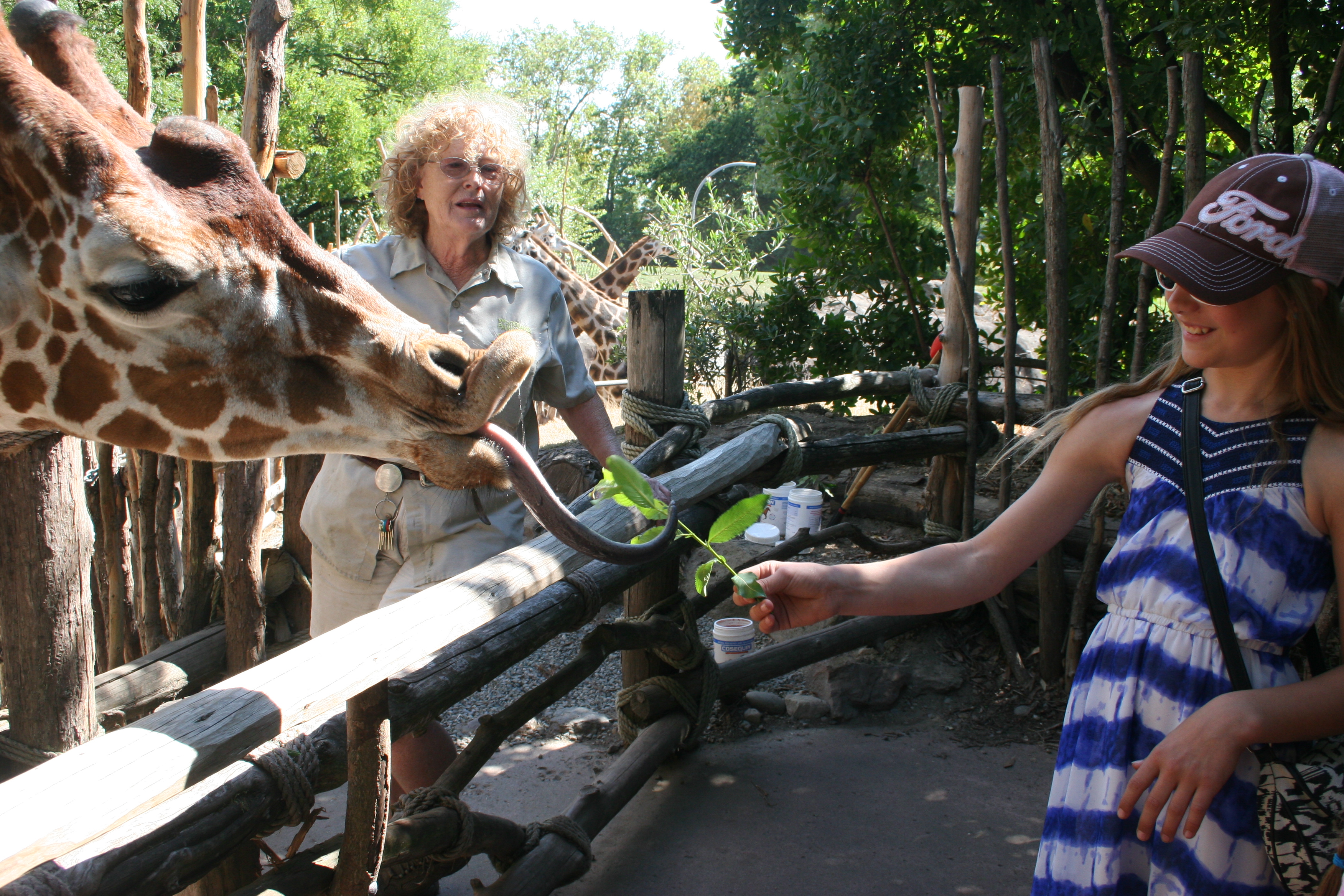
giraffe feeding

A day at the zoo was perfect for my nature explorers.
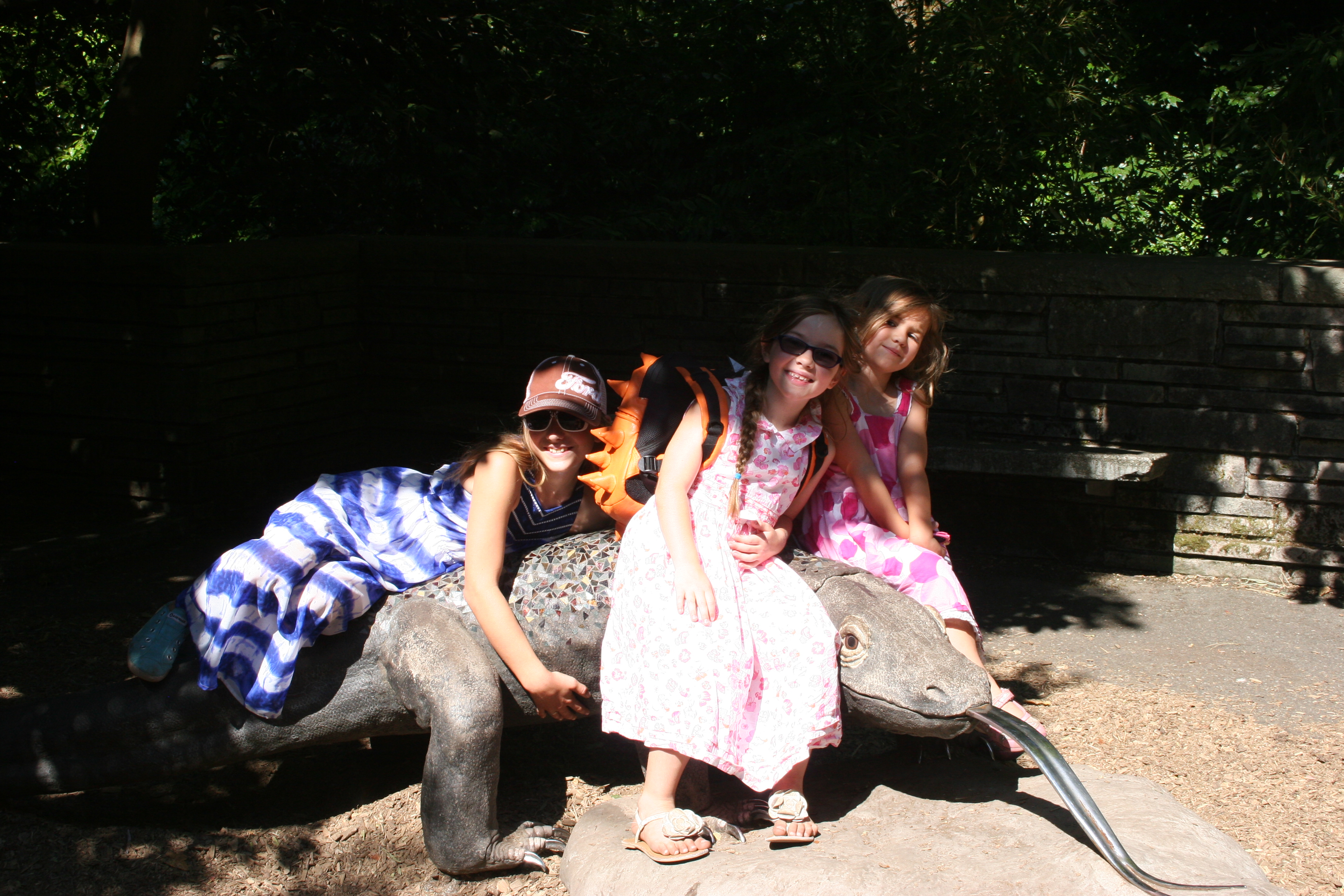
IMG_0826

Membership Offer

Zoo membership is perfect for families with young children. There are a number of membership options to suit different needs and admission is free for children under 3.

Right from the Start readers can benefit from a special offer.

Quote MOM15 at checkout to receive a 10% discount plus entry into a draw to win 2  giraffe feeding tickets and 2 tickets for a carousel ride.

Disclaimer:  Complimentary tickets for 4 people were received.  All opinions are my own and we were under no obligation to write about our visit.

How Do You Know When You Have Found the Perfect Preschool?

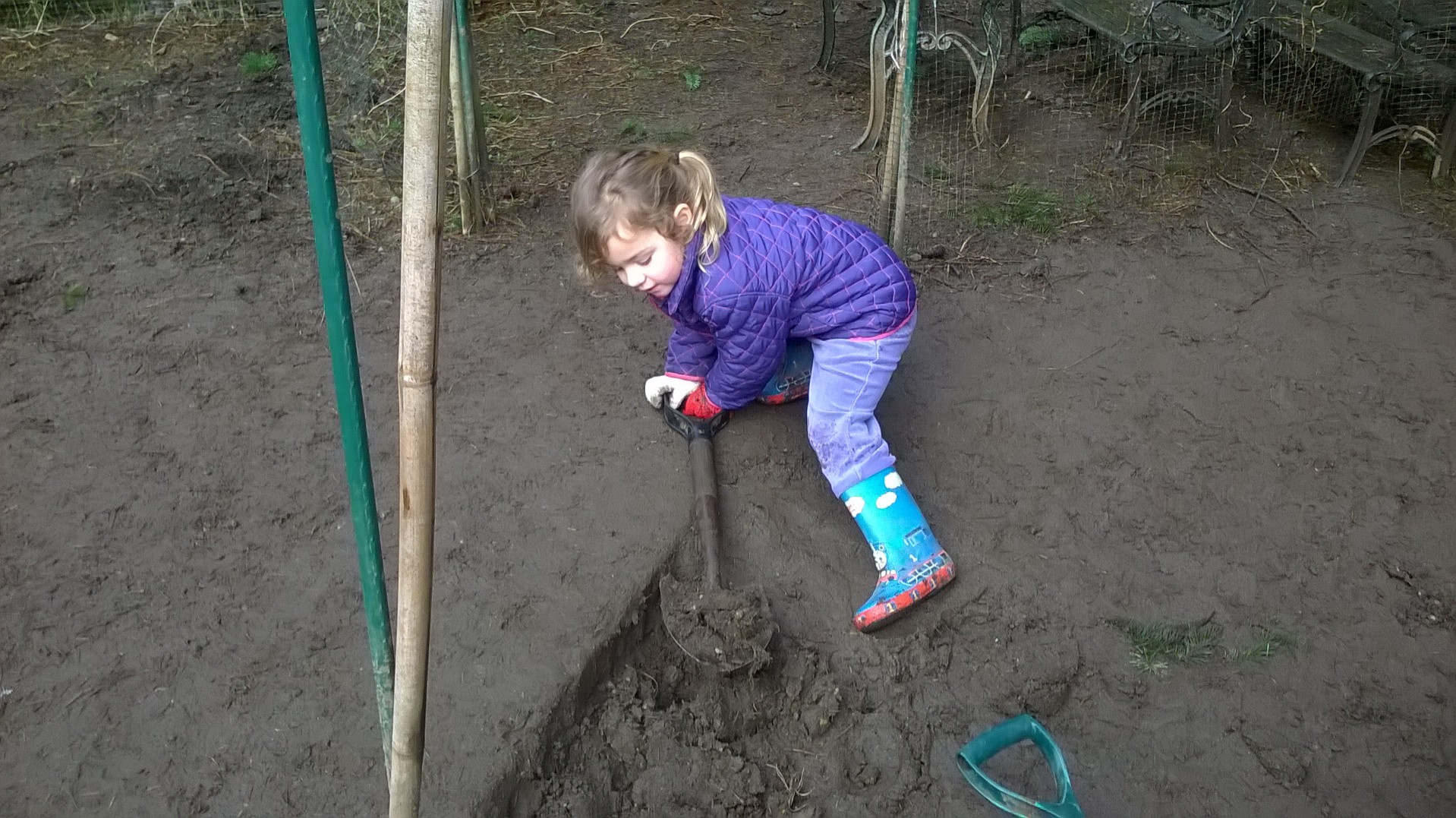
muddy feet
A place where I can kick my shoes off and sink my toes in the mud.

Regular readers will remember that when I moved to the US, I struggled to find a preschool that I was entirely happy with.  I became so disillusioned that I decided to home preschool for a year. I’d lost faith of ever finding a preschool that valued play, independence and individuality above academics and rigid schedules until a friend told me of a preschool situated on a farm.  The preschool shared my belief that children learn best by doing things that have relevance in their lives through exploring, discovering and creating.

The school is so popular that it was a whole year before I had a chance to visit and see the school for myself. Children were busy pulling apart sunflower heads on the covered deck area whist others moved freely between the different activities indoors and outdoors. The teacher’s enthusiasm and passion for both the children and the setting was evident immediately and a bubble of excitement rose up within me. Our name was put on the waiting list for Sept 2015 but before Christmas a place became available in the co-op class so finally my youngest daughter had the chance to attend.  This was perfect as I also had the chance to be involved in this wonderful experience as a parent helper.

ducklings

There was little doubt in my mind that this was the perfect preschool for my outdoor loving daughter. My expectations were high. I have been fortunate to teach at a highly acclaimed nursery in the UK and to visit the best preschools in my local authority as an advisory teacher. My experience of this school has surpassed all my expectations, I couldn’t have hoped for a more perfect preschool for my daughter and I am only sad that my older daughters didn’t have a chance to go there. After she started, it just seemed to get better.  Regularly she would come home covered from head to toe in mud.  To some parents this would be horrific but to me it meant she had the freedom to be herself and have fun.

Being a part of the co-op class means that I get to help out once a month. This is the most exciting part for me as I get to join in.   I love the covered deck area which enables the children to play outdoors all year.  The children explore the whole farm for the 2nd part of the session, mud, water, animals, climbing and balancing. They are actively encouraged to take risks.

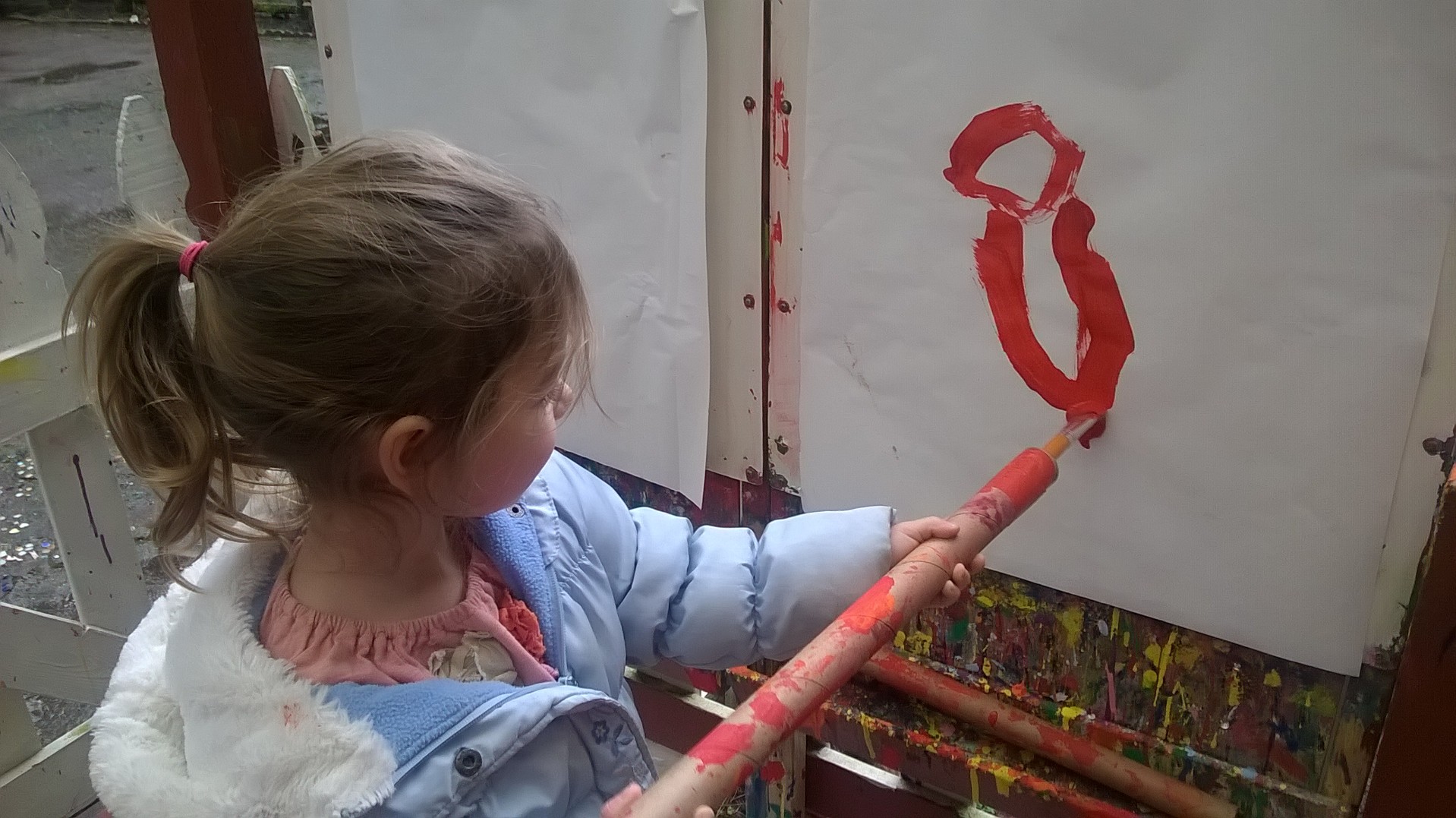
long paintbrushes.
As we arrive my daughter always chooses to paint . She liked this painting activity with paintbrushes placed on extended poles.
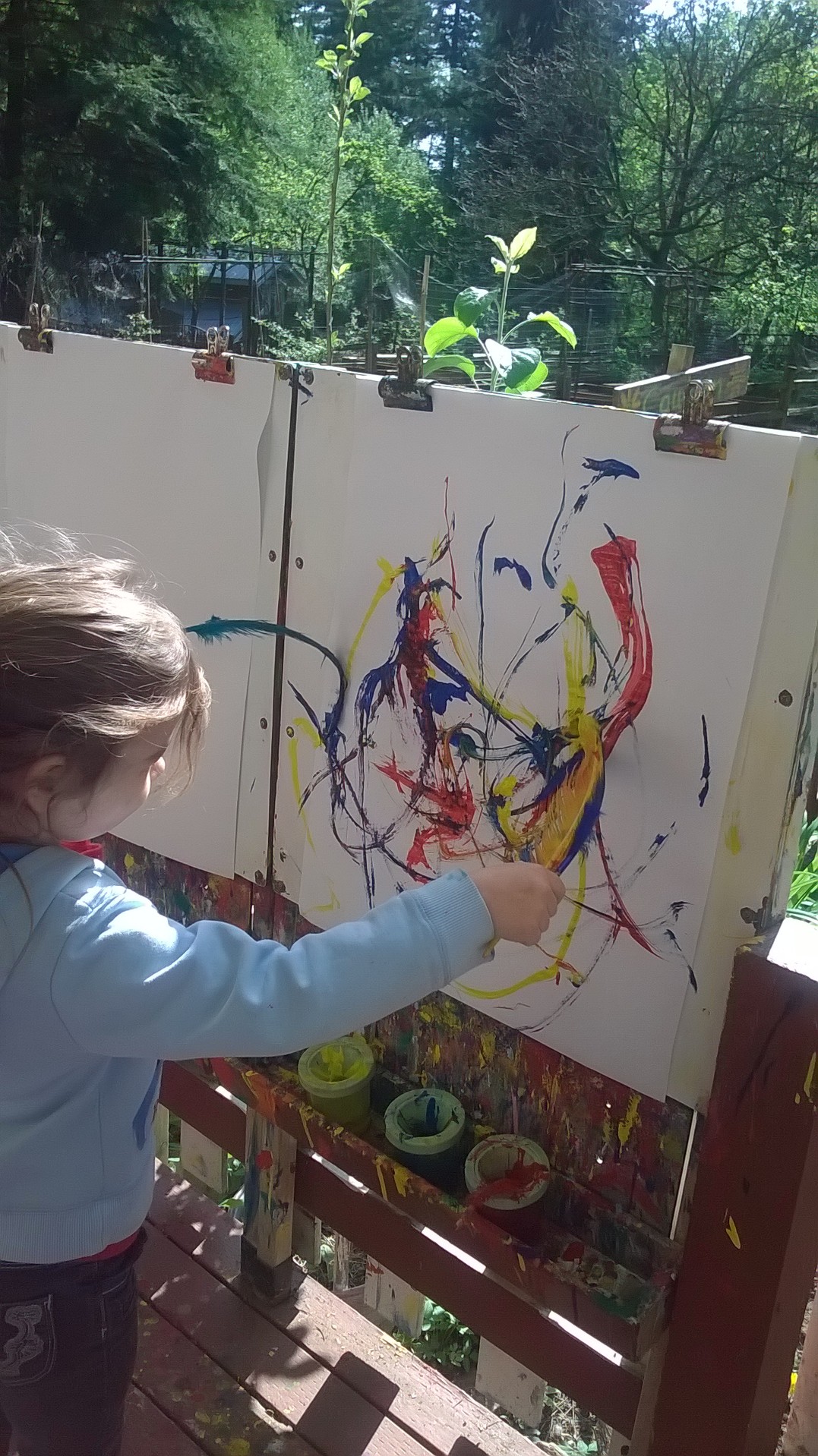
painting with feathers
Painting with feathers

What makes it so perfect?

1. Children are individuals

Small classes and the dedication and experience of the teacher, mean that she understands each child as an individual. My daughter who is uncomfortable speaking in a group or to unfamiliar adults is given time to think about what she wants to say, often being presented with a question at the start of a session and returning for a response later.  The child who hates to get his hands dirty is offered alternative tools and all the materials are open-ended so that children can use them as they see fit.

2.Children are competent

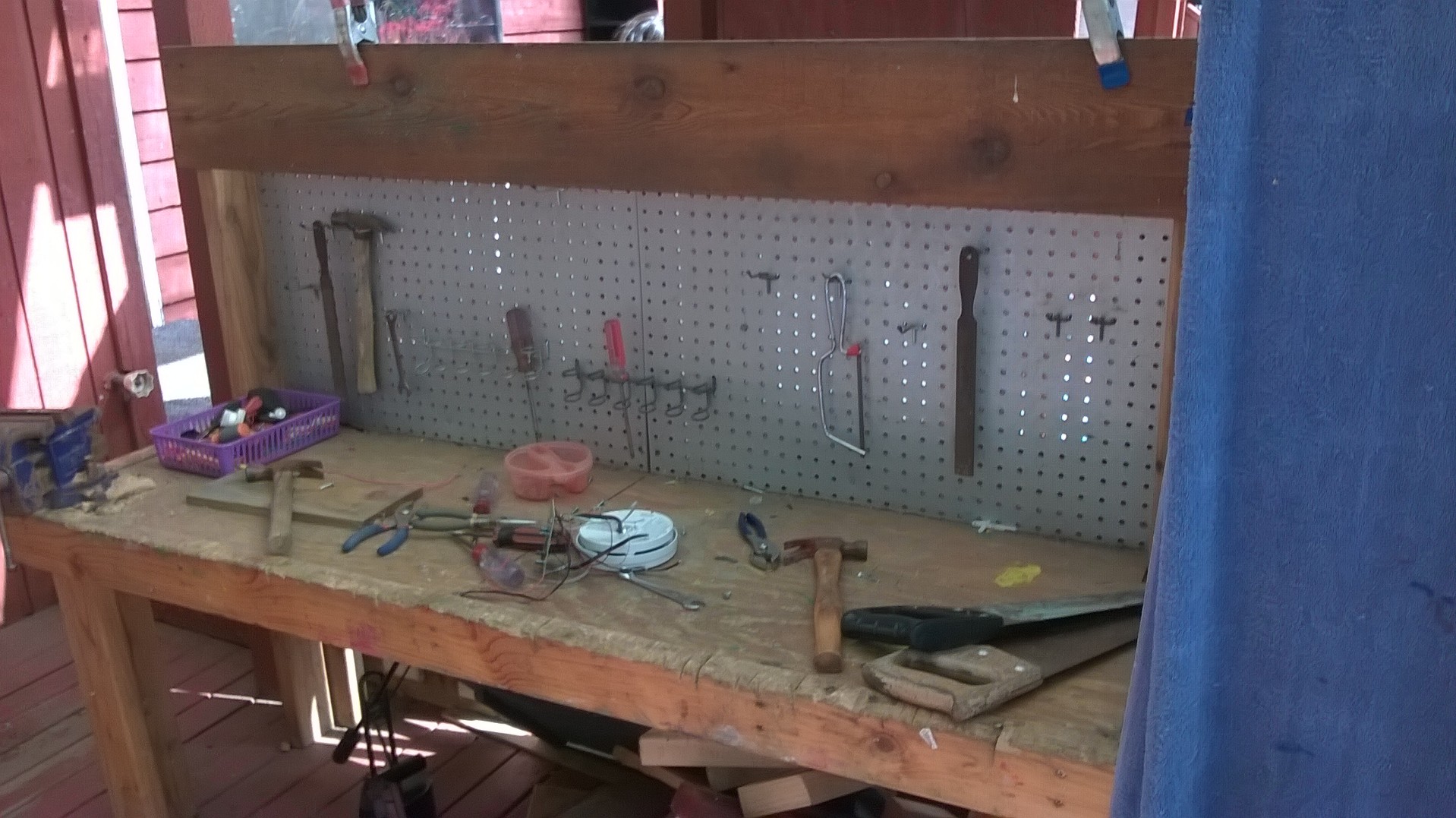
Children are always encouraged to try things for themselves, even when they ask for help they are first encouraged to try.  The children are trusted to use adult tools for woodworking and tinkering, peeling vegetables and cooking.  The teacher shows them how to use the tools safely and responsibly and thereon in they are trusted with them.  The children cook their own green eggs and ham on the tiny stove, they dig with metal shovels, they observe candle flames and peel carrots with a peeler.  Outside they are permitted to climb trees, feed the animals, hold guinea pigs and dig in the mud. The children are trusted to handle precious materials like birds eggs, chicks and nests.

WP_20150501_004

This tinker table is always available. I regularly see children sawing pieces of wood placed in the clamps, hammering nails or taking apart electronics with a screwdriver. In the nursery I taught at we had a tool bench with real tools but we weren’t confident enough to leave it out all of the time. I have never seen a child have an accident or do anything dangerous with the tools.

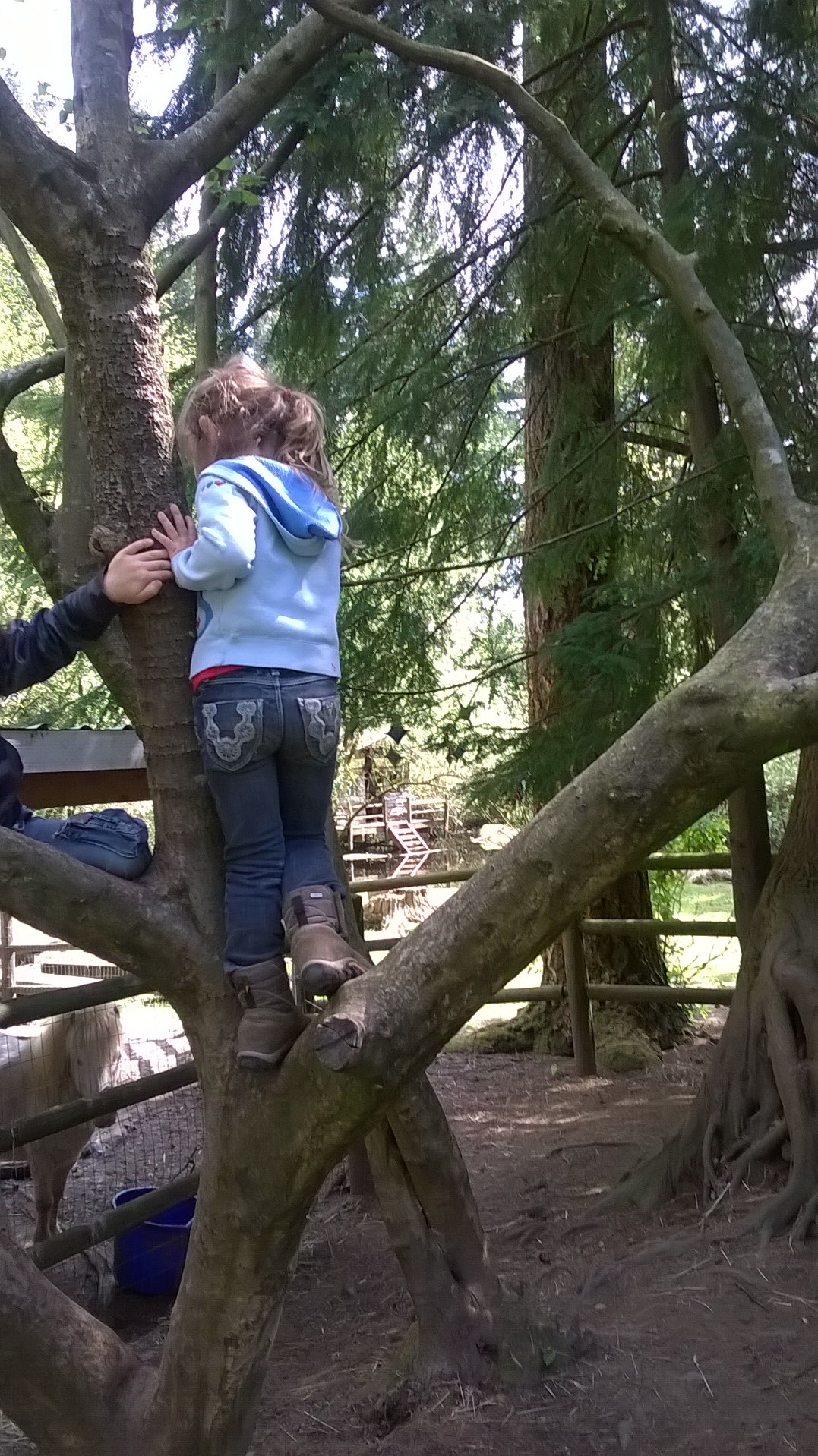
climbing trees at preschool
My daughter loves to climb trees – I’m not sure I could find anywhere else where this would actively be encouraged.

3. The Preschool fosters understanding and respect for nature.

Many of the activities involve the natural rhythms of the farm, collecting the produce, understanding the cycles of the plants and learning about the animals and creatures they find.

WP_20150225_002

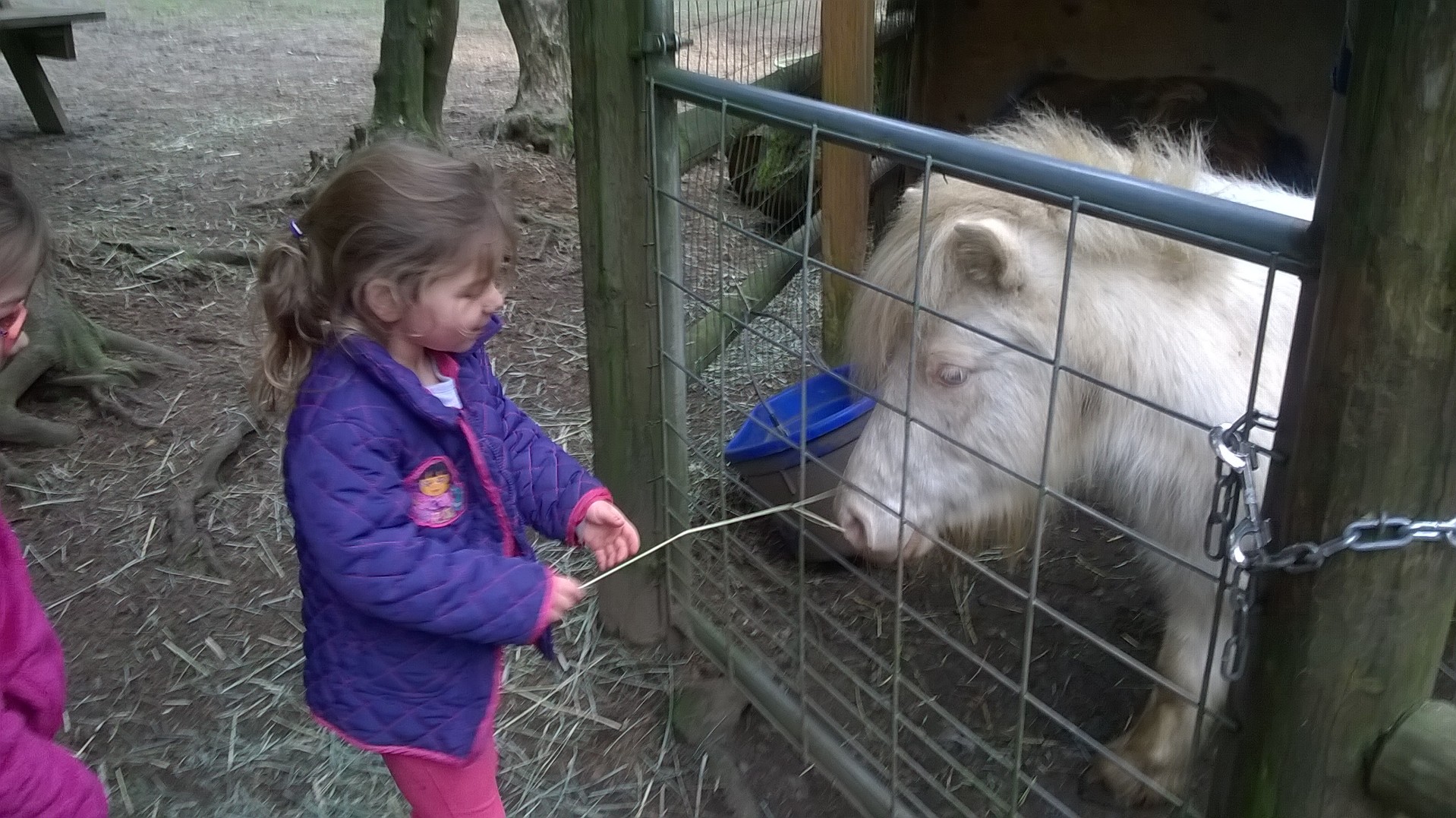
After the first few sessions, my daughter told me they had unicorns at preschool but that it was too small to have grown a horn yet. A preschool with unicorns? Could it get anymore magical?
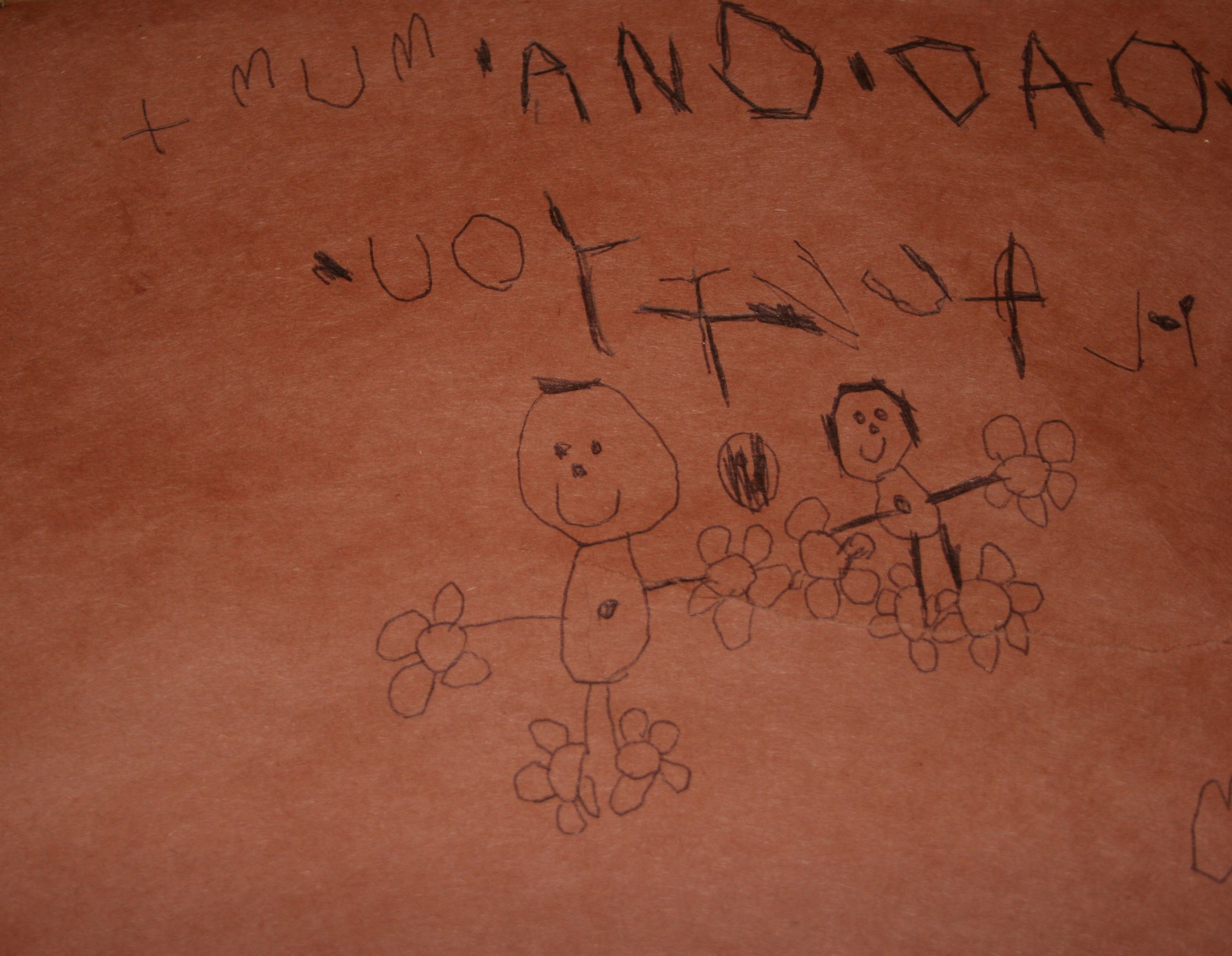
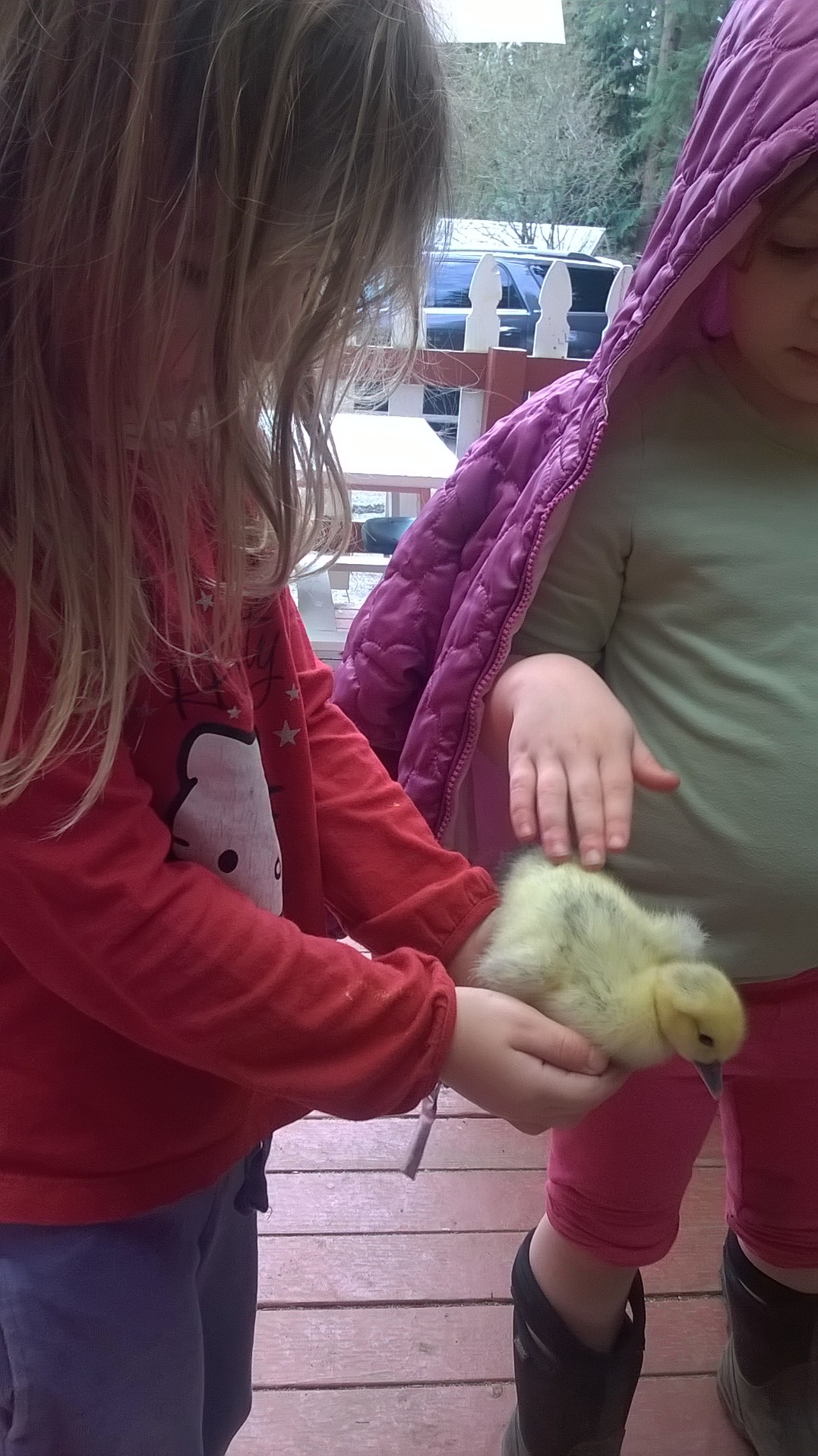
ducklings.
When the duck’s eggs hatched the children were allowed to hold them.
bug hunt
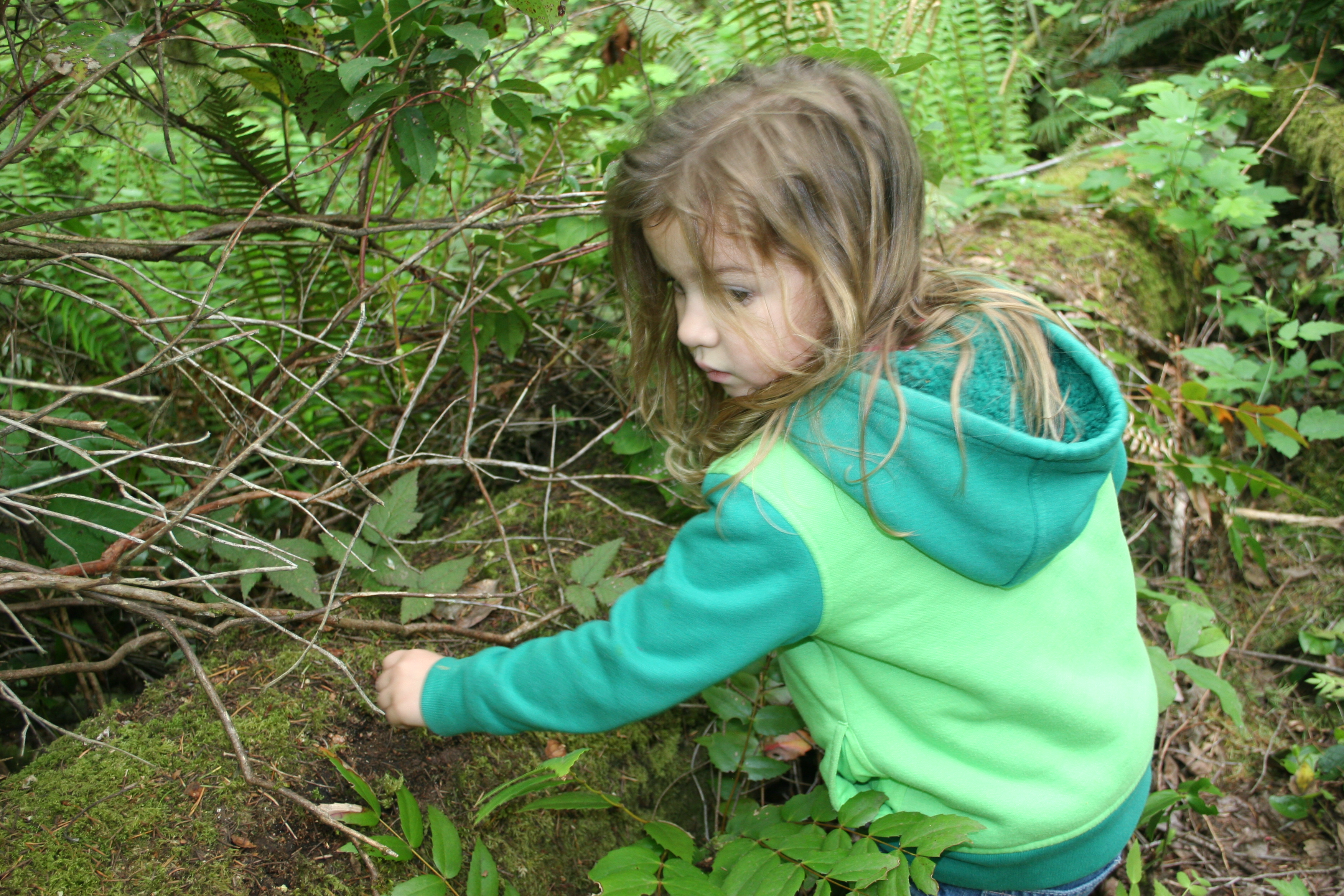
A bug hunt in the woods

4. Children’s thoughts and opinions are important

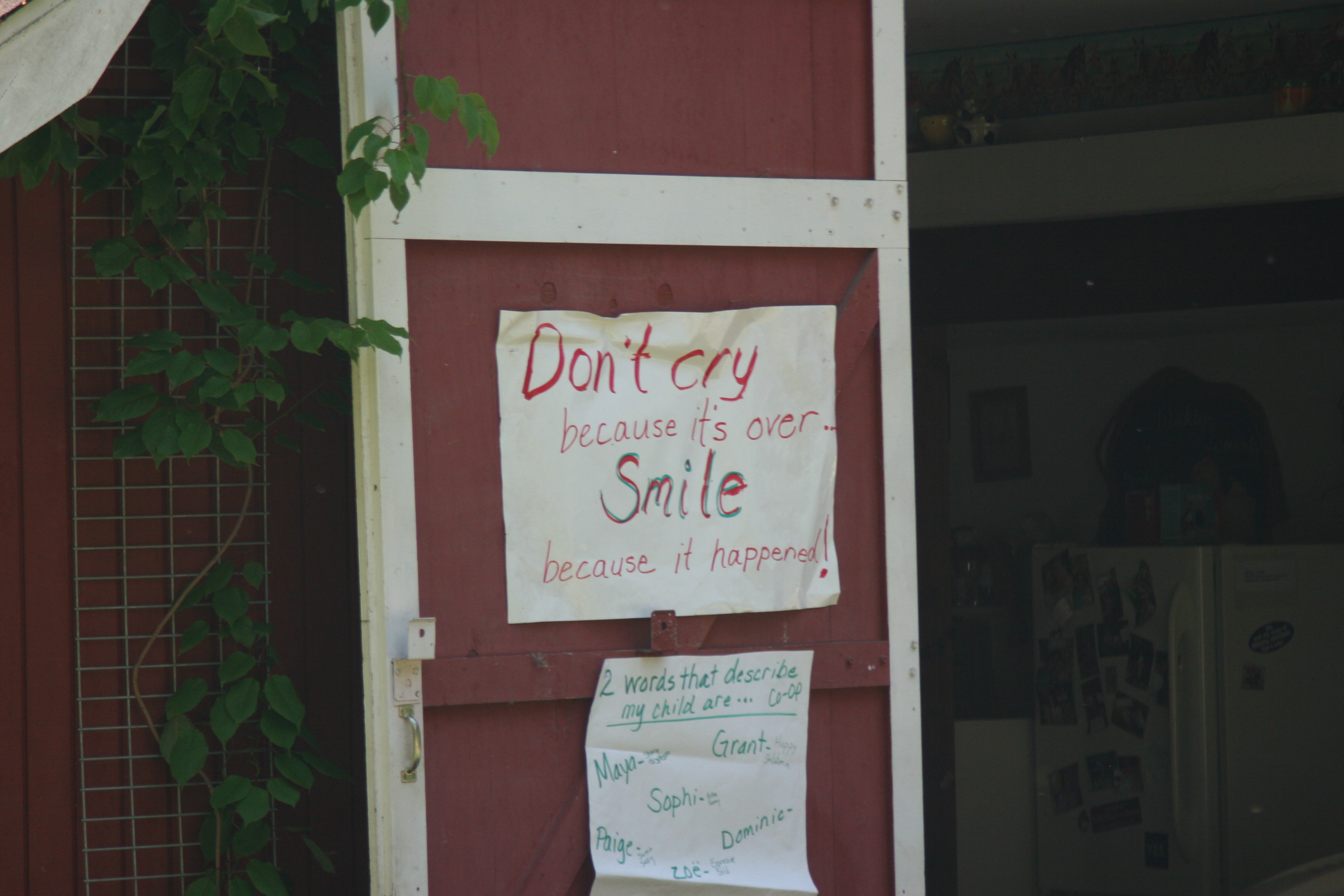
Each session the children are asked a question and the answers are recorded for parents to read on the wall outside.  The children listen to each others responses and discuss them with respect.  The children’s choices are respected as they are presented with a number of activities to choose from at leisure. They also have opportunities to choose the songs they will sing and are confident at asking for things.  The children are offered a snack, they choose when and if they would like to eat it .

5. They have fun.

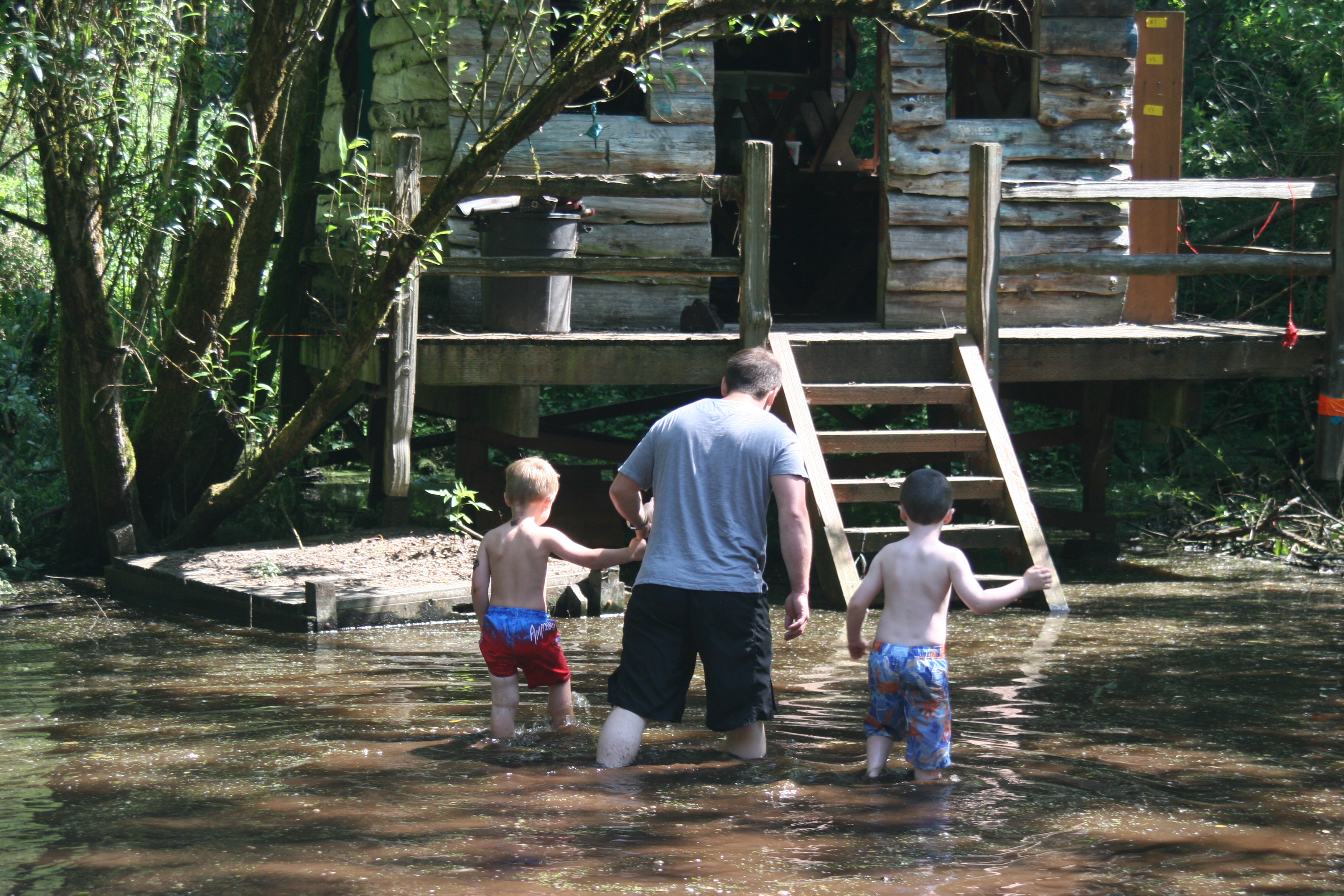
wading in the swamp
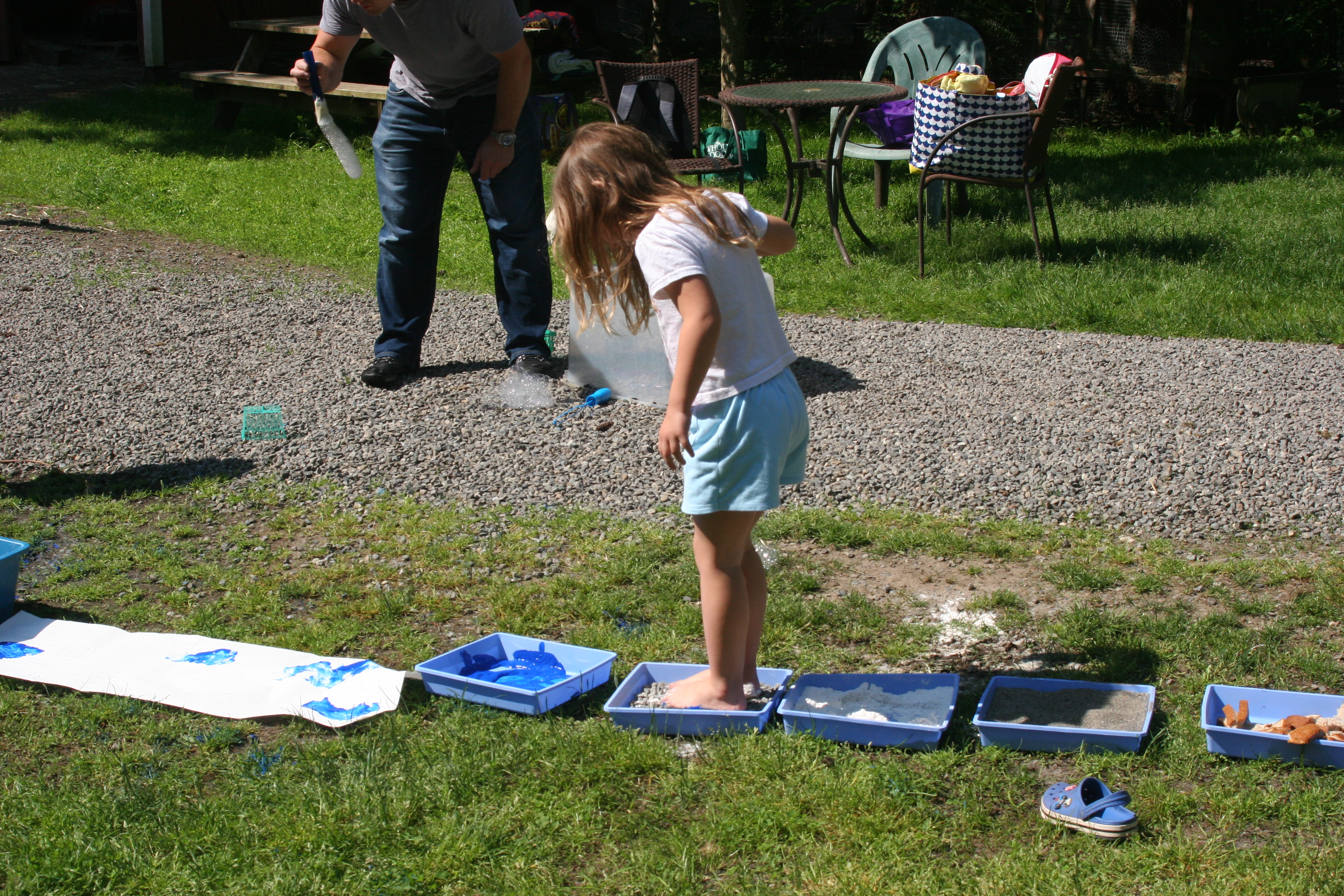
On the last day of school, parents are invited to join the children as they wade in the swamp.
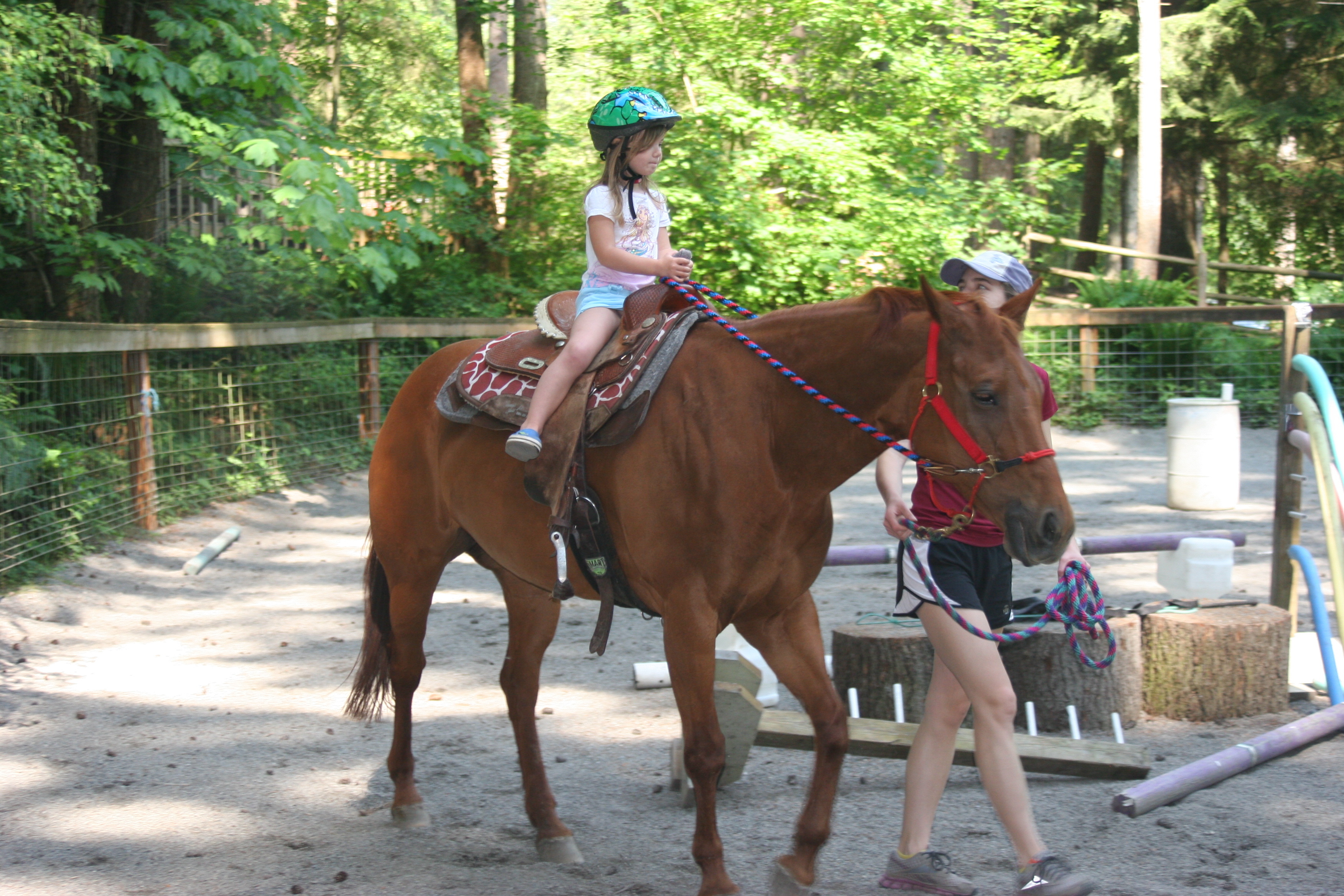
horse riding on the last day of term

.

Best of all, I feel that my daughter experiences something here that she would never have the chance to experience elsewhere.  I feel so fortunate to have found this preschool and that my daughter has one more year there.  When our time is over I will be so sad but I hope I can remember her teacher’s words of wisdom.

IMG_0626

The Mirror Table

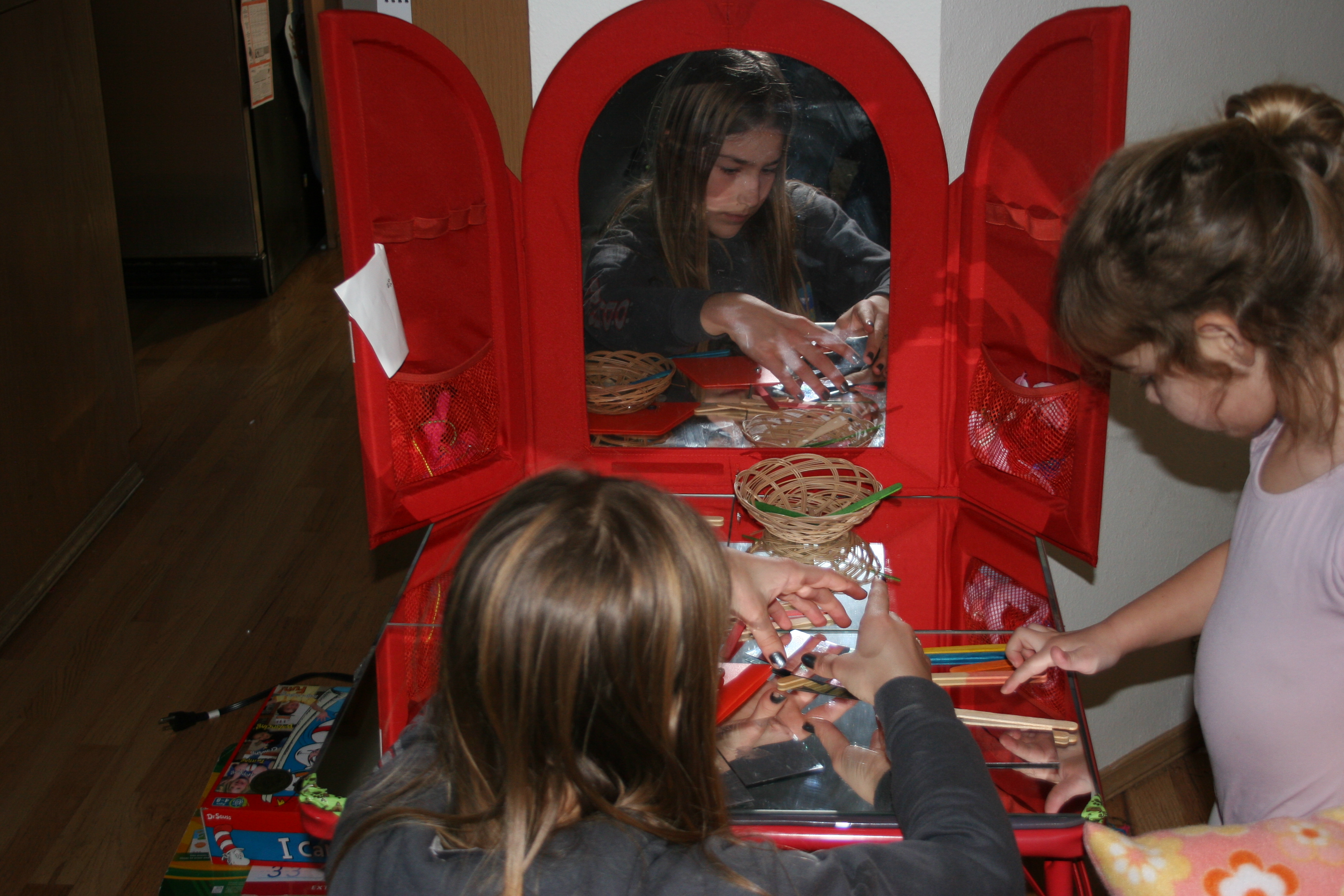
investigating natural materialsThe girls often enjoy mirror play, I’ve tried a number of different types. I love this big one but it is very fragile and difficult to store. For small projects, I have an oval mirror in a tray but it isn’t big enough for more than 2 children to play with.  Unframed circular mirrors work well, but I’m yet to find a suitable one. We also use Ikea mirror tiles, these are portable and I can change the arrangement to suit the project but the pointed edges bother me.

ice skating mirror

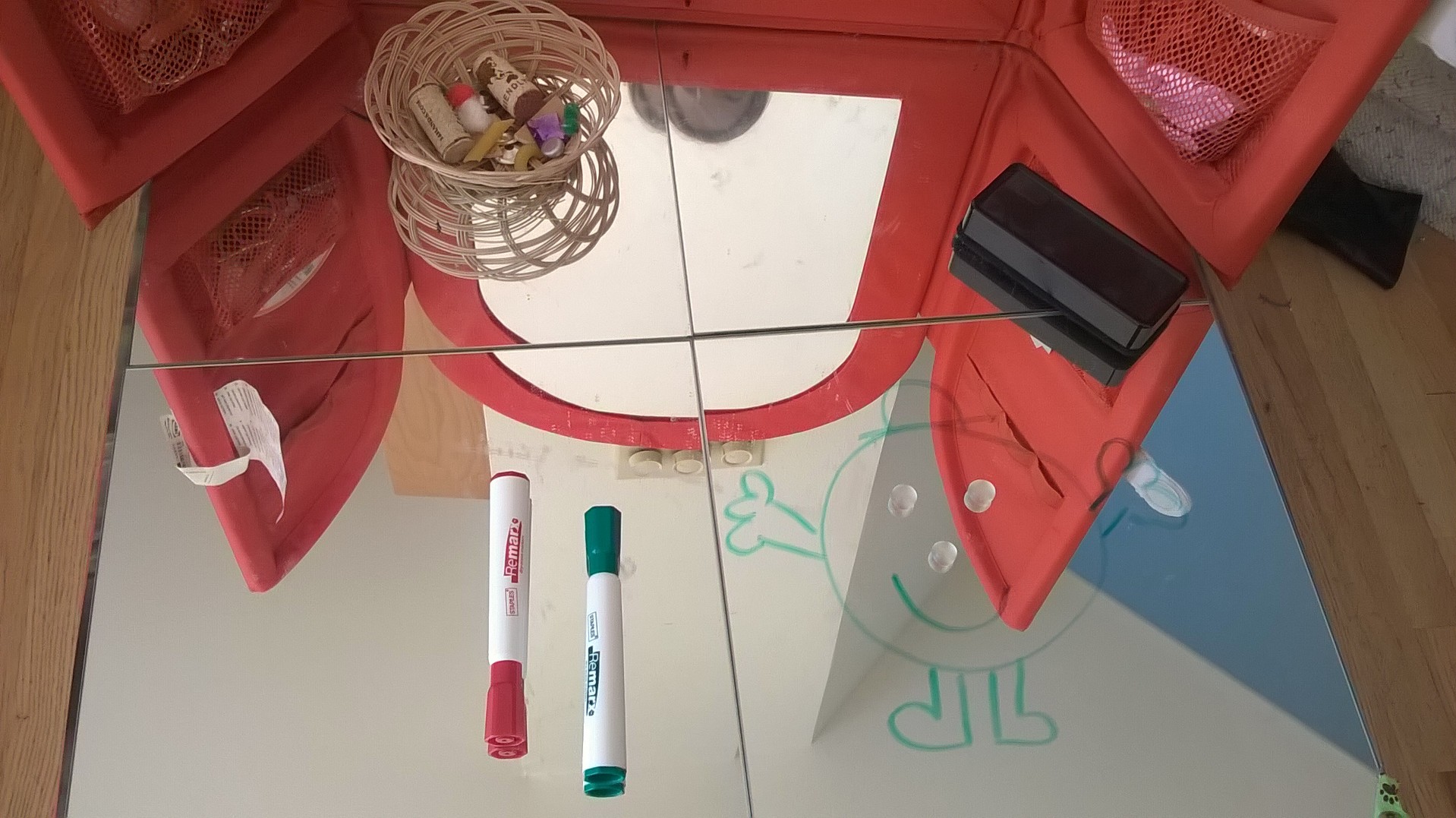
Suddenly it came to me – “why not stick the mirror tiles onto a table?” I sent out  a plea for a table to my Buy Nothing group. I didn’t expect to find one that was the perfect size but within 30 minutes I had been offered a table that would fit the tiles perfectly. The mirror tiles come with sticky pads for mounting to a wall. These were perfect for attaching the mirrors to the table.  I taped the sharp corners with duct tape and a vanity mirror was placed against the wall.  In a preschool setting I would mount more tiles to the wall and put the table in front to allow for seamless reflections. The border around our mirror makes it difficult for small items to be reflected in the upright mirror.

mirror table

A couple of small card mirrors and a few loose parts led to fun explorations.

mirror table loose parts

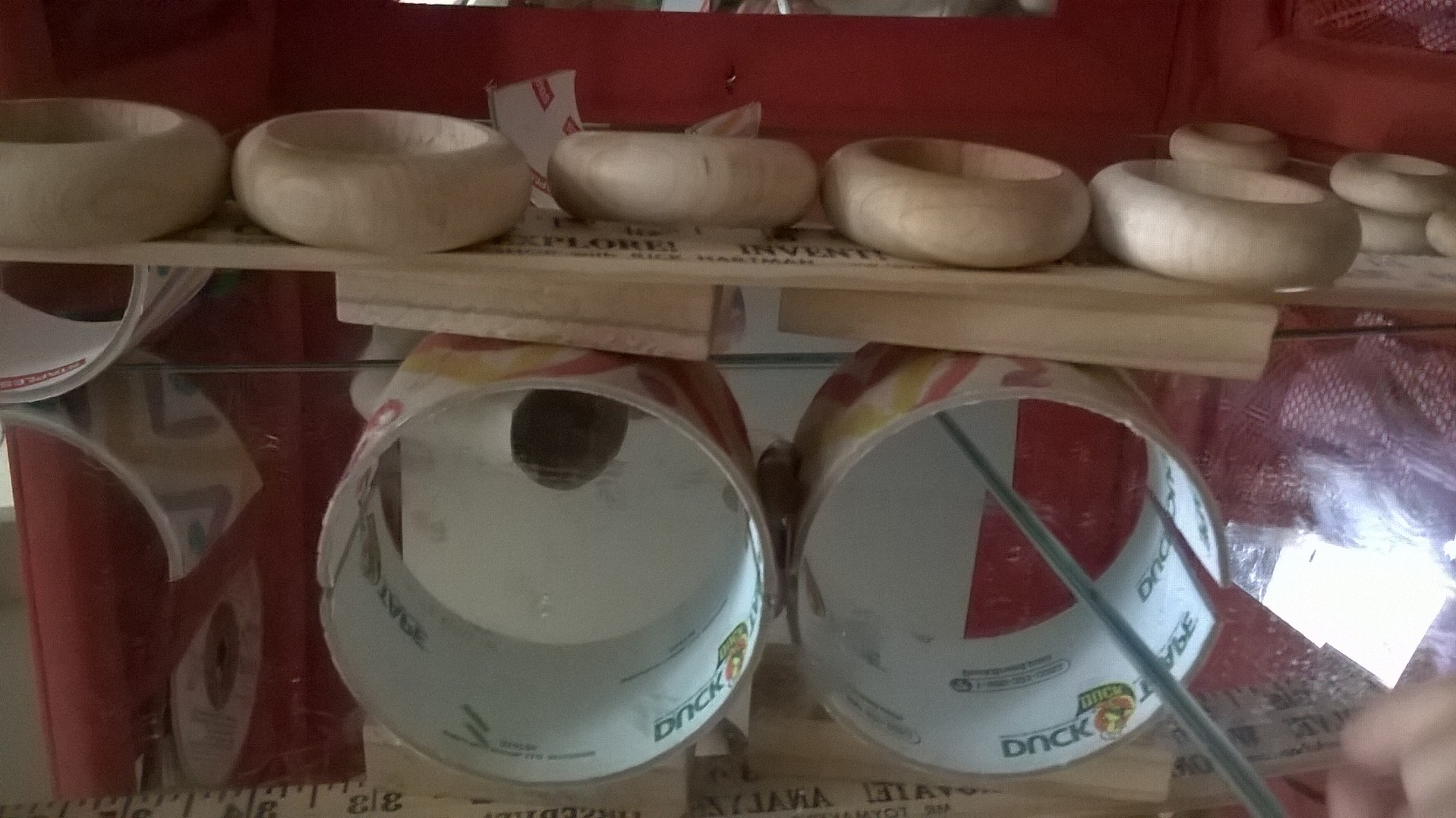
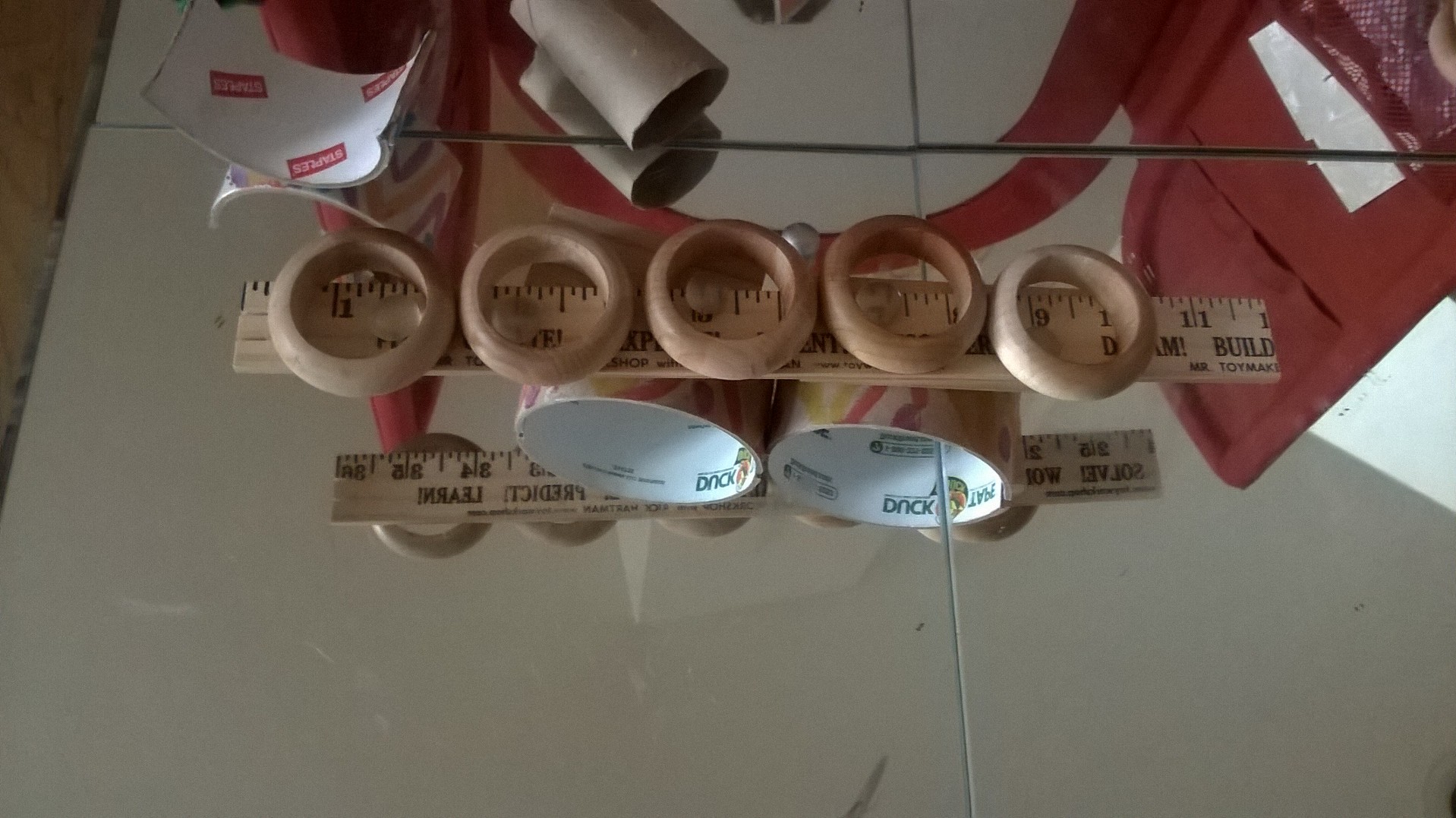
I cut the insides of a roll of tape in half and placed them on the table with a few wooden rings.

“It looks like wheels.  I’m going to make a car”mirror table car

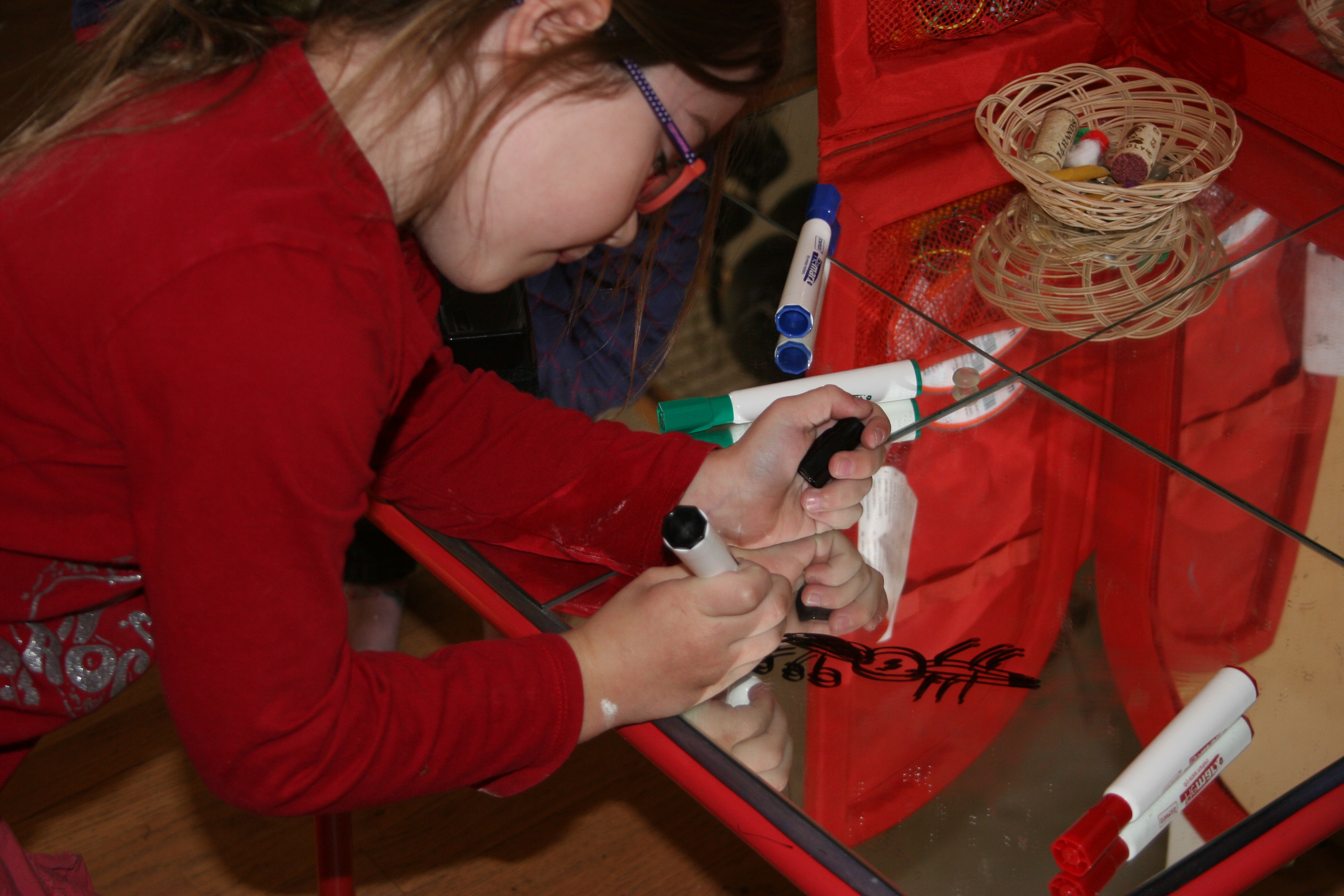
To keep the interest going, I changed the materials regularly. The loose parts, building bricks and mirrors maintained interest for only a short time. Knowing that my children love to draw and write, I decided to leave white board markers and a rubber on the table to see if this would engage them.

using a mirror table for drawing.

This arrangement was perfect and by far the most popular so far.

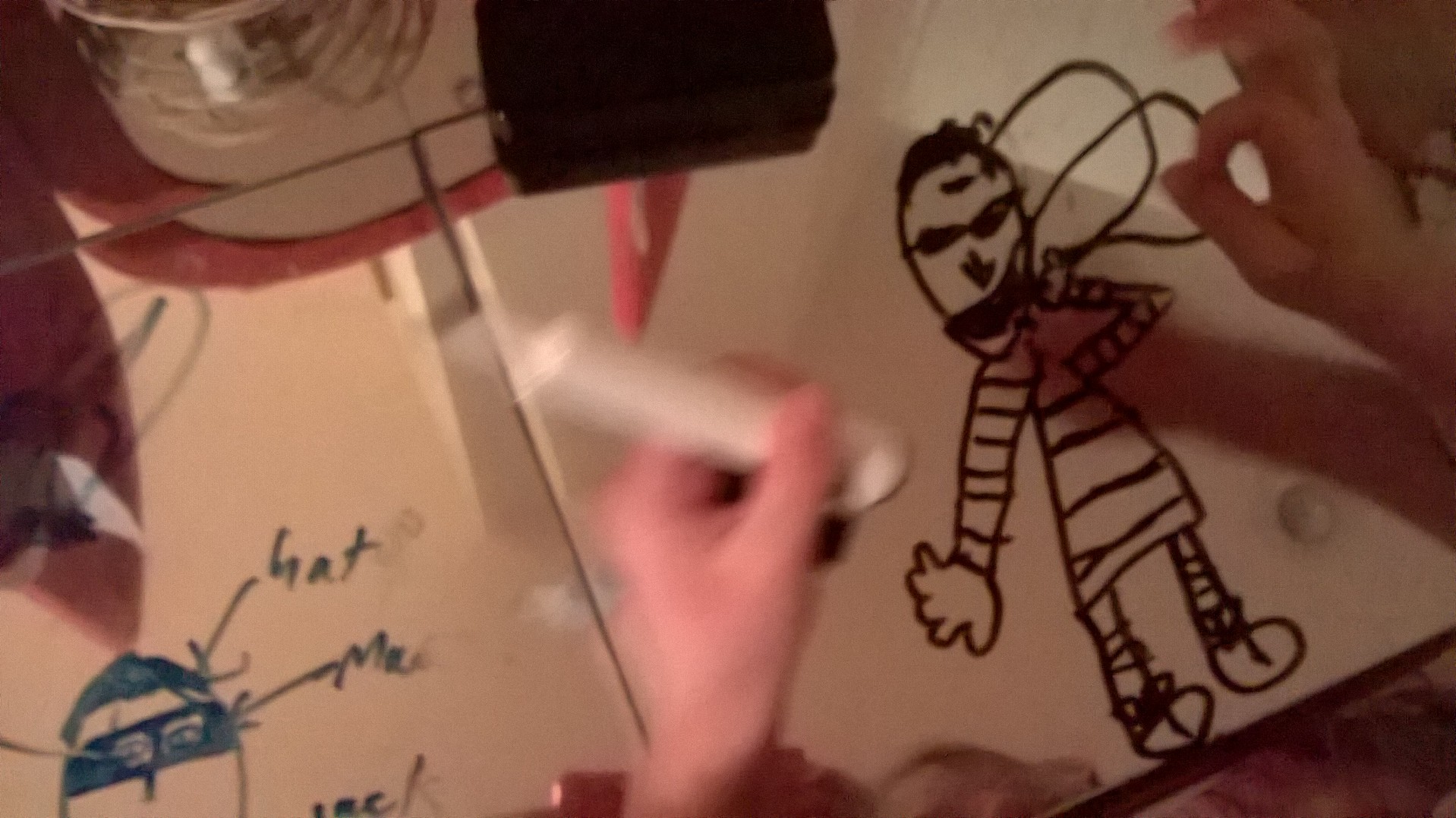
abstract drawing

writing on a mirror table

collaborative drawing

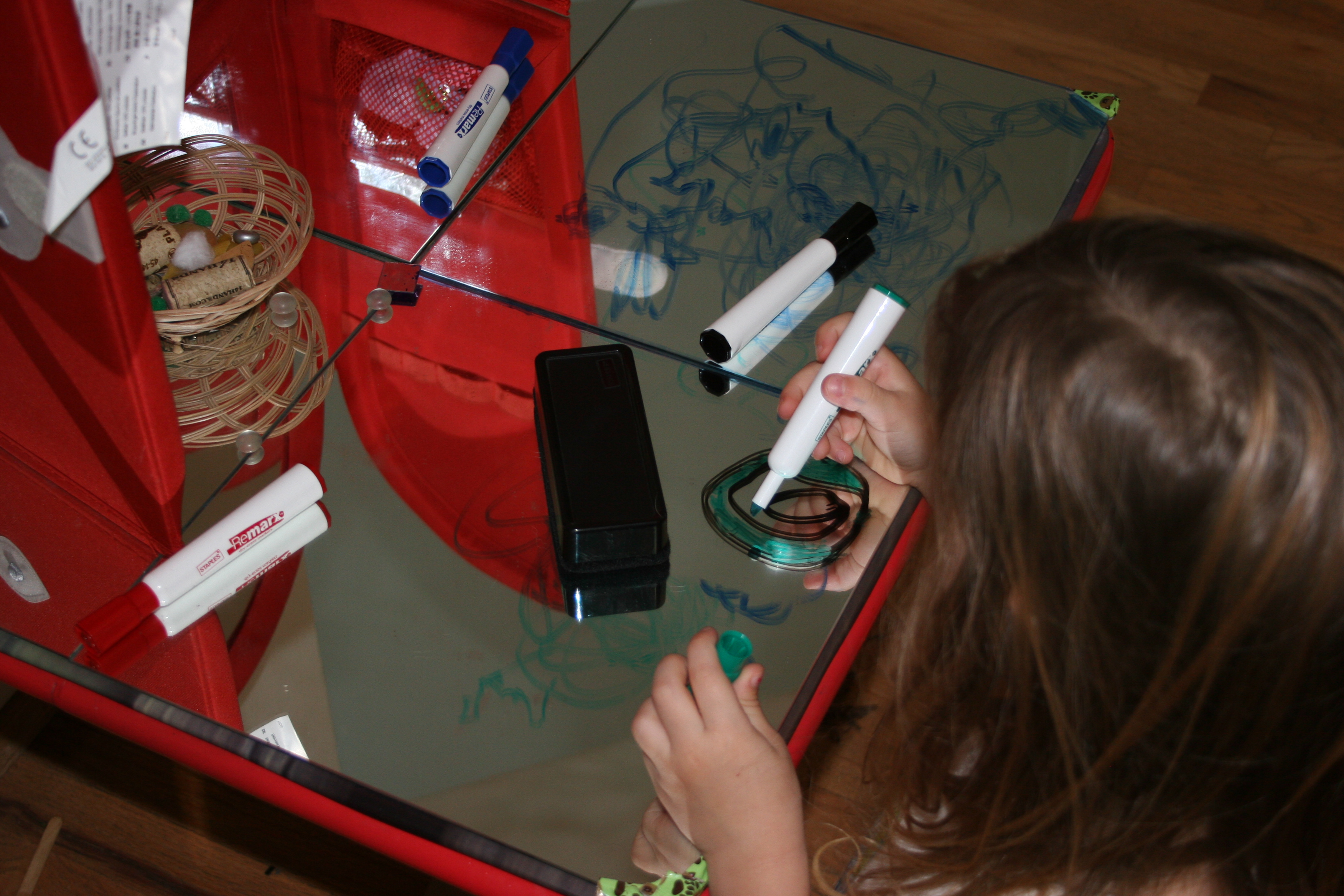
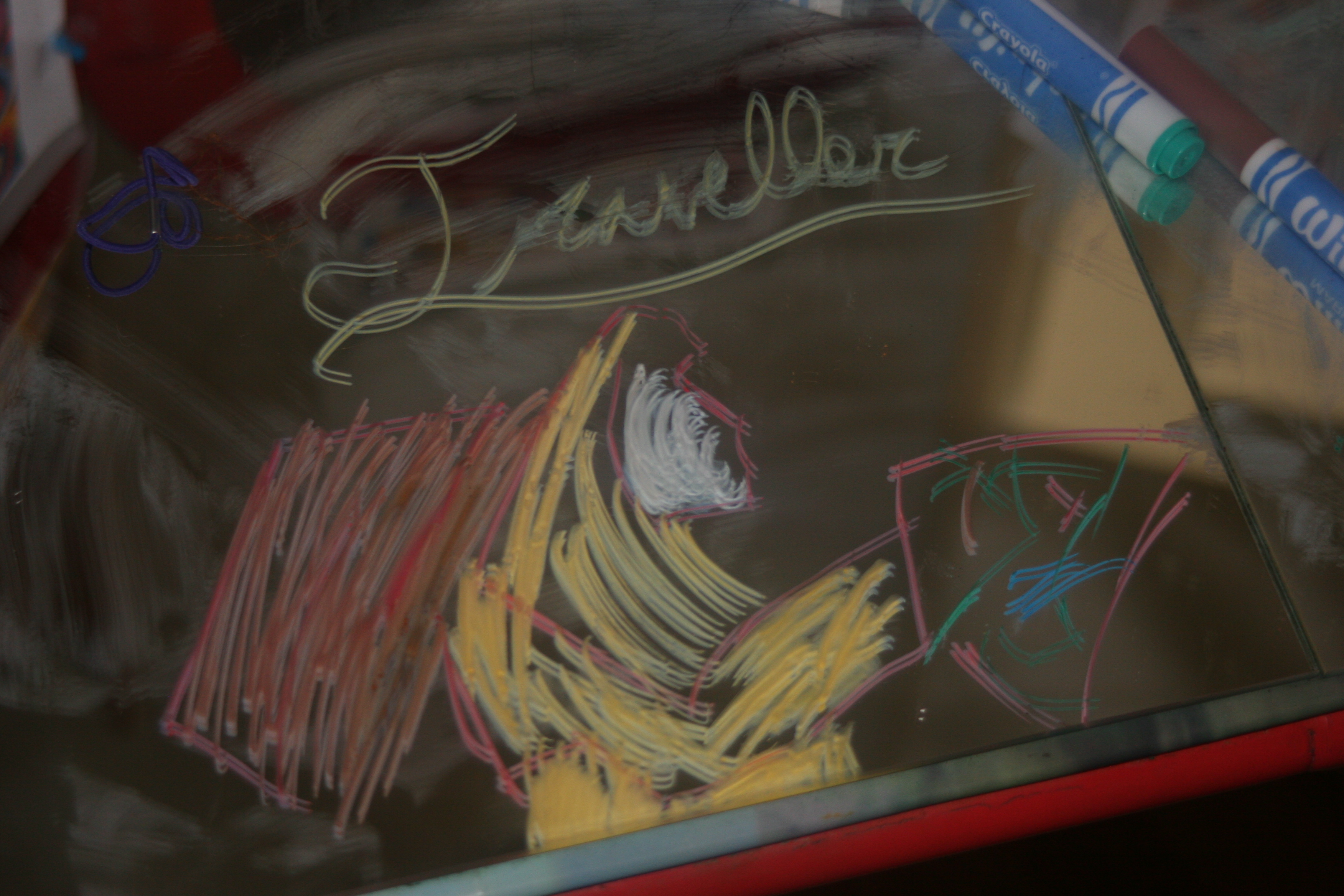
To add variety, I purchased a pack of glass markers.  This was a very different experience.  The girls discovered that the pens were difficult to erase. They liked that they no longer needed to avoid erasing part of the picture with their sleeve. It took more effort to erase and the girls experimented with the best ways to do this. Since they love to use cleaning sprays, I showed them how to use a small amount of glass cleaner to remove the pens quickly.

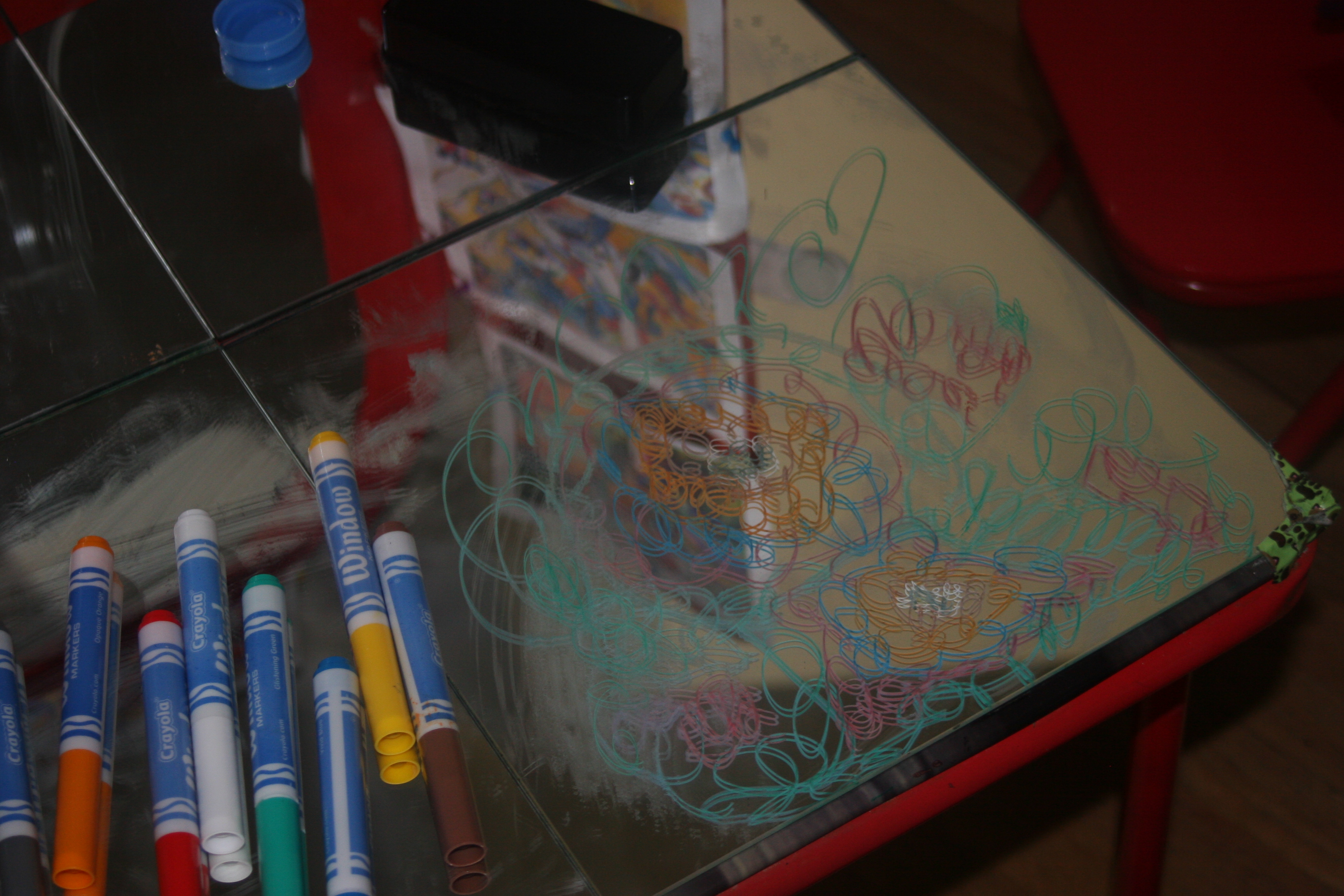
I noticed that the style of drawing changed when I introduced these pens. The girls drew intricate patterns using the colours and adapting their movements to light touch of the pens.

pattern and colour on mirror table

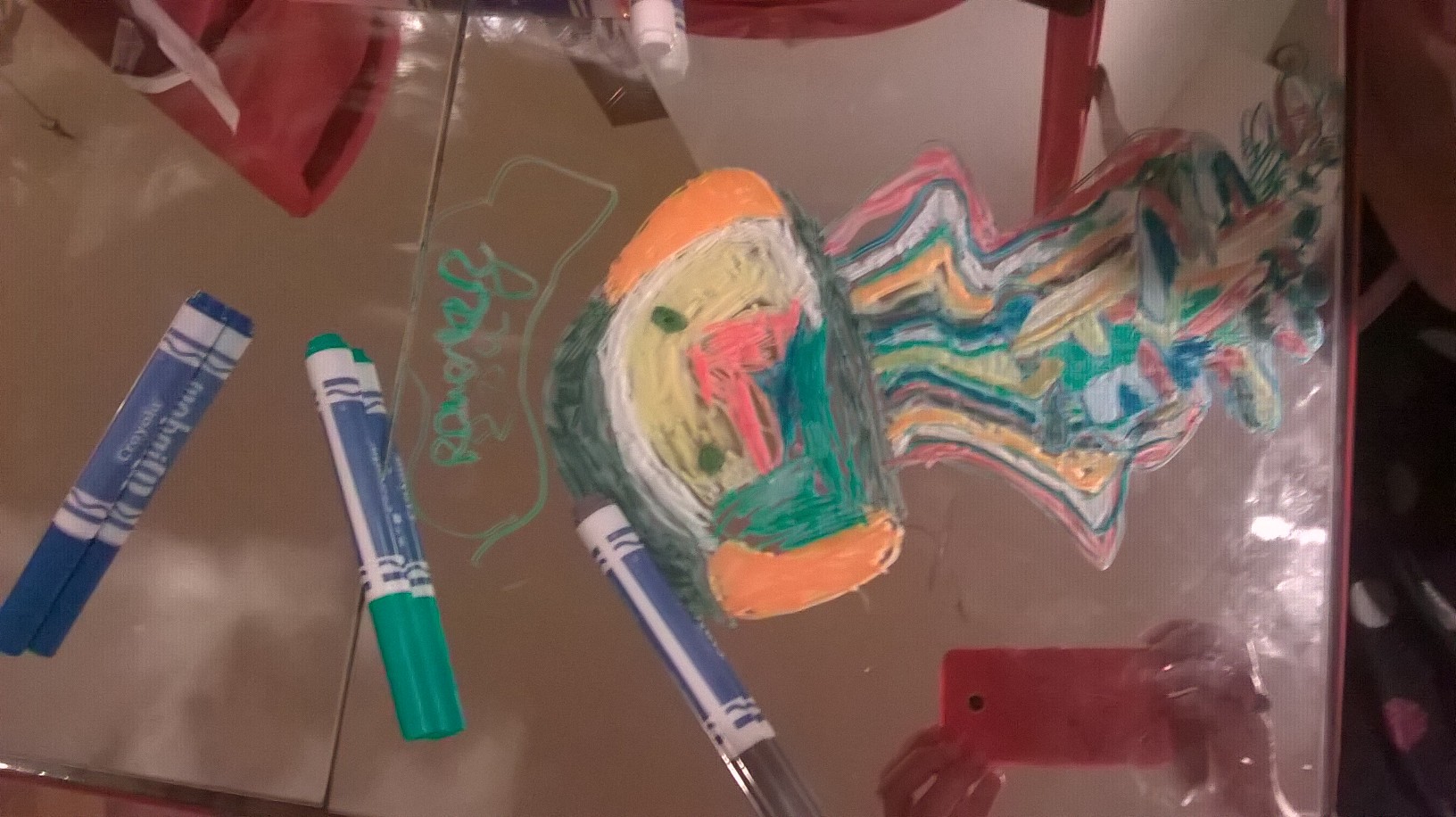
This one reminded me of Kandisky ( and a pattern in one of the earlier photographs is reminiscent of concentric circles).

“I like drawing random things that come into my head. Then they don’t have to be anything”   said my 6-year-old.

I explained that this is called abstract art. I have an artist friend and we all visited her exhibition recently. I told them that this was the kind of art that she makes.
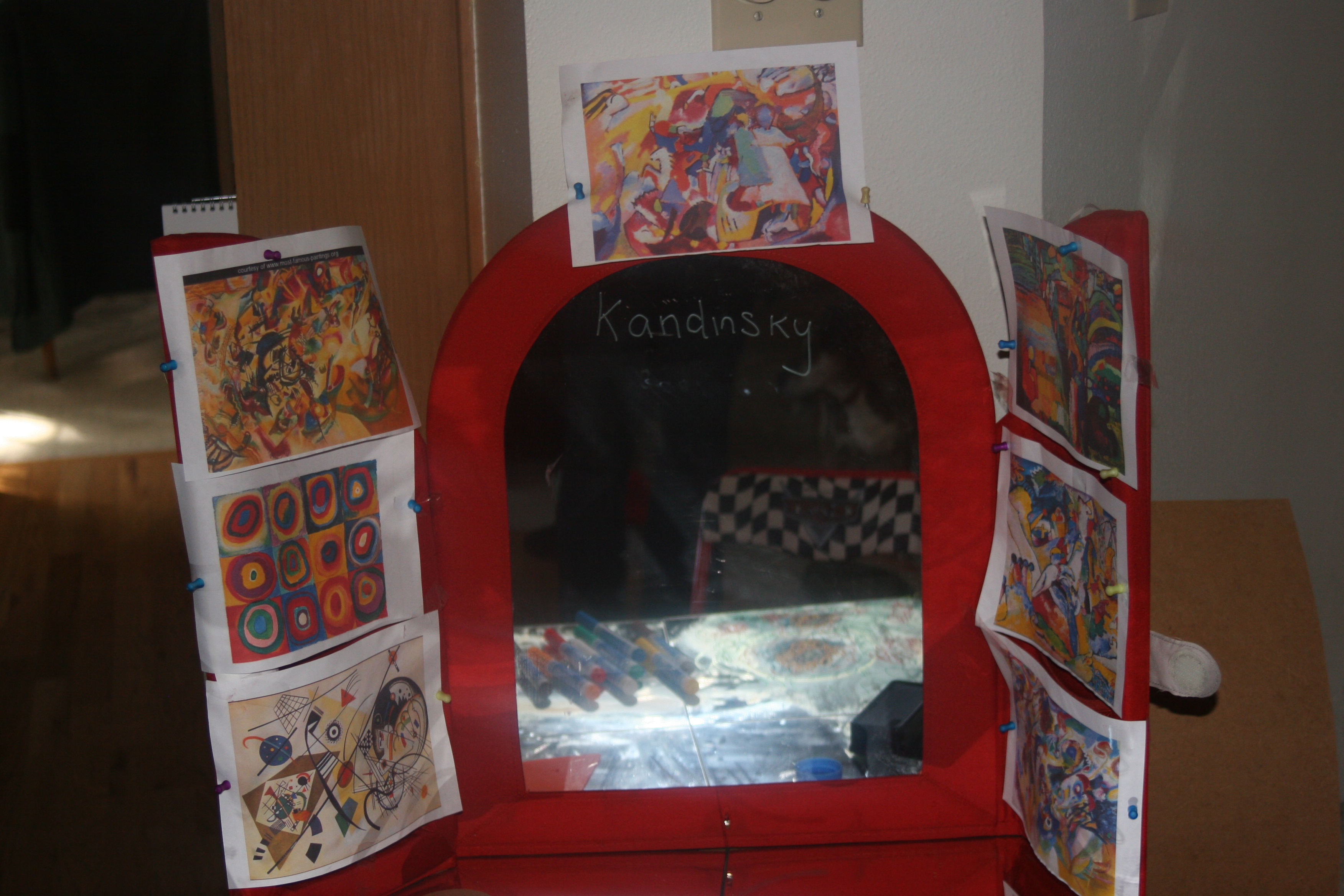
Later, I printed some Kandinsky paintings, placing them around the edge of the vanity mirror.
art on mirror table
glass pens on a mirror table

“Why did you name this one the traveller?” I asked.

“He looks like he has a bag on his back and the multi-coloured bits look like a map”

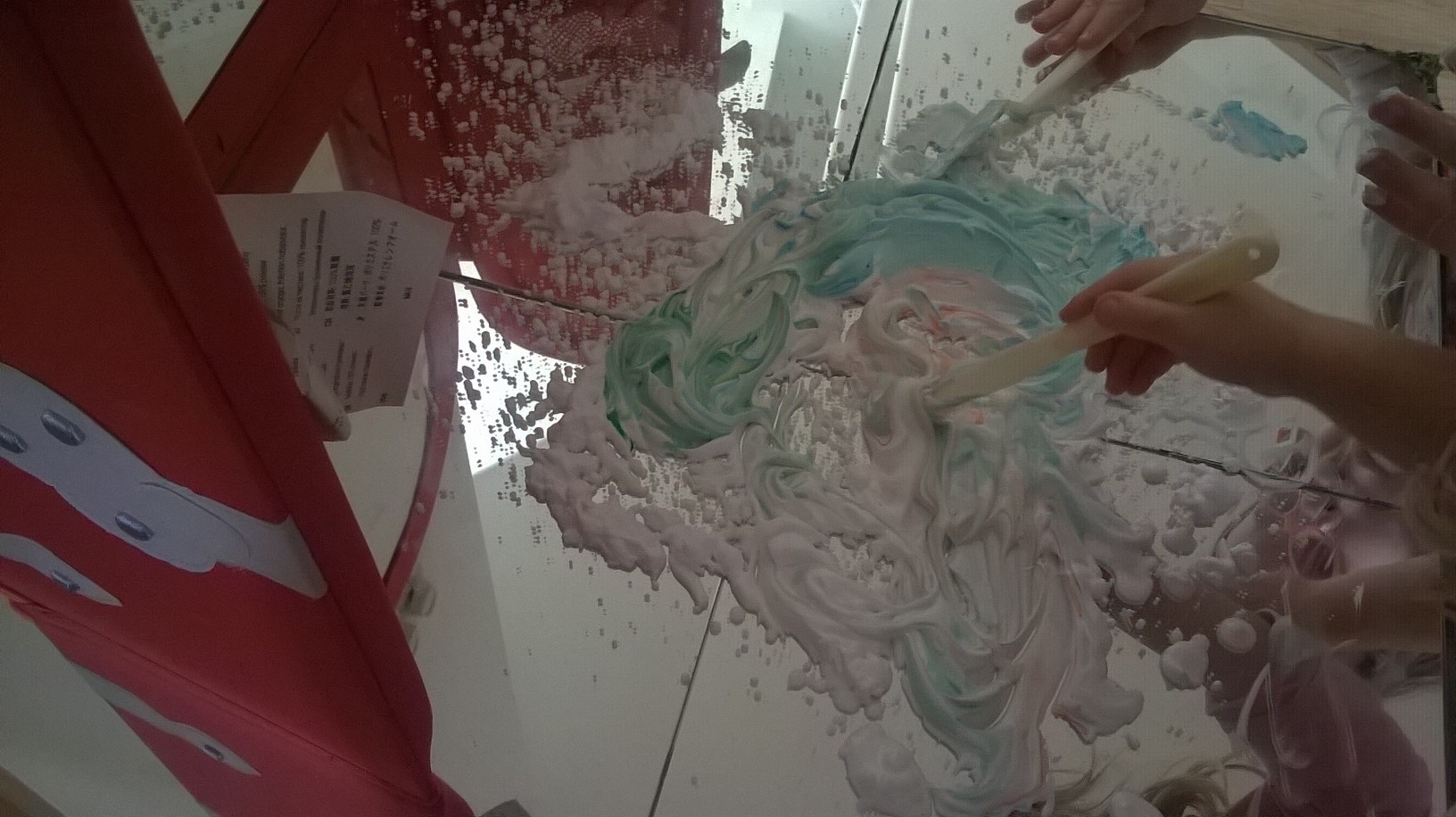
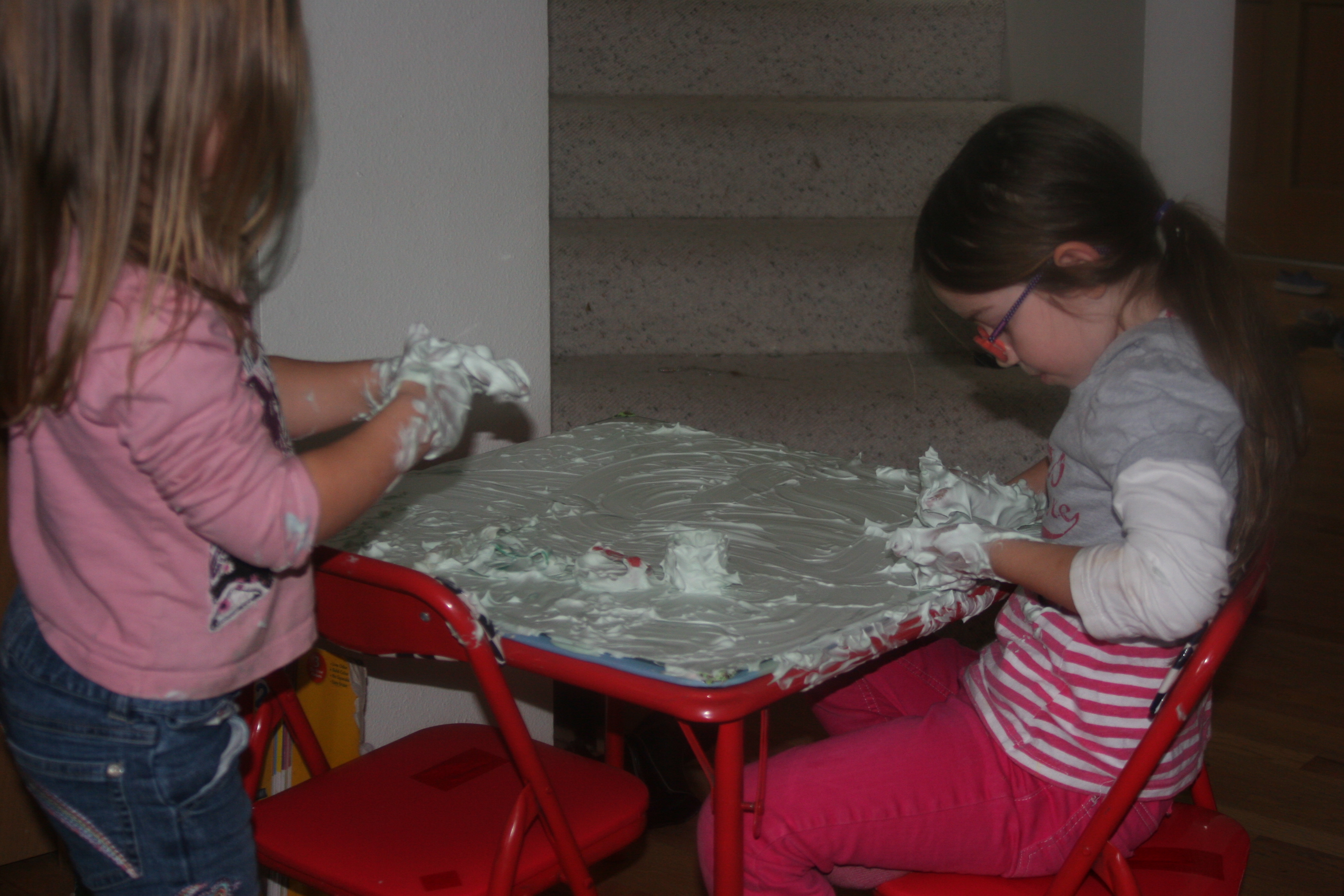
The mirror table is also the perfect surface for shaving foam.

mirror table shave foam

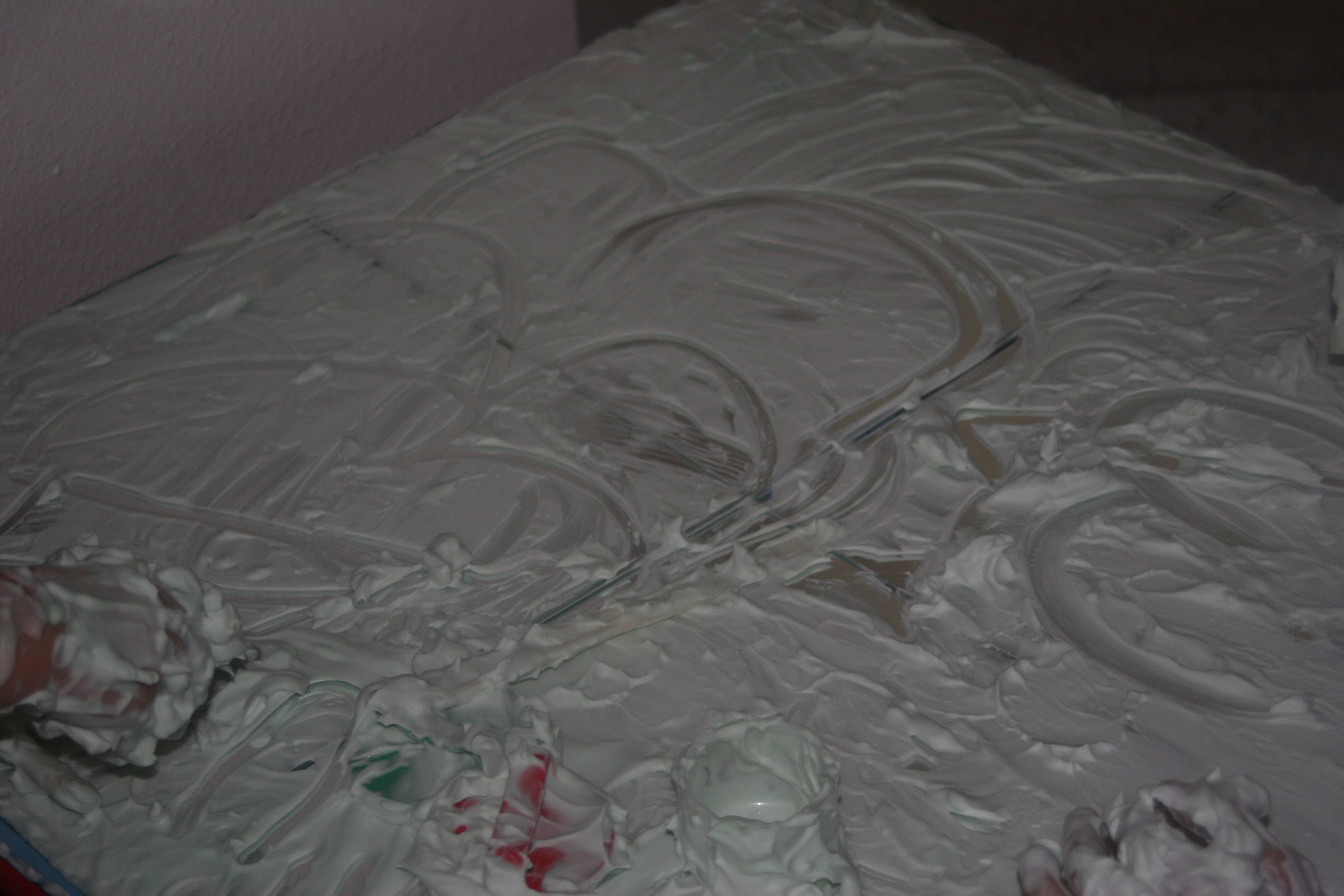
On a flat, even surface their natural instinct was to cover all the space, smoothing it over like icing a cake.

shaving foam on a mirror table

They began to create a story.

How about we’re the servants and it is the queen’s birthday and she wants us to decorate everything?

Now we need it all smooth again. We are the servants.

Wait, she said decorate everything. How about our hands? Oh no there are some gaps.

Maybe the queen will be mad. Come on we’ve got to make it smooth.

I don’t think she’ll be mad. She is the nicest queen. Everyday for pudding she gives us cupcakes.

It’s all textury, move your hands around like this.

Or I could do an M – like this.

IMG_0428

The scenario soon changed to one where they were at school.

There is lots and lots of art  but you don’t like doing it, do you?

Of course I do, why wouldn’t I? I love it

No, but remember we’re playing a game where you don’t like being creative . You just like playing video games and stuff.

I know, this is creative and you don’t like it. Pretend when someone asks you to do something creative you just say ” but when can I watch tv?”

Do you know what I’m going to do next?

No

Neither do I but it will be something creative.

How about you make a snowball?

The girls  abandoned a game of Minecraft when I put the foam out.  It is interesting that they were exploring ideas about creativity in their play.

Additional mirror table activities can be found on my mirror table Pinterest board.

British Children Learning to Read and Write in the US.


I knew my youngest children would learn to read and write in the US and as a result I would have to accept that they would spell differently and use American phrases and grammar.  There are some unexpected differences however that I hadn’t considered.

A few days ago my 4-year-old remarked,

“Mummy, all the other children at preschool don’t write t’s properly”

“Really! Can you show me”

It is a bit like an x, like this……

t

My youngest is 4, I taught her to write her name but it never crossed my mind that letter formation might be different here.

I asked my kindergartener

” Do you write a curly bit on the bottom of the letter t at school?”

“No we do it like a cross”

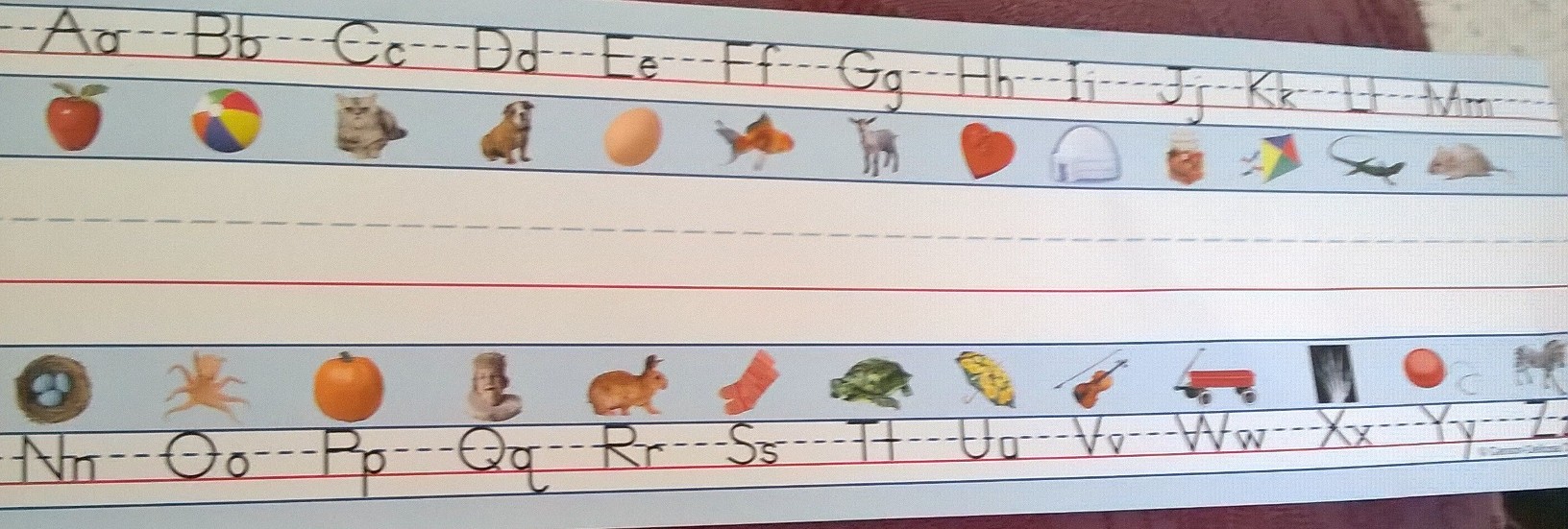
I checked with the teacher and she explained that they use the ball and stick method where  letters such as t, w and y use straight lines rather than curves as they feel it is easier for the young children to master. It is one of many differences that I hadn’t anticipated.

alphabet ball and stick

I always believed the transition would be most difficult for my eldest, who went  to school in England until she was 8, so learned to read, spell and write ‘the English way’. The first thing she noticed, was that punctuation had different names; full stops were periods and brackets became parentheses.  We were really keen that she wouldn’t lose her knowledge of British spelling, so school agreed that she could learn both.  As an avid reader and proficient speller this wasn’t really difficult.

Choosing books wasn’t simple either. Most books by British authors are rewritten for an American audience.  When we borrow books by British authors from the library or buy books here, they are American versions.  My daughter is really eager to maintain her ‘Britishness’, so we often order books from the UK. This way she can still read books with British spelling and vocabulary and is able to read literature from both cultures. Tonight we read an American translation of Pippi Longstocking. This was my daughter’s favourite book for many years, so she knew much of the text by heart.  Every time she spotted a difference, she would quote the British text. In the end we got her old battered copy down to compare. I was surprised that though the meaning remained the same, the texts were very different. The monkeys name was different and the language in the British version was more detailed and poetic (although I am sure that the original Swedish is even more rich).

“A remarkable child” said one of the sailors, wiping a tear from his eye when Pippi disappeared from view. (British translation)

” A remarkable child” said one of the sailors as Pippi disappeared in the distance (American translation)

My daughter’s desire to maintain her British identity isn’t without its pitfalls.  Once she was marked down in a piece of writing because she referred to a ladybird rather than a ladybug (which I felt was a little harsh).

I thought things would be simpler for the younger ones because they started school here but they have been faced with different challenges:

1. The alphabet ends with zee (my daughter has decided that it makes more sense the American way because the song rhymes).

2.  What sound does a short ‘o’  make? To us it is o as in fox, box and top but American pronunciation is different, instead it makes the sound a as in fax, bax or tap. Confusing but also a little amusing to the girls who still have perfect English accents. I think I was fortunate that my daughter was beginning to read when she went to school and had already learned basic phonics so this wasn’t too much of an issue.

3. School reading books have American phrases which to a Brit’s ears sound totally wrong and often make me shudder. An examples from today’s reading book is :

Let’s go find Leo.

The omission of “ly’ at the end of adverbs is common as in ‘We need to be real quick’. I suppose one positive is that the girls generally notice and remark that it sounds different.  When my daughter reads a word that we don’t use, she substitutes it for the British word “I’m just going to say mum not mom”.

4. Sometimes they complete worksheets where they have to circle pictures that begin with particular letters. This can be confusing if the British word is different from the American or if it is something traditionally American like baseball equipment.

On the whole I think the girls awareness of the differences gives them a far richer experience of the written word.  It certainly gives us a lot to talk about.


Why Do Young Children Draw Belly Buttons?

IMG_2251

My youngest daughter (age 4) has recently started to draw detailed pictures. Mostly they are people.  She always starts with the eyes, adds a nose and mouth and then draws the circle for a head. After adding hair, she draws a torso, arms, legs, hands and feet.  The finishing touch is always a belly button. I found this fascinating. I don’t remember my older children doing this for any sustained period of time, if at all.

In the earliest stages of children’s drawings of people, there is no torso. At this stage they often draw a navel (or circle) between the legs to depict that there is a torso there.  I’m not so familiar with children drawing belly buttons onto a torso however.

drawing by 4 yr old of man with belly button

Clearly, children under the age of 5 do not generally draw clothes on their people.   Seeing a navel on her sister’s drawing, immediately led my 6-year old to the assumption that it was naked. As they talked through the drawing together, the picture became one of a daddy and his little girl in the shower and anatomically correct details were added.  These didn’t survive into later drawings when her sister was not present but the placement of the belly button continued.

There is a boy and a girl holding hands, the boy is a man and the girl is his child. They are naked because they were in the shower. ( The lines above are water from the shower)

My intrigue grew, when a friend with a child of a similar age shared her daughter’s drawing of the family.  There was the belly button again.

I  decided to ask an expert and consulted Ursula Kolbe author of Rapunzel’s Supermarket:All about Young Children and Their Art for help. She suggested that children are fascinated by belly buttons and the drawing of a simple round shape is often intensely satisfying.  Perhaps then, it is the circles that she finds fascinating.  The drawing sequence always begins with eyes made up of a circle within a circle. Kolbe also suggested that children often copy the ideas of other children but since my little one is yet to attend preschool and only has her sisters to influence her this is unlikely in her case.

4 yr old drawing people

Often what children include or don’t include in their drawings is determined by the sequence in which they draw. “If a child draws a torso and then legs they sometimes won’t go back up to include a navel even if they intended to do so” says Kolbe.  I watched my daughter’s sequence with interest; she always drew the whole person and then went back to draw the navel as a finishing touch.


child's drawing of people

Sorting through boxes, I came across some old photographs of me as a child. In amongst them was this.

childs drawing of people


I must have been 4 or 5 years old when I drew this man, complete with belly button.  What a magnificent and timely discovery to help solve my conundrum.

Furchester Hotel – The Sesame Street Gang Come to CBeebies

CBeebies and Sesame Street


It always feels good to get a little something from CBeebies drop into my inbox.  We miss CBeebies quality programming featuring British accents and no adverts. American children’s television isn’t all bad though.  Through childhood, student years and as a mother I have always been a huge Sesame Street fan.  The wonderful documentary Being Elmo made me an even bigger fan.  The latest news from CBeebies was the most exciting I’ve received in a long while. CBeebies and Sesame Street are working together to create a new series,  The Furchester Hotel.

Filming started on Monday 24 February, and will continue for just over three months. The enormous Furchester Hotel set fills all 700 square metres of the HQ2 studio at dock10, MediaCityUK, and was transported in 10 lorries from the three construction companies employed to build it over two and half months. It shows the interior and the garden of The Furchester Hotel and is raised 1.1 metres off the floor in order for the puppeteers to perform standing in the main areas. The set is double height with a sweeping staircase that guests take to the bedrooms when the lift isn’t working – which is almost always.

How amazing does that set sound and how disappointed am I that I can’t accept an invite to visit the set for myself? It makes me want to jump on a plane right away.

What is The Furchester Hotel?

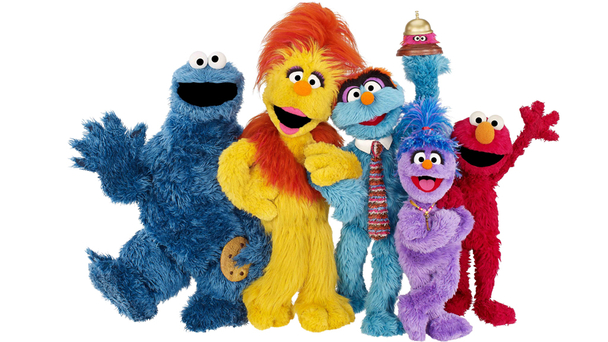
The Furchester Hotel, is about a close-knit family of cheerfully incompetent Muppet monsters who own and operate an ‘almost’ world-class hotel. The proprietors are Funella Furchester, the welcoming monster owner, her loving husband, Furgus Fuzz, and their daughter, the unflappable Phoebe Furchester-Fuzz. The Furchester family is joined at the hotel by Elmo, Phoebe’s cousin who is on an extended visit, and Cookie Monster, who has landed his dream job as room service and dining-room waiter.

The Furchester Hotel aims to promote and build creative problem-solving skills for its young viewers. As the Furchester family scrambles to meet the needs of its guests, the monsters use their exceptional thinking skills to brainstorm possible solutions to problems that arise. And even when they think they have exhausted all the possibilities, their perseverance prevails because their family motto is, “A Furchester never gives up!” The daily mishaps and mix-ups at The Furchester Hotel will provide many opportunities for our young Muppet friends to model ways in which pre-schoolers’ natural curiosity and creativity can be harnessed to collaborate and solve problems.

Cookie Monster and Elmo are in Town

It takes approximately 70 cast and crew to make the series, including nine puppeteers and four assistant puppeteers. Experienced puppeteer Louise Gold plays Funella; Mak Wilson, who has been designated Puppet Captain, performs many of the guest Muppets, including resident guest Harvey P Dull; Andrew Spooner performs Furgus; and Sarah Burgess plays Phoebe. Elmo and Cookie Monster are played by Sesame Street puppeteers Ryan Dillon and David Rudman respectively and the head writer for the series is Belinda Ward.

“We’re so excited to be starting work on The Furchester Hotel. The studio set is truly amazing, and to see the puppets arriving on site really brings the project to life,” says Alison Stewart, Head of CBeebies Production. “We’re delighted to welcome The Furchester family, Elmo, Cookie Monster and their friends to Salford.”

“The excitement in MediaCityUK is palpable as we begin production on The Furchester Hotel,” says Carol-Lynn Parente, Executive Producer, Sesame Workshop. “We know this series will engage children with humorous problems and quirky solutions in ways that only the beloved Muppets can. We look forward to seeing The Furchester Family, along with their friends Cookie Monster and Elmo, delighting children and families on CBeebies for years to come.”

“Me cannot wait to ‘work’ as dining-room waiter at The Furchester Hotel,” says Cookie Monster. “Me hear their cookies are delicious. Om nom nom.”

The Furchester Hotel is co-produced by Sesame Workshop, the nonprofit educational organisation behind Sesame Street, and the In House Production team at CBeebies, the BBC’s pre-school children’s channel. The 52×11-minute series is set to debut on CBeebies in Autumn 2014 in the UK.

Hopefully I can find a way to watch it here too.


Ideas for Learning Environments Inspired by Children’s Museum of Tacoma

I’d never heard of a Children’s Museum before I moved here but as I entered the door I was greeted by a little bit of play heaven. I think I was more excited than the girls.  My 9 -year-old remarked

It’s not really a museum is it?

True not in the traditional sense.

According to Wikipedia, Children’s museums are institutions that provide exhibits and programs to stimulate informal learning experiences for children. In contrast with traditional museums that typically have a hands-off policy regarding exhibits, children’s museums feature interactive exhibits that are designed to be manipulated by children. The theory behind such exhibits is that activity can be as educational as instruction, especially in early childhood.

In essence it’s like walking into a really well- resourced nursery or pre-school.  I loved that many of the exhibits used simple, cheap materials that could be replicated at home, like a blackboard with a pot of water and brushes.  I particularly like these; they would be a great addition to a child’s bedroom wall, garden fence or in a toddler room at nursery.

The water area was a huge hit with my youngest. My favourite was a water bath with a transparent window so that you could see what was happening under water.

This slideshow requires JavaScript.


Behind the glass is an area for art based activities – musical instruments, painting, movement with ribbon sticks and scarves and drawing.   The metallic walls made it so easy to dry and display pictures. What a great idea for a messy play room.

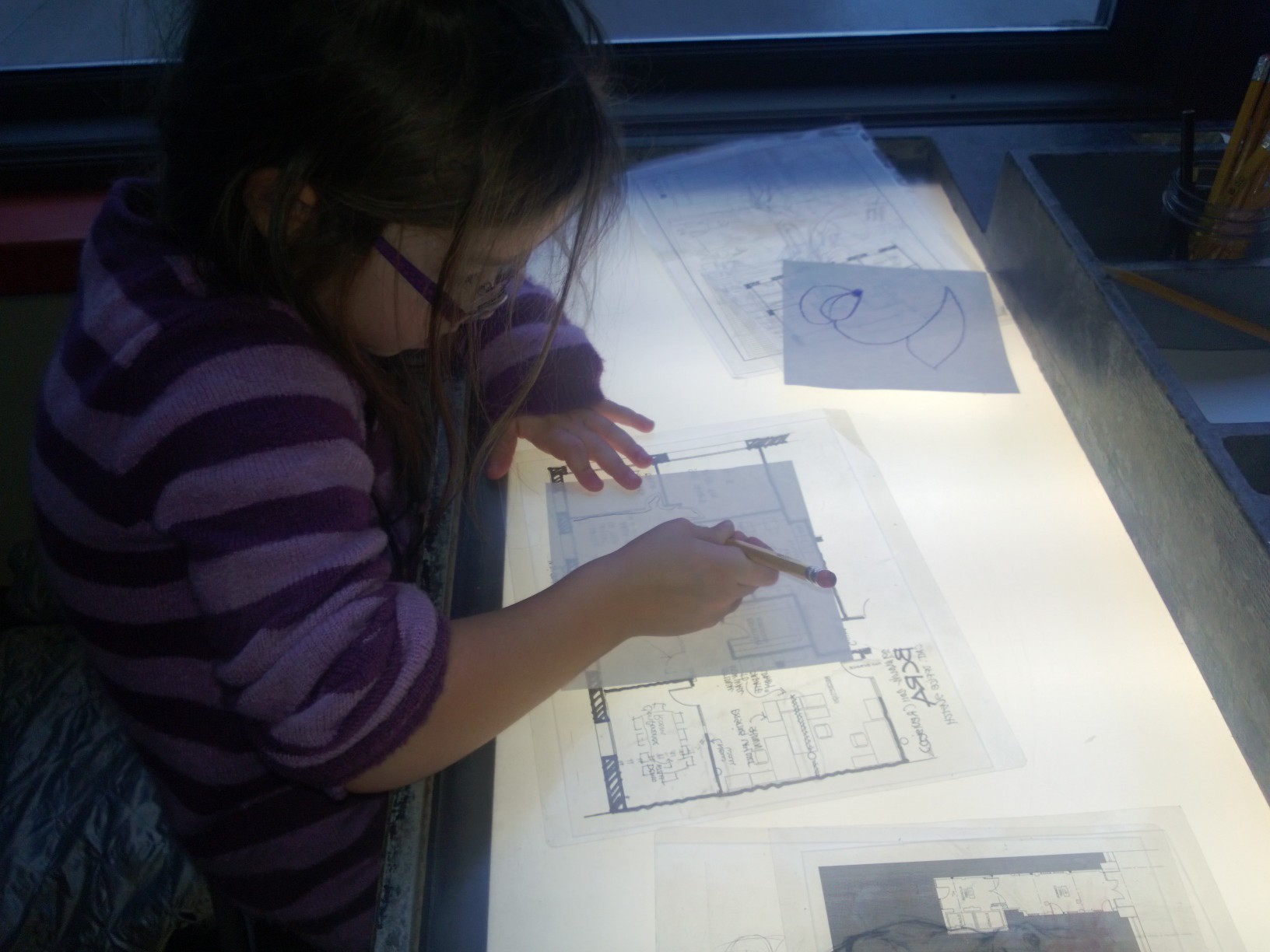
There were 2 light tables in the space with very different activities, the girls chose to trace and draw.

light table with maps and plans

My eldest loved  den building best of all.  The smaller structures were not very stable so she negotiated with the other children in the space to create a big den together.

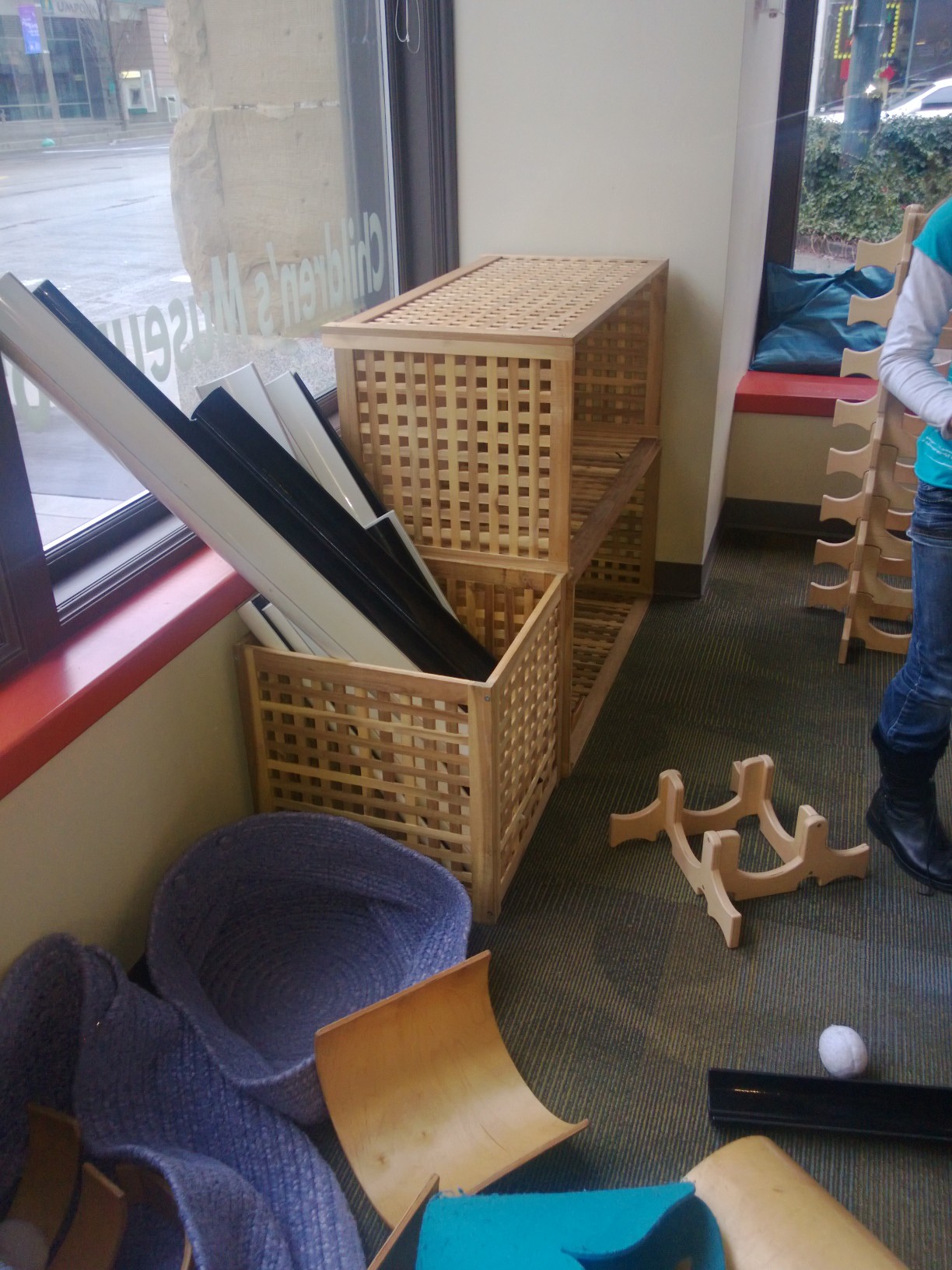
More building – drainpipes and gutters

drainpipes and gutters

I’m so glad we discovered Children’s Museums and I’m looking forward to visiting the others in the area and sharing more ideas.

The Land of Song – A Guest Post for St. David’s Day


Today we have a St. David’s Day guest post from Penni Carr.  I met Penni during my  musical theatre days (sorry Penni for the old photo).  She went on to become a professional actress and since becoming a mum, has founded Babi Bach a bilingual music class for babies and toddlers. Penni writes about the connection the Welsh have with singing and how the Welsh language is an integral part of that. Are Welsh people good singers? Why do we love singing so much?  Read on the find out more…

Penni and Rachel
Welsh people often get asked if they are born being able to sing? As if it is some magical power that Celtic people posses from birth. Now, some people may believe this is true but I believe something slightly different. I believe that Welsh people are born into a heritage rich in tradition and passion and one way that we pass this on is through song.
Children will be taught nursery rhymes and songs in Welsh and English, even if English is the only language spoken at home (which Welsh people here have ever sung “Mi Welais Jac y Do” or “Calon Lan” without learning any other welsh?!) I think that, from birth, singing is something that we usually hear every day and so it becomes something very natural for children to do; to sing along and join in with the song – to pass on the history, the tradition and the language.

Welsh lady
Music is one of the only things that engages the WHOLE brain and, as such, is an incredibly useful teaching aid. I bet you can remember songs that you sang at school when you were five far more easily than you can remember the periodic table! Unless you can sing that too like the fabulous Tom Lehrer!

I founded Babi Bach in September 2013. We are a bilingual baby music class suitable for little ones from birth to three and we use music and songs to help little ones learn languages. We believe that music and language help children develop communication skills, social skills, gross motor skills, fine motor skills, spatial awareness, community links and, most importantly, it’s FUN! So pass on your song and watch your little ones flourish. All together now…

Mi welais Jac Y Do         ( Me well-ice Jack err Door)

 Yn eistedd ar ben tô      ( Un ‘A’ steth arr ben tor)

Het wen ar ei ben            (Het when arr ‘A’ ben)

A dwy goes bren              ( a doi gois bren)

Ho ho ho ho ho ho!         ( Hor hor hor hor hor hor)


Thanks Penni x

Outdoor Play: Ice Activities – how a simple art ice project turned into a science investigation.

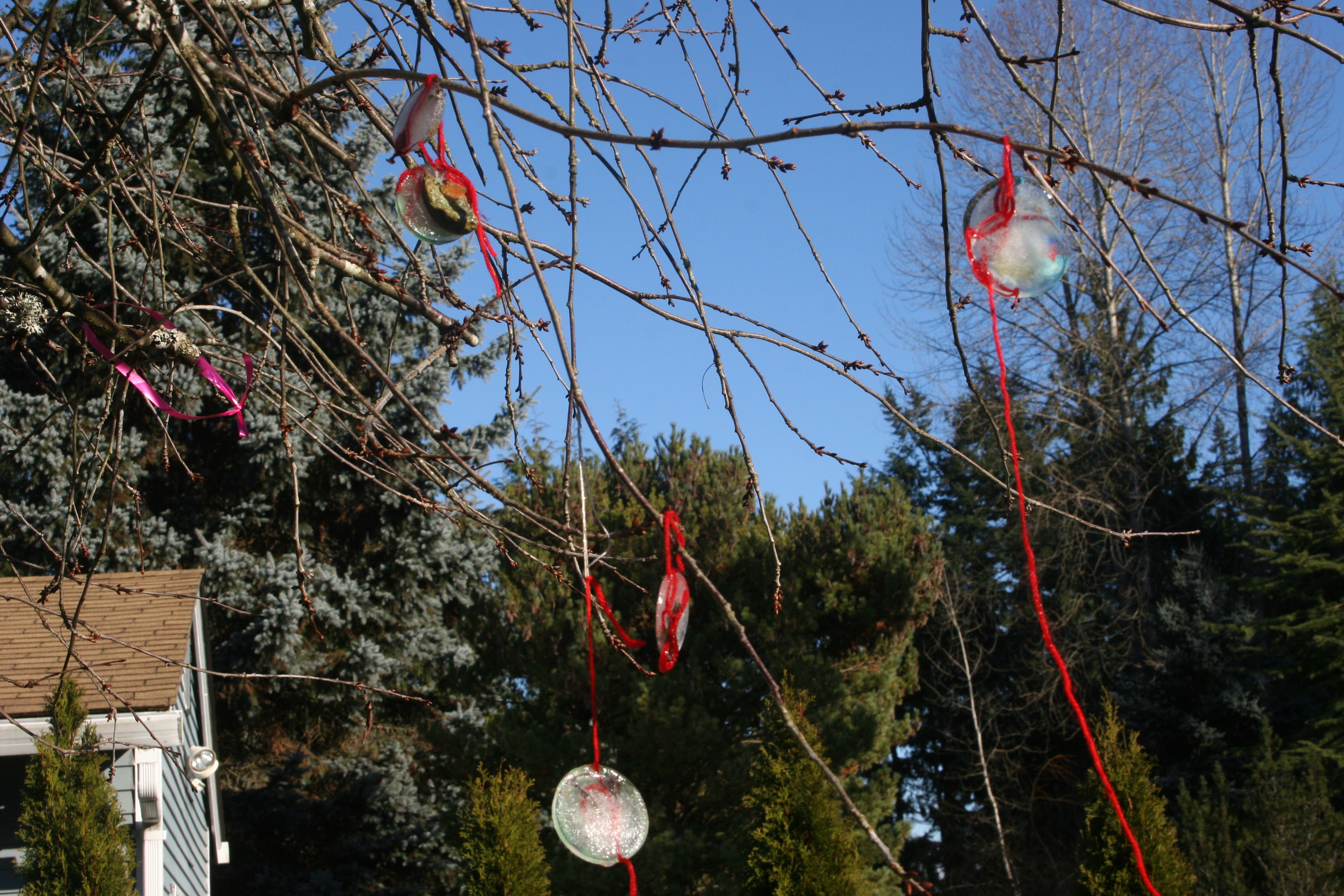
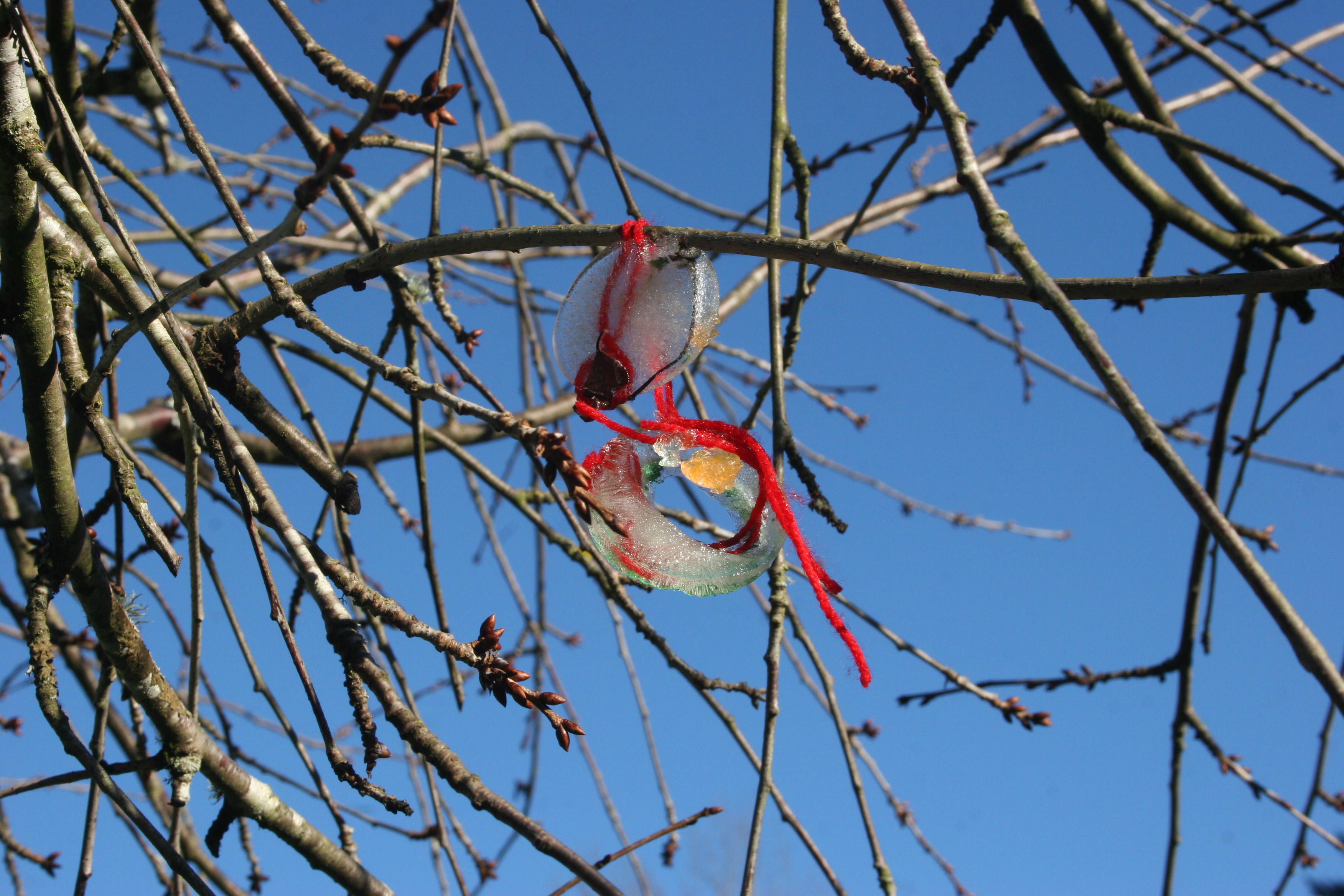
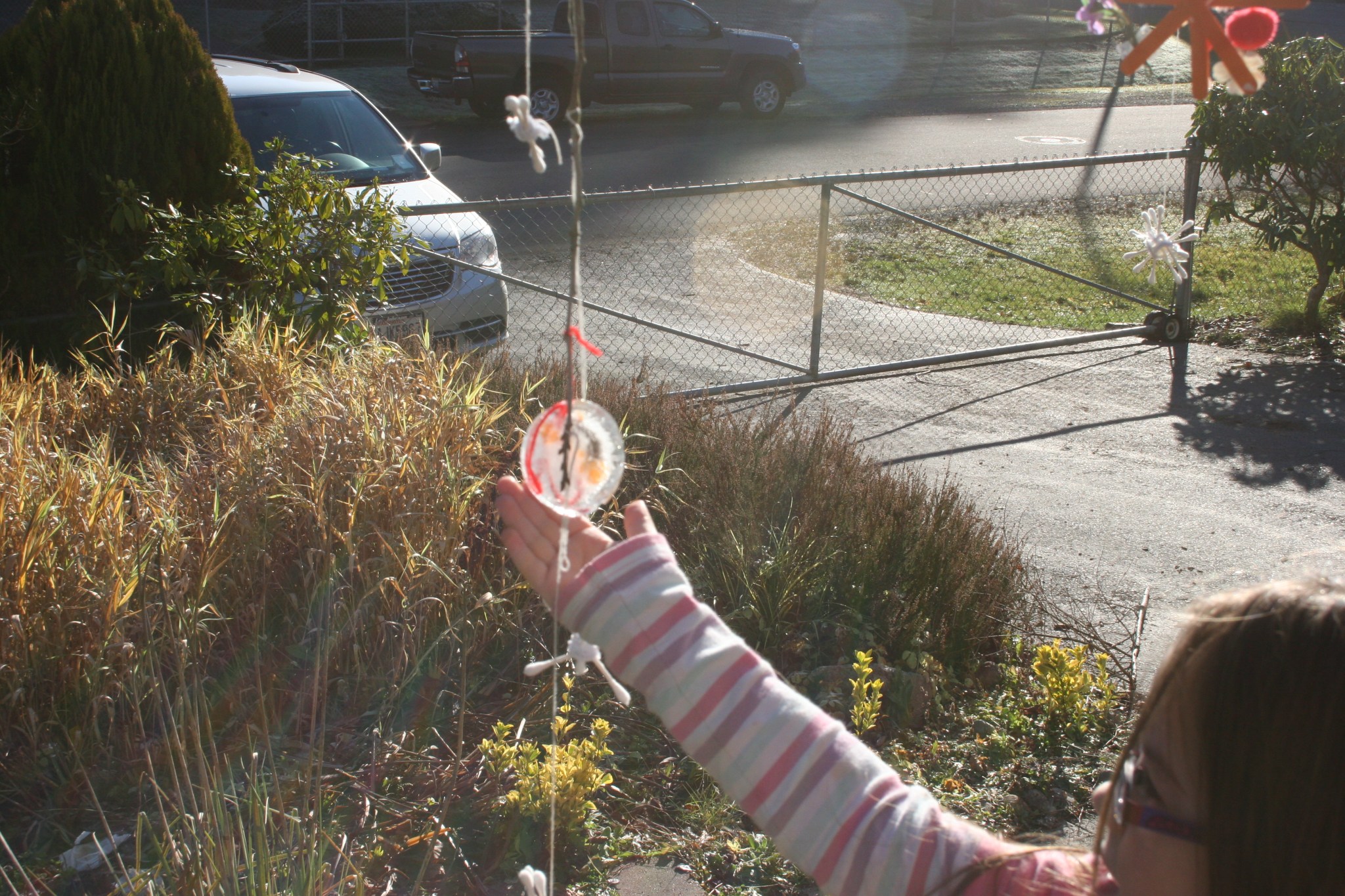
ice decorations

Ice Ornaments and Icicles

What had originally been an icy art project, unexpectedly turned into a fascinating science investigation.

A few weeks ago we filled up my baking tins with water  that we coloured with powder paint and dropped all manner of things into them.  Shells, berries, leaves, sequins, buttons and even a stone were placed inside to make ornaments for our tree.  The weather unfortunately instantly became warmer, so we had to wait some time before they were ready to hang.  Even then,  only the top layer of ice had frozen and within an hour of hanging them on the tree they had melted.  We also discovered that if you colour water with powder paint it separates once it begins to freeze, so most of the ornaments were not the lovely colour we had hoped for.

The girls have been peeking outside every morning to check if there is any ice.  This week they were rewarded with below freezing temperatures.  The ice ornaments were finally ready!  We hung them on the tree.  The sun was shining and the tree stands in the sun until mid afternoon.  I wasn’t sure how long they would stay this time as ‘plop’ one fell down from the tree.

Let’s put it by the door. That’s in the shade – it might make a nice present for Father Christmas.

Ice ornament
A present for Santa

As we went inside I asked the girls to watch the ornaments from the window.

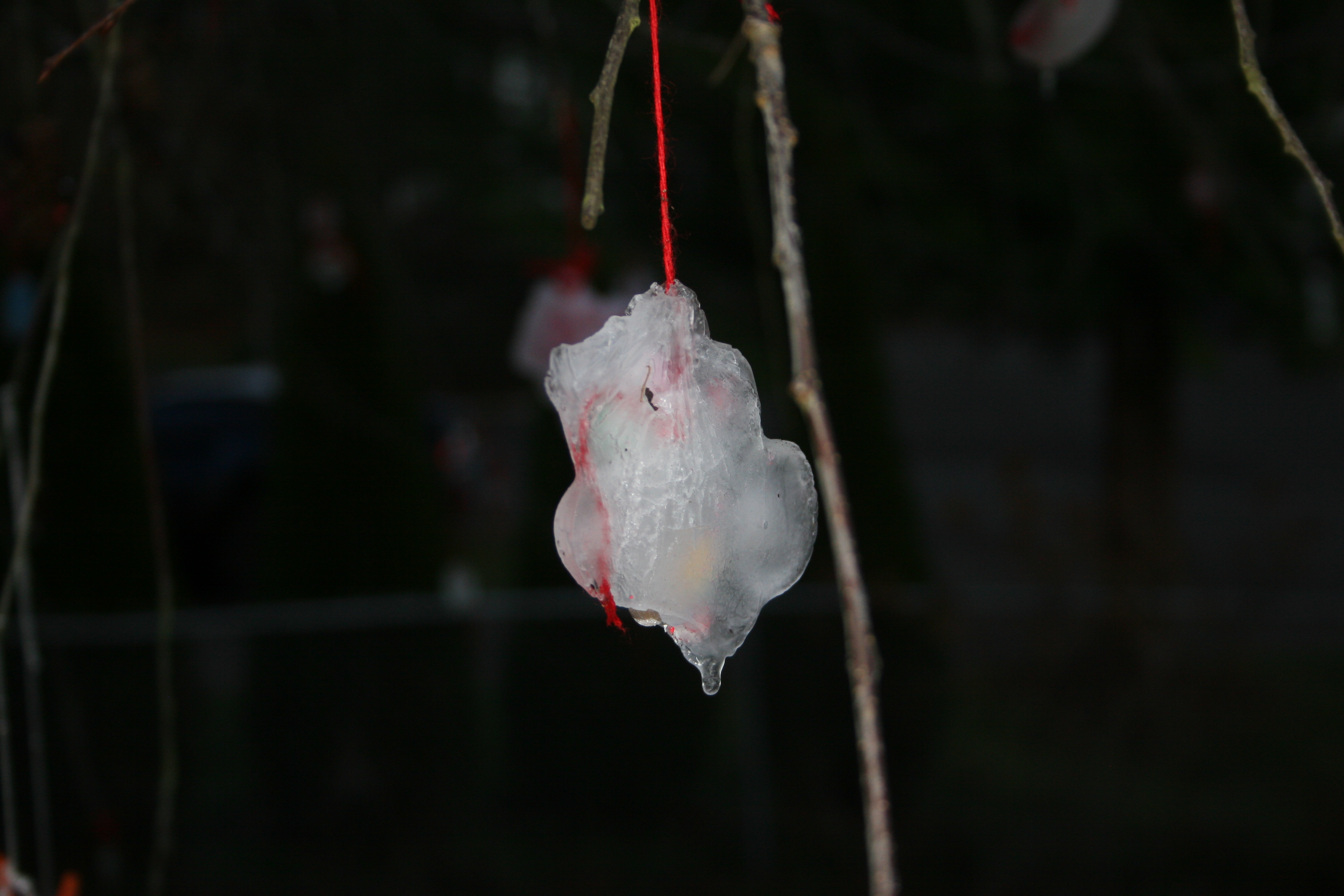
They are melting.

How do you know?

They’re wet and they’re dripping down.

What do you think will happen as they melt?

I don’t think it will fall off the string because the string is attached. It will just melt and the floor will be wet.

When we went out later there were more interesting observations

Look this one has holes in it.  It might break not melt.

melting ice ornament with holes

Can I touch one?

Yes sure.

child touching ice
It’s cold and wet.

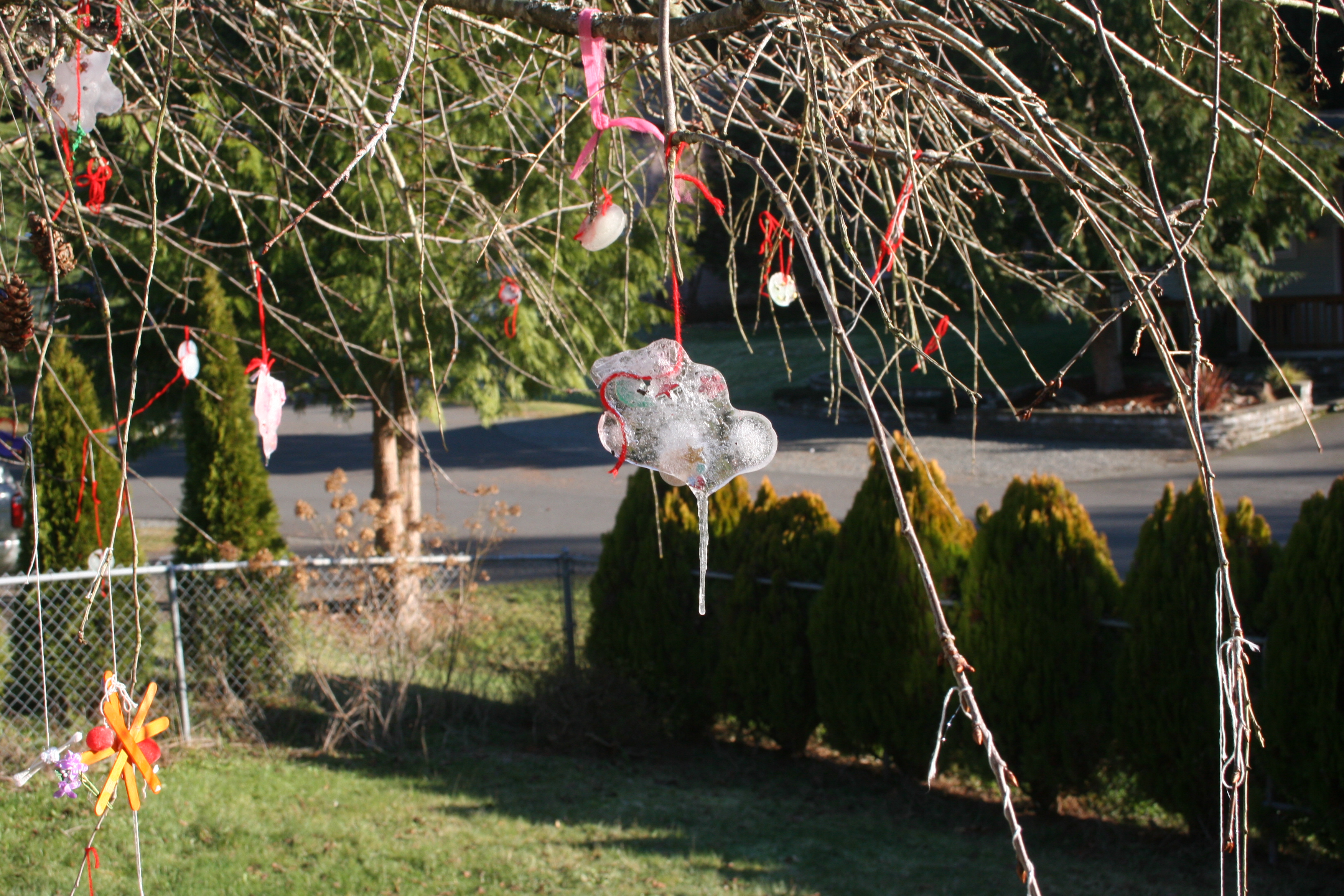
Within an hour or so the tree was in the shade and the temperature was beginning to drop. We noticed that the drips were starting to turn into little icicles.

icicles

The girls thought this was really cool and the next day even more so when we saw large icicles had formed.

icicles

They rushed outside to feel them, touching them gently so that they didn’t break off.

A Winter Pirate Treasure Hunt

The weather was so cold that during the late afternoon I sneaked into the garden with a jug of water and some pirate coins.  I put the coins in various containers and poured a little water on the top.

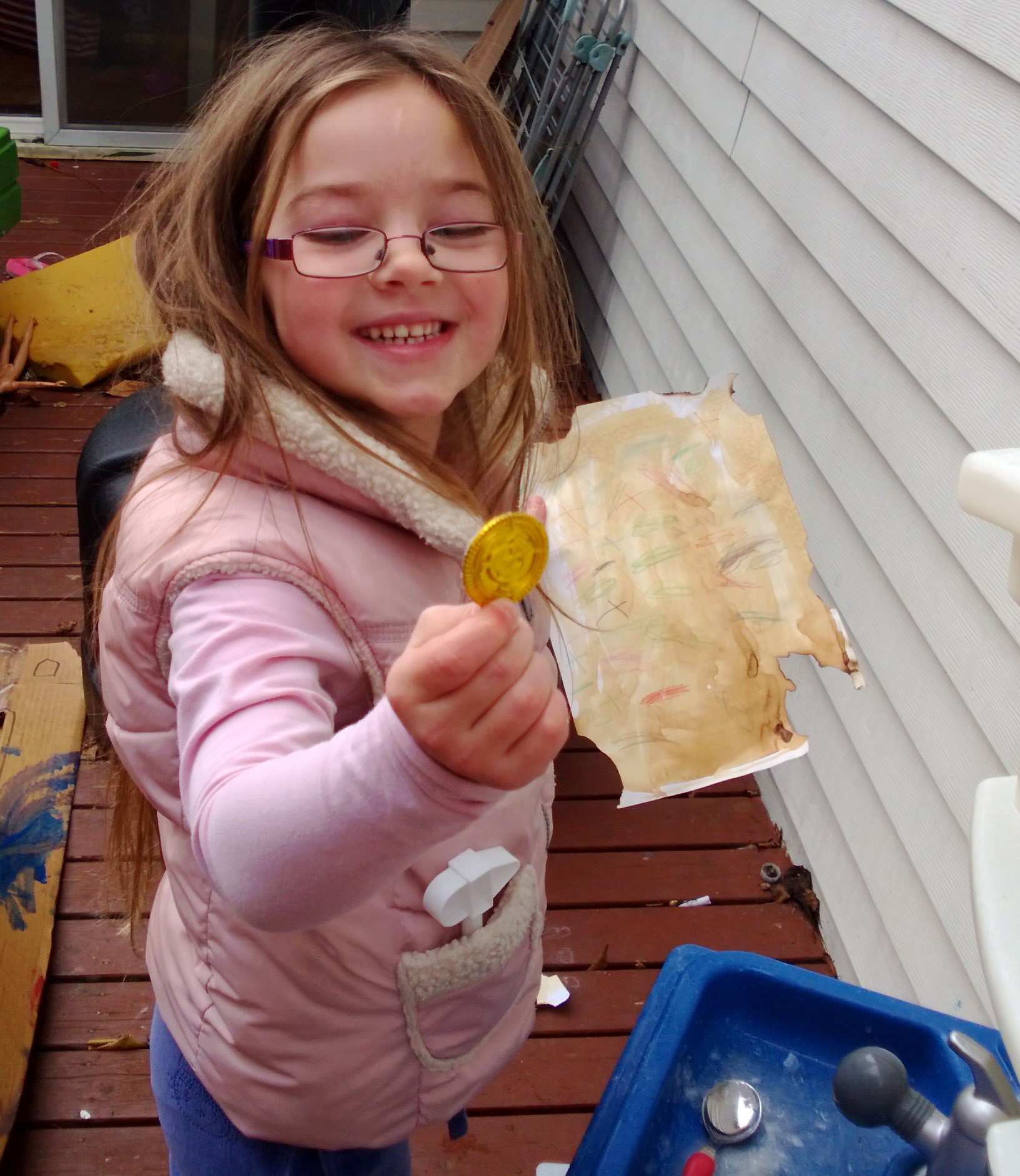
In the morning I invited the girls on a pirate treasure hunt. First they needed to make a map.  I had some coffee stained and singed paper that in true Blue Peter fashion I had prepared earlier.

Next they needed their pirate toolkit:
A hammer
A spoon
A pot of pirate sea salt

pirate toolkit
Ready Mummy

Out they went and quickly found coins. The hammers were their first choice. They weren’t very successful so then they tried the salt. They found that if they used the spoons and the salt they could gradually get down to the coin and hook it out.

pirate treasure hunt
Got it!

This could take ages, if we got a jug of hot water it might be quicker.

We were talking about the sea salt later in the day.

How do the pirates get salt from the sea?

Good question.  The salt is in the water so how do you think they could get it out?

I don’t know.

Shall we try it?

Yes.

Little Scientists

What do we need to do to make the salt disappear into the water?

We need to dissolve it

How? Do you remember how we made jelly dissolve or the sugar water we make for the hummingbirds?

We put hot water on it. Let’s be scientists and do an experiment.

The girls helped to stir the mixture until all the salt had dissolved. We poured the mixture into a pan and put it on the stove.

What happens to water when it gets cold?

It turns to ice

What about when it gets hot?

I don’t know.

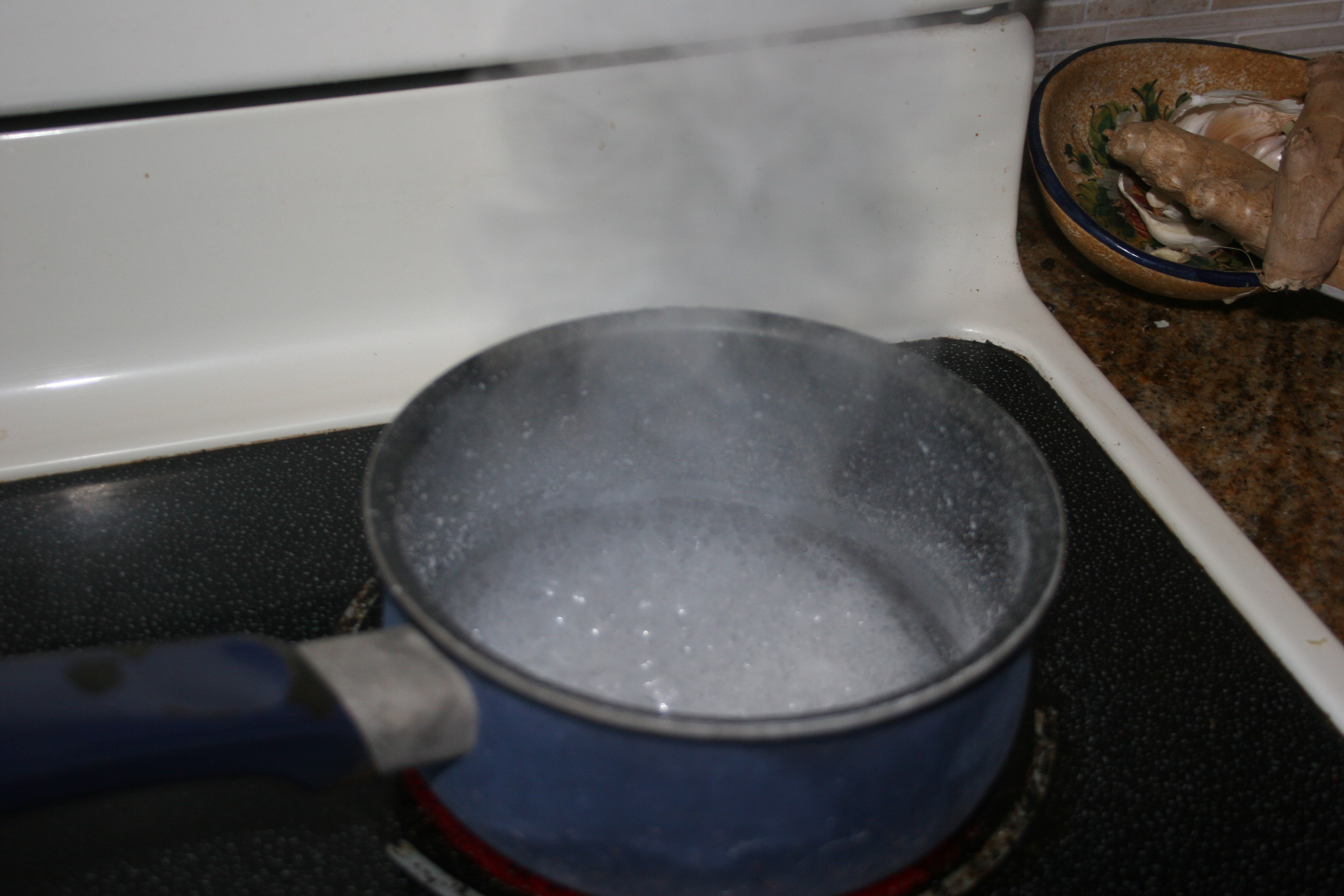
Watch. What can you see.

steam

steam

If I put this spoon over the steam what can you see on the spoon.

It’s wet – water.

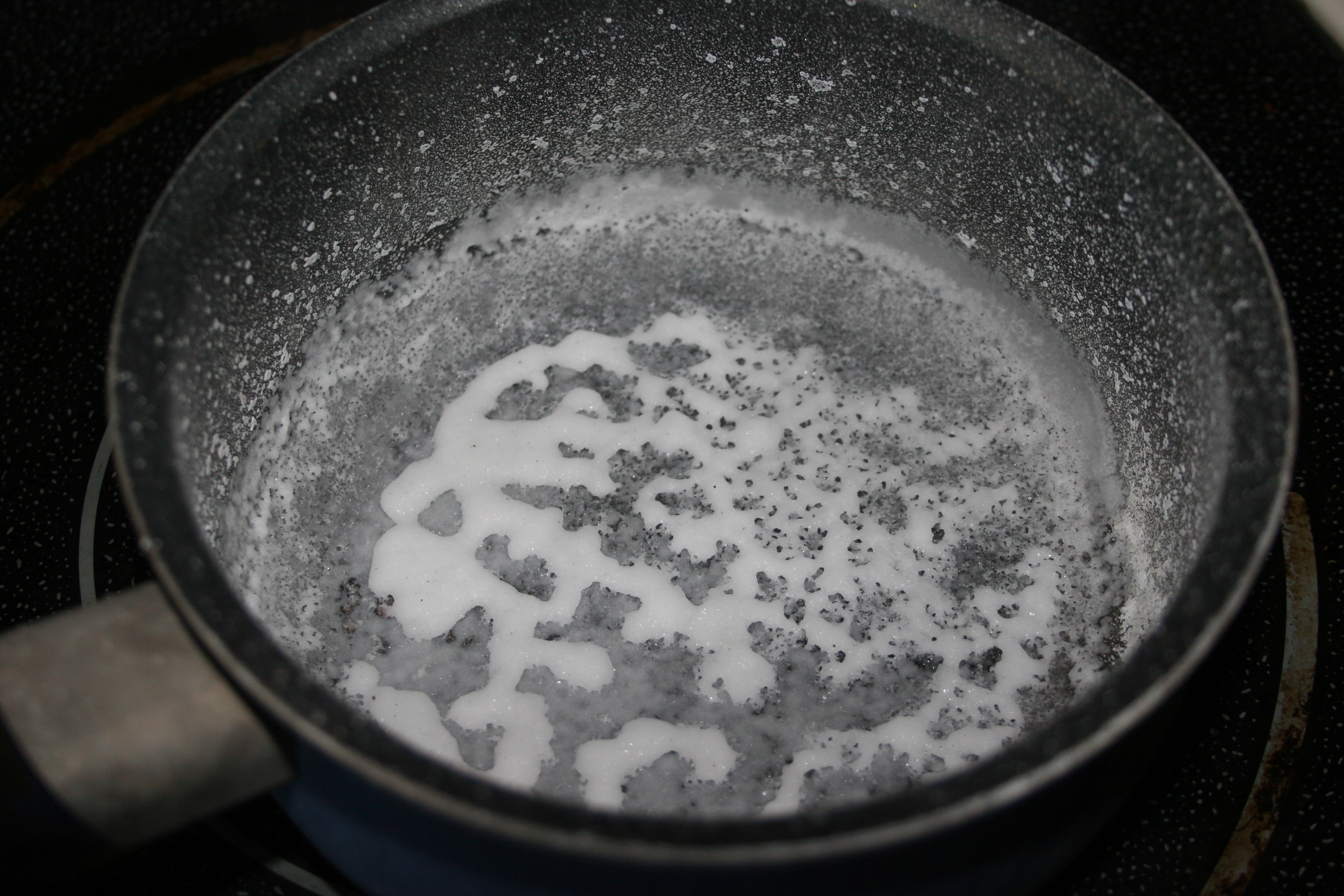
Yes the water is turning to steam. Now look what’s happening in the pan. What do you think the white stuff is?

salt distillation

I don’t know. Is it steam. 

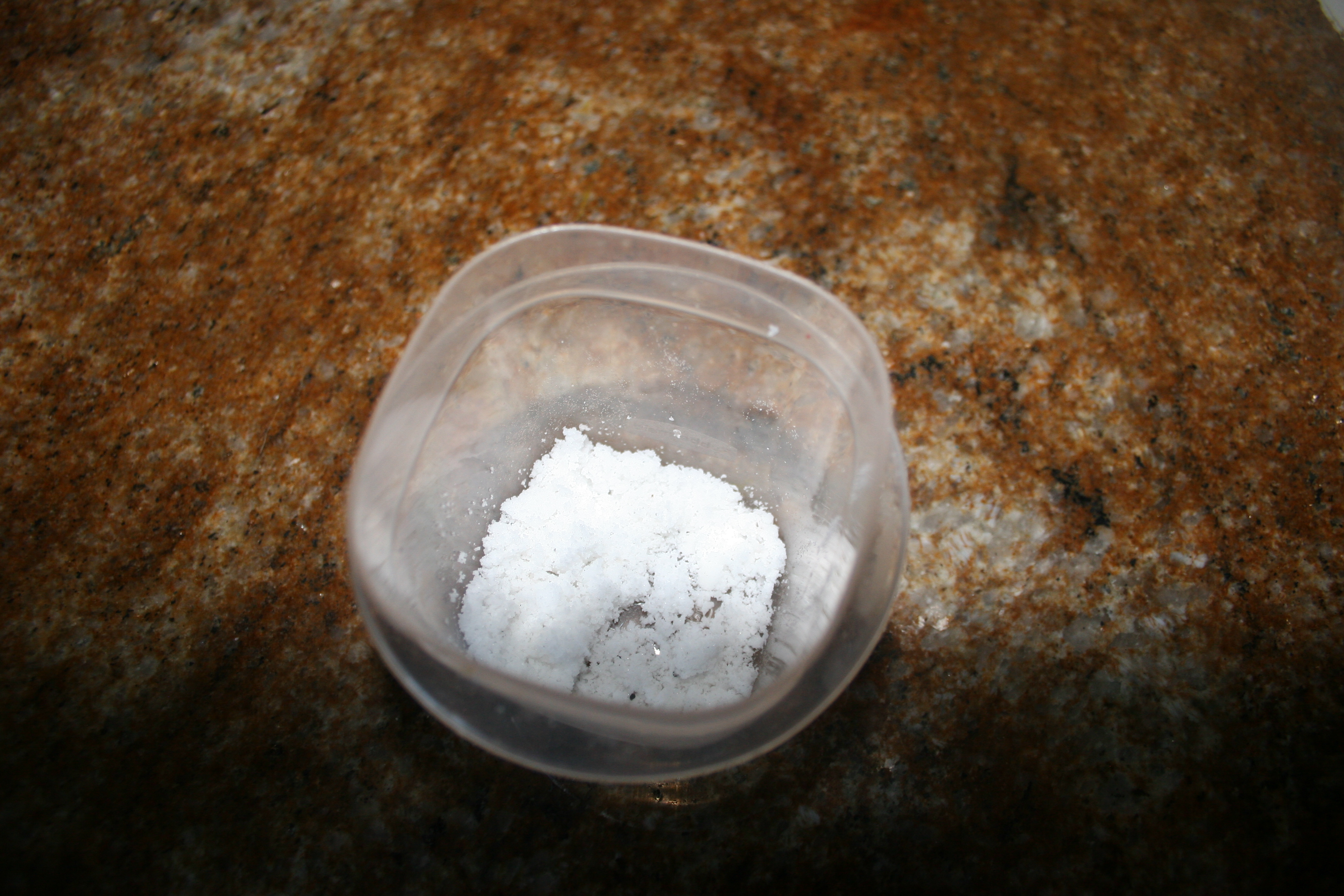
No. The water has gone now so what is left?

salt.

salt

We had another idea for an experiment.  If we put the salt back in water and then left it outside would it freeze?

We will find out tomorrow.

Linking to :

afd38-outdoors-aspx

10 Preschool Activities using Leftover Pumpkins

Hallowe'en pumpkinsWe were a little disorganised this year and didn’t get our pumpkins until Hallowe’en.  It seemed such a shame to throw them away almost as soon as we had made them.  To avoid  this the pumpkins were incorporated into our play, building on the children’s interest in pattern making and investigating some of the questions and discoveries they  made when we visited the pumpkin patch.

One of the things I love about living here is that we don’t have to go to the supermarket to buy our pumpkins because there are pumpkin patches everywhere.  I love that the children can find out how pumpkins grow by wading their way through the leaves and mud to find the perfect pumpkin.

This slideshow requires JavaScript.

Pumpkin Play

  1. Exploring Inside a Pumpkin and Learning about Seeds

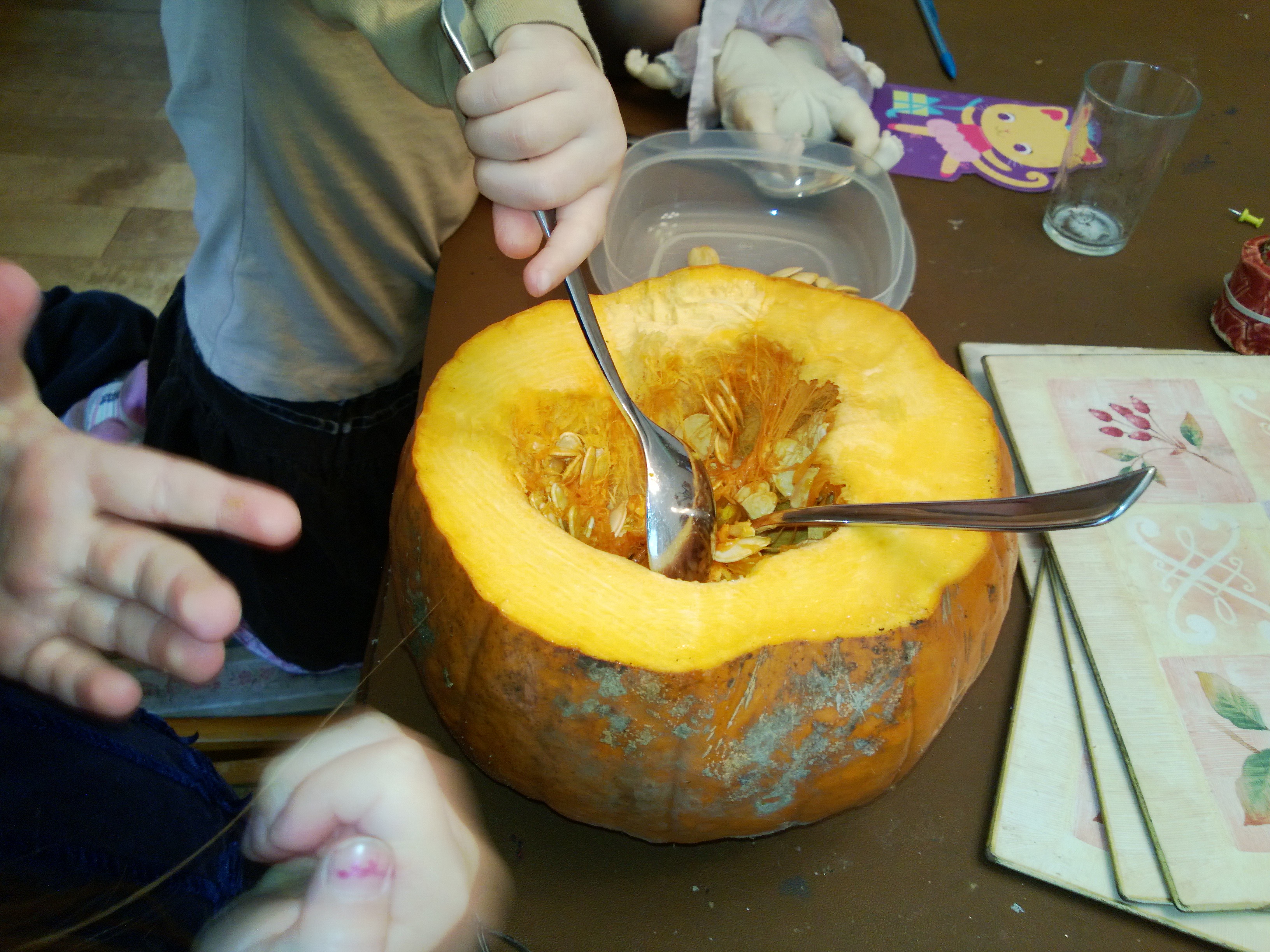
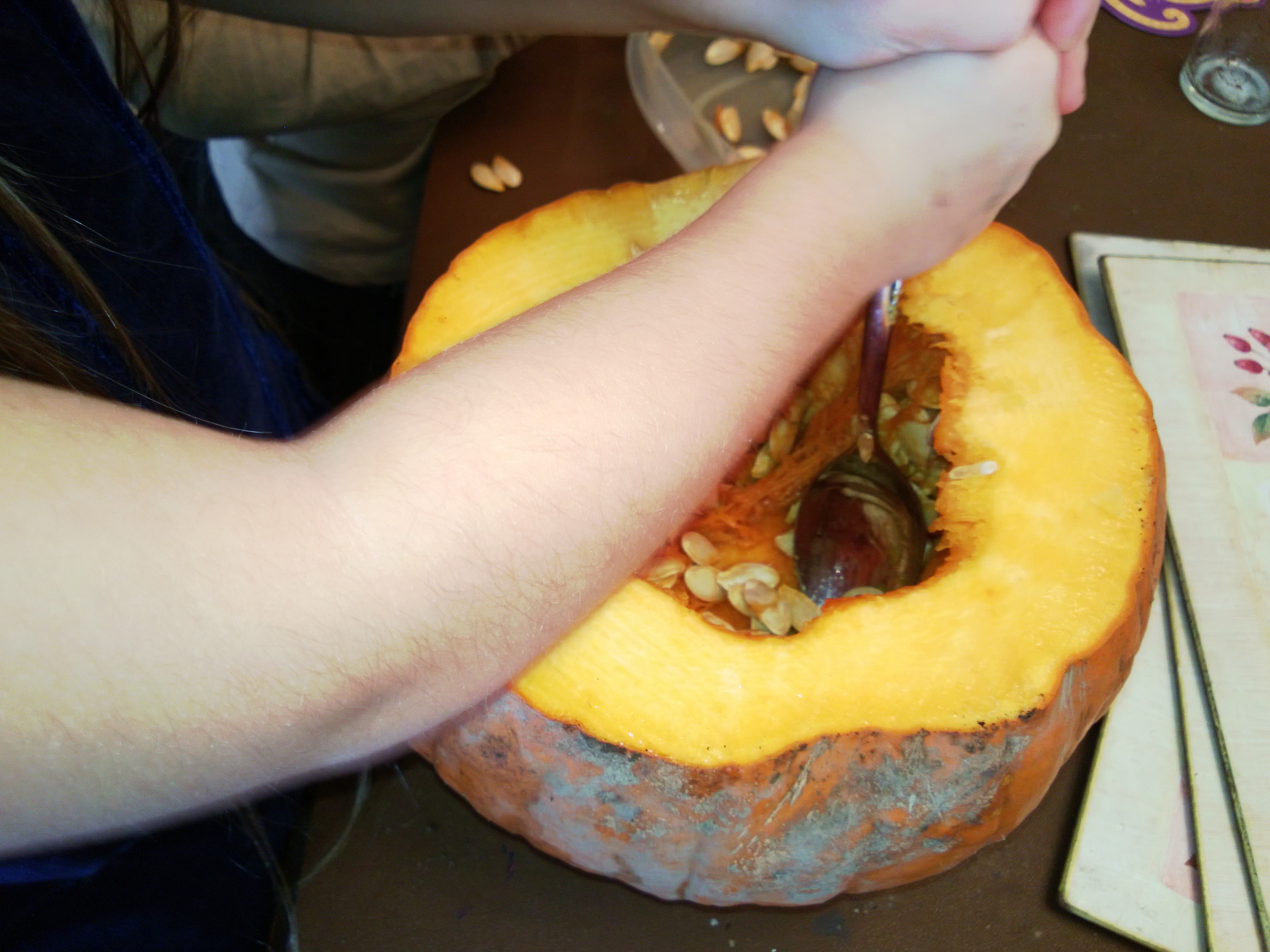
I removed the top of one of the pumpkins and gave the girls spoons to explore what was inside.

Look at all the seeds, they look like lemons but with no other side

It's a slother pumpkin. It feels really cold. There are lots of stringy bits, they look like messy hair.
It’s a slother pumpkin.
It feels really cold.
There are lots of stringy bits, they look like messy hair.

We talked about saving the seeds for the Spring, so that we could try to plant pumpkins in the garden next year. This lead to a discussion about how the seeds were spread.

How do the seeds get out of the pumpkin if they are in the pumpkin patch?

The pumpkin gets mouldy and then the seeds can come out.

Do you know how the seeds are spread?

No

What happens to a dandelion seed?

Where are the dandelions seeds?

The seeds are on the dandelion clock.

Oh so they get blown around.

Yes. Does this happen to the pumpkin?

No

We talked about how the animals spread the seeds – the girls thought it was a bit disgusting to talk about poo so we left it at that but later read ‘The Tiny Seed’ by Eric Carle to remind ourselves how other seeds are spread.

2. Scientific Experiments

How Does the Pumpkin get Soft?

I think we eat this bit because it’s all juicy but it is hard. How do we make it soft?

Hmm, can you think of any ideas?

I know we could make it wet and then dry it.

We could sprinkle it with soft sugar.

We could cover it with a bag.

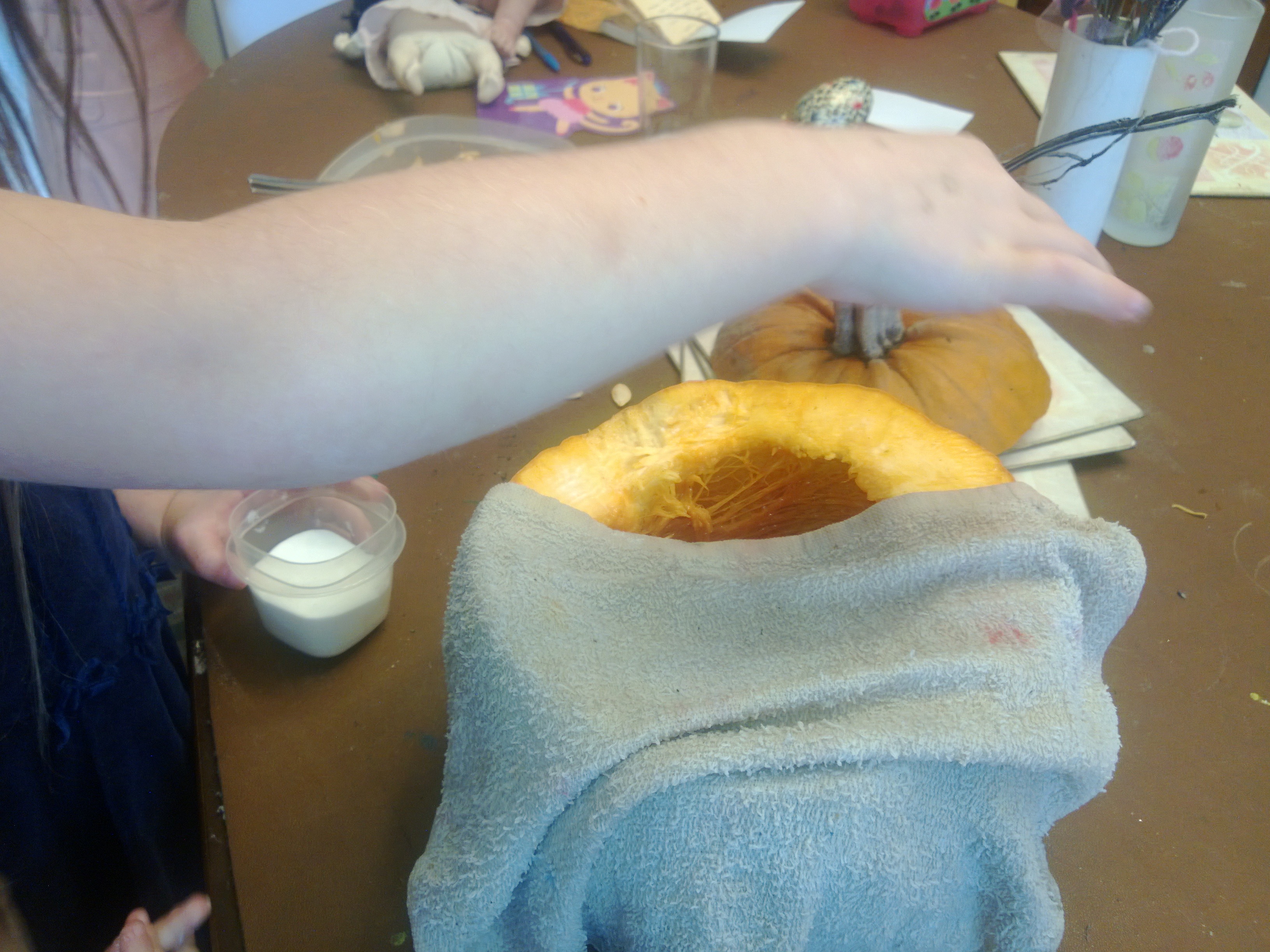
We covered one half odf the pumpkin with a warm flannel to see what would happen.
We covered one half of the pumpkin with a warm flannel to see what would happen.

We sprinkled the other half with caster sugar.

After 30 minutes we checked to see what had happened.

It didn’t work, it just got wet on my side.

What about the sugary side?

It feels softer, the sugar is softer but the pumpkin is hard.

I asked the girls if they could remember how I made spaghetti squash soft (when I tried to cut it, it was so hard I cut my finger instead). They couldn’t remember. I said that they had been along the right lines when they decided to warm it.

How could we warm it?

Put it in the microwave

or?

The oven.

Yes that’s how I made the squash soft.

3. Paint a Pumpkin

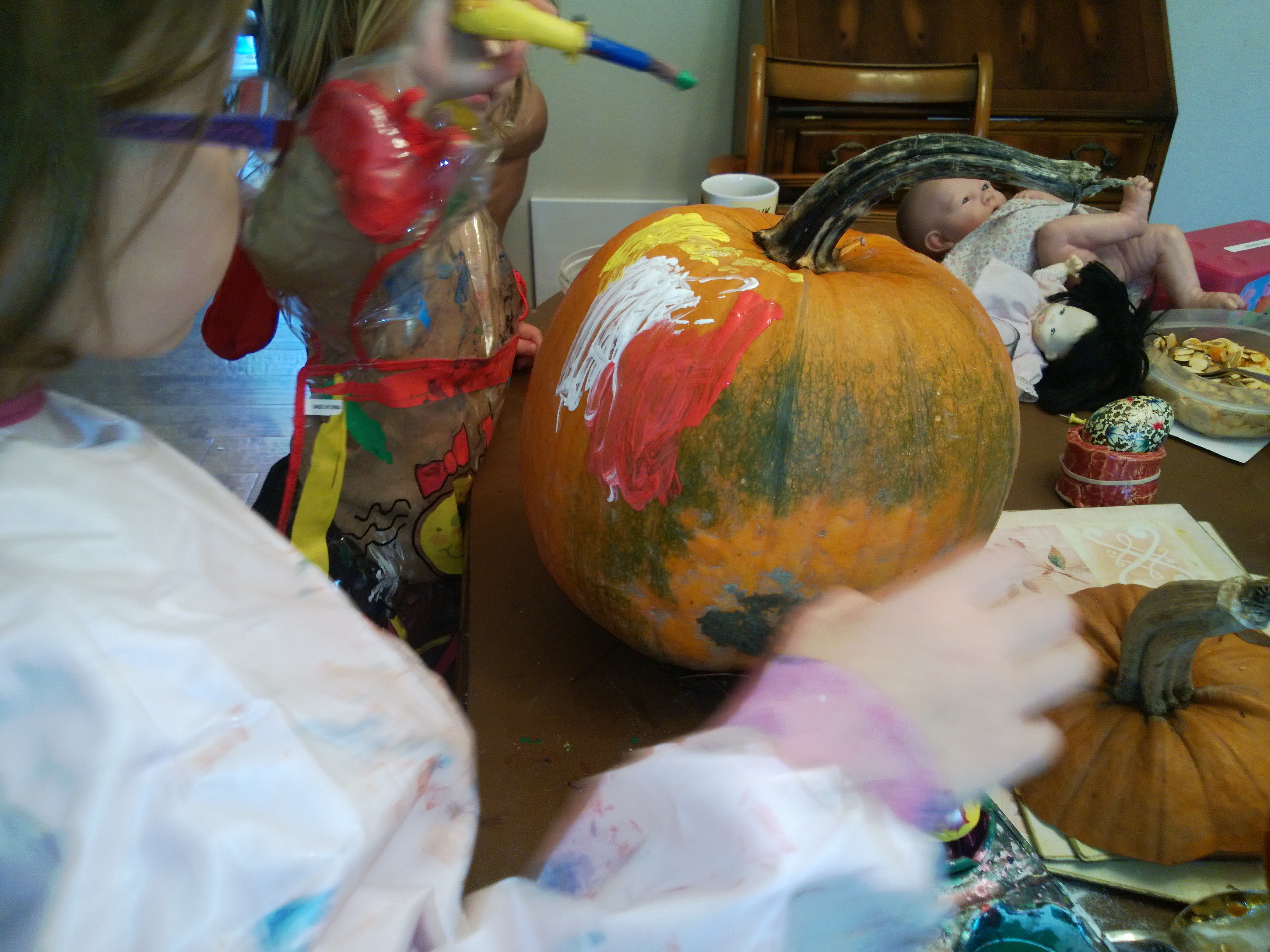
We painted our largest pumpkin with acrylic paint. The acrylic paint remains shiny .

painting a pumpkin

4. Make a Squirrel Feeder

With the painted pumpkin we made a squirrel feeder by removing a section at the front and sprinkling it with birdseed.  We often have squirrels in the garden but this gave us a good opportunity to watch them close up.

5. Fairy Toadstools

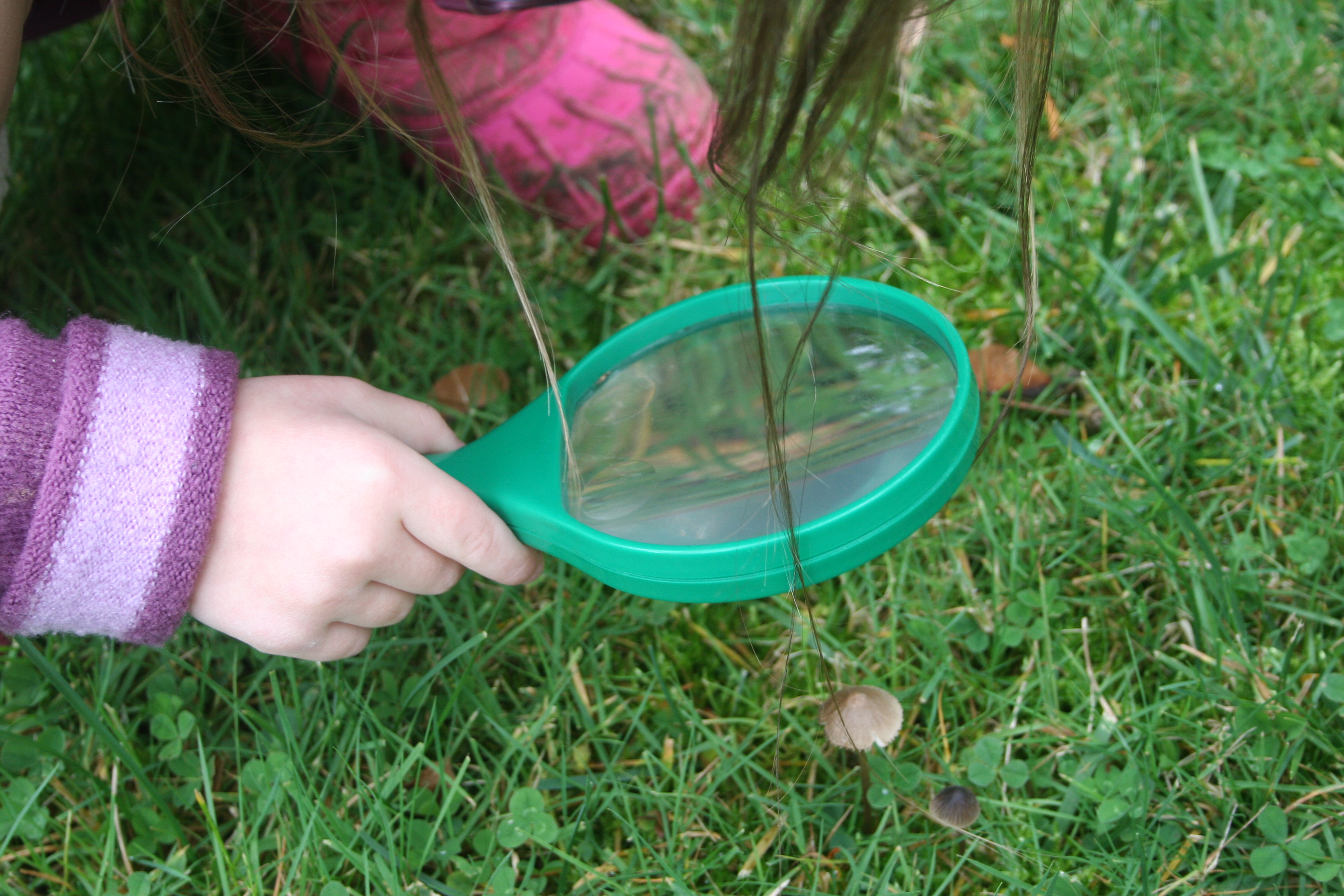
Our garden is full of toadstools in this damp Autumnal weather and we have been exploring them to see if we could find any fairies.

toad stools

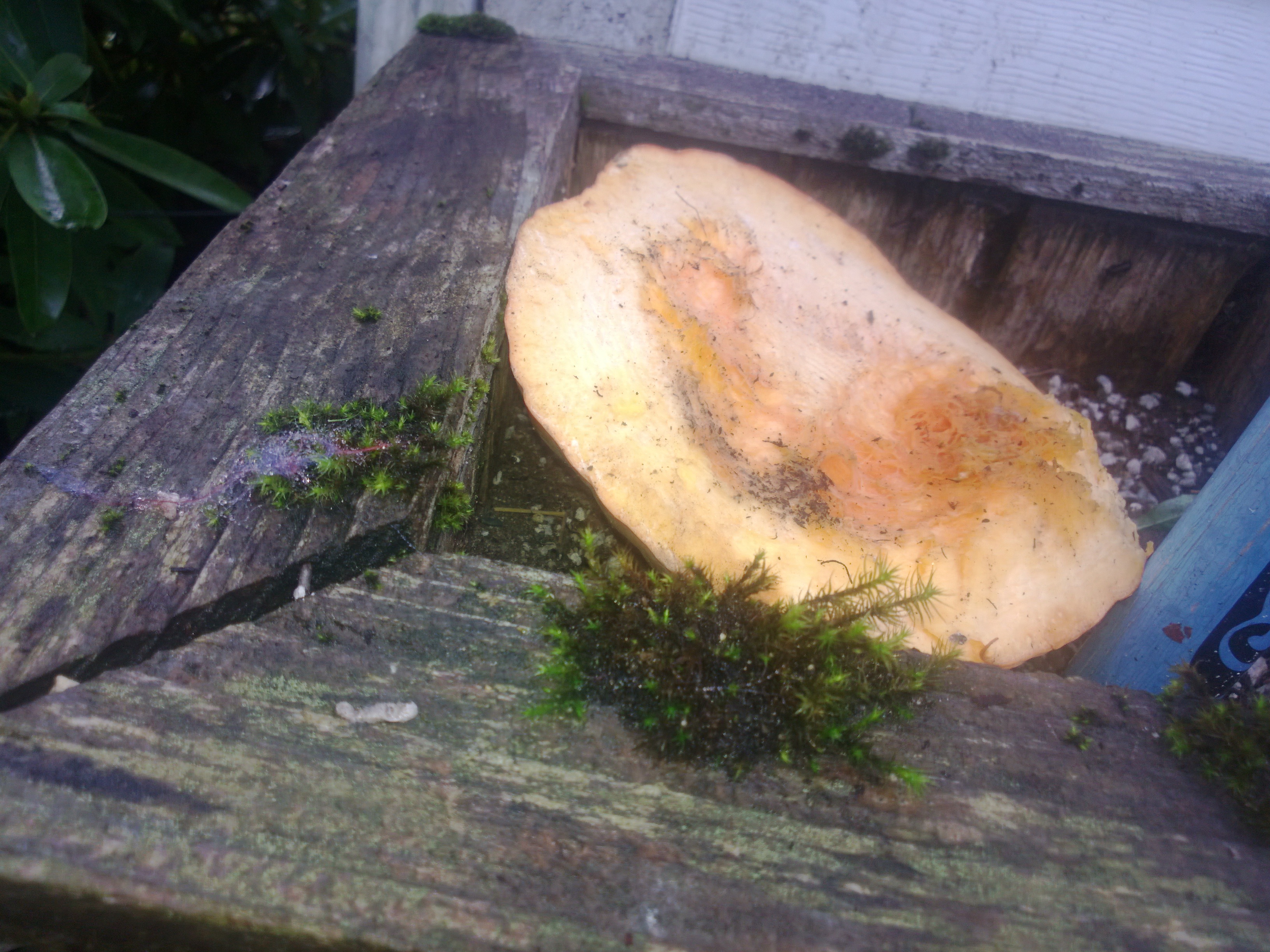
Turning the top of the pumpkin upside down made a perfect fairy toadstool for our flower-pot.  We are also going to watch and document what happens as the pumpkin starts to decay.  It might make a nice art or photography project for the girls.

toadstool from a pumkin lid

6. Pumpkin Poetry

I helped the girls to make up a poem about a pumpkin using some of the descriptions I had recorded them saying.

Pumpkins by my 5-year old

Pumpkins are very orange

Inside they have seeds

The seeds look like lemons

And feel slimy and cold.

Around the seeds it is orange and stringy

It looks like crazy hair.

The bottom is lumpy and chunky

I call it the core.

7. Pumpkin Juice.

pumpkin juice

I sliced and peeled the pumpkin we had been exploring and we used it to make pumpkin juice.

Ingredients (quantities according to taste)

Pumpkin

Apple

Carrot

Ginger

Sprinkle with cinnamon.

8. Seed Collage

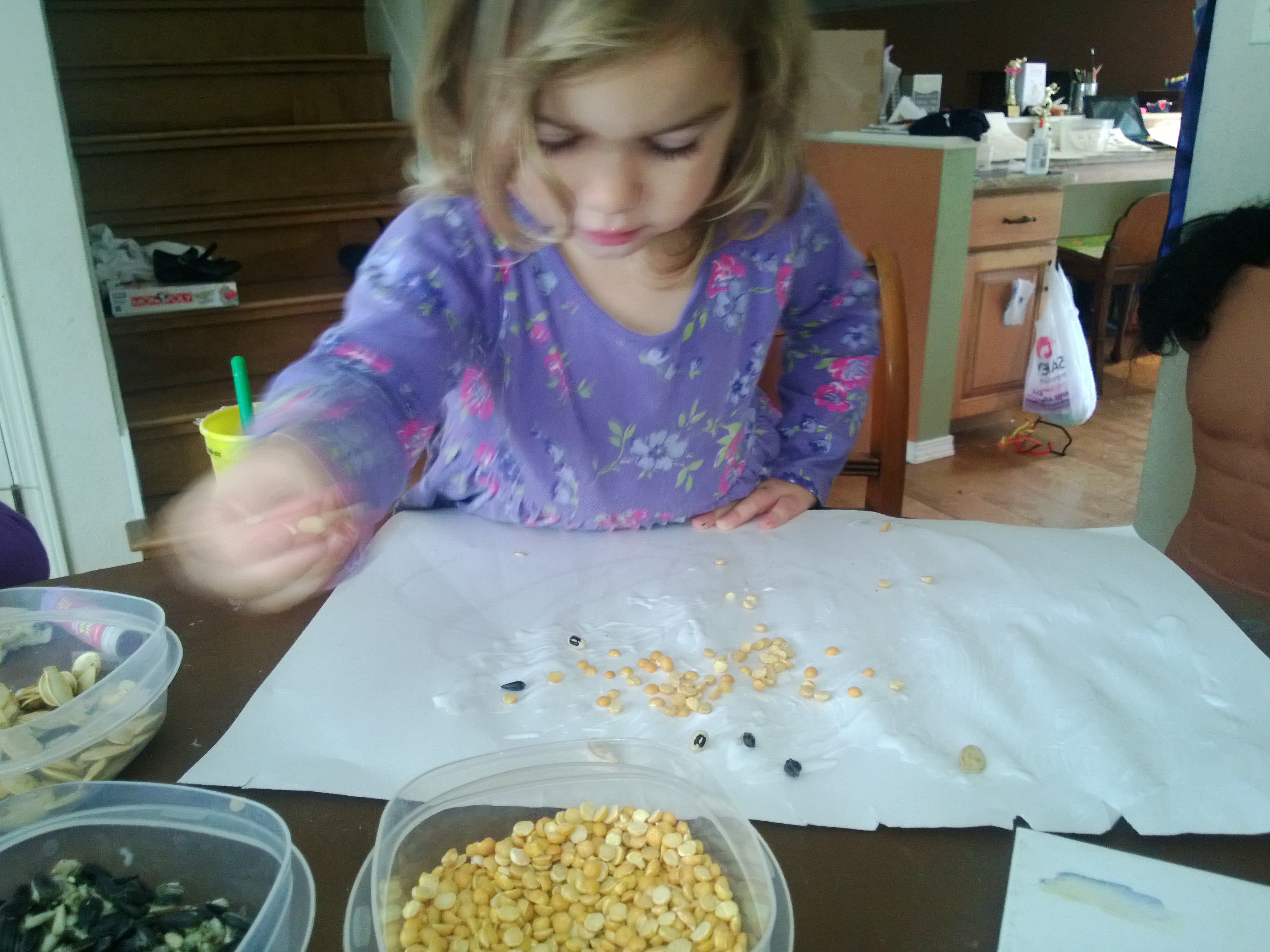
One of our current topics is pattern.  We used the pumpkin seeds alongside other seeds and pulses to make collages.

seed collage.

9. Roasted Pumpkin Seeds

As a healthy snack we tried roasted pumpkin seeds.  Sprinkle with oil, salt and pepper and roast in the oven for 25 minutes.

10. Mr Potato Head


We still have one small sweet pumpkin left to make into a pumpkin curry.

Further ideas

  • Use the seeds for measuring in a balance scale
  • Use the seeds in a play or mud kitchen
  • Put a hollow pumpkin in the water tray
  • Make pumpkin cookies
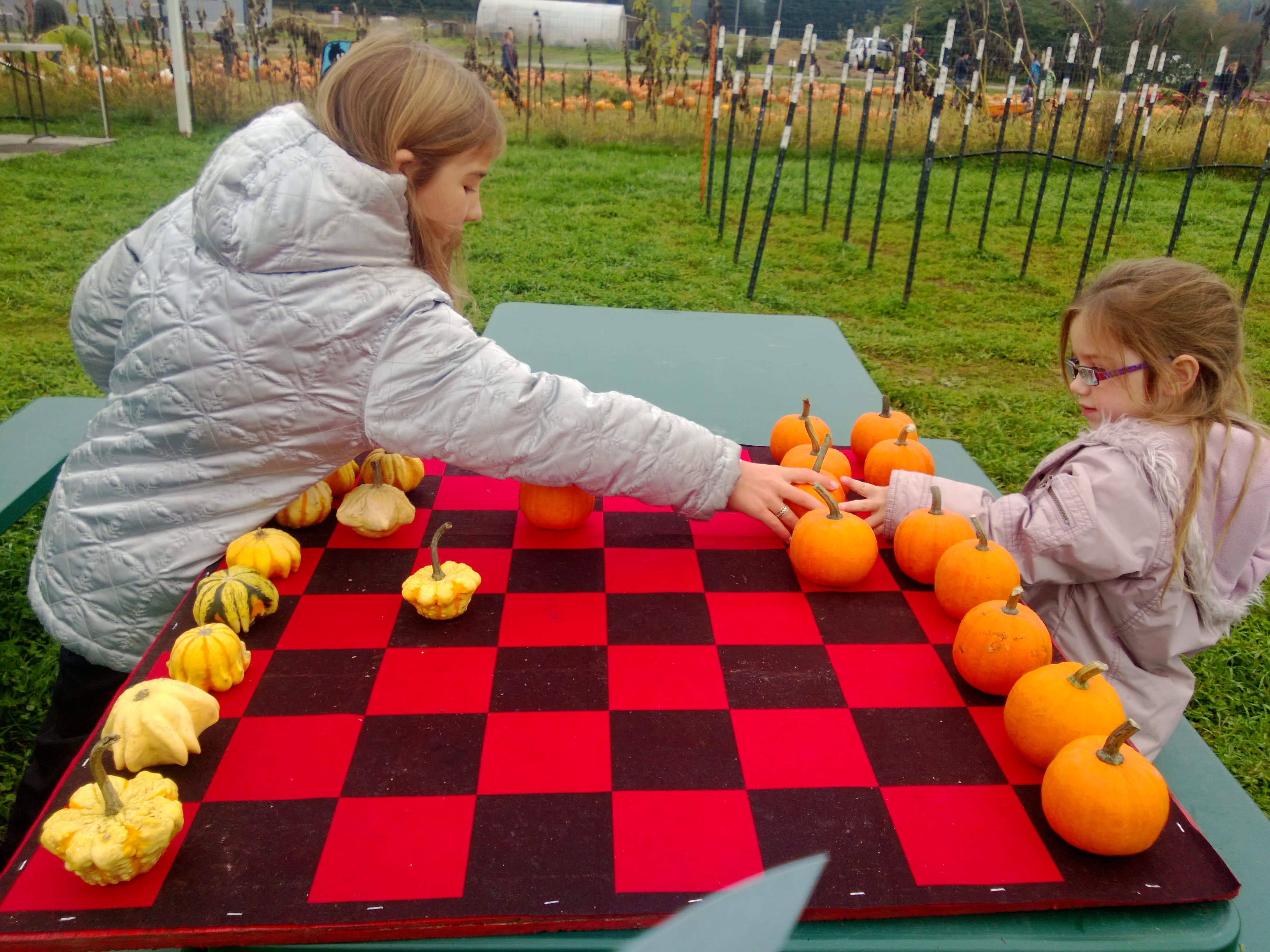
  • Make pumpkin drafts or checkers

pumpkimn checkers

  • Roll pumpkins down a hill and see which one reaches the bottom first.
  • Give children trays of seeds with scoops and containers.
  • Use the seeds with clay or pumpkin scented playdough.